
Table of Contents
TL;DR:
- Mulch in potting conserves moisture, moderates temperature swings, and improves soil structure in containers. Proper selection and application of mulch are essential for healthy potted plants, especially since containers heat up and dry out faster than garden beds. Organic mulches like pine bark nuggets or coconut coir are most effective, while inorganic options suit specific plants like succulents.
Mulch in potting is defined as any material layered on top of container soil to conserve moisture, regulate temperature, suppress weeds, and improve soil structure over time. The role of mulch in potting differs sharply from its use in garden beds. Containers lose water faster, heat up more quickly, and have no surrounding soil to buffer temperature swings. University extension programs and horticultural researchers consistently confirm that these constraints make mulch not just helpful but genuinely necessary for healthy container plants. Choosing the right material and applying it correctly separates thriving pots from struggling ones.
How does mulch conserve moisture and regulate temperature in container plants?
Moisture loss is the most immediate problem mulch solves in containers. A 1–2 inch mulch layer reduces soil water loss by approximately 33%, cutting watering frequency from daily to every 2–3 days during hot summers. That single change saves time and protects roots from the stress of repeated wet-dry cycles.
Temperature swings are the second major threat. Container soil can shift more than 20°F in a single day, especially in terracotta or metal pots sitting in direct sun. Mulch acts as insulation, slowing both heat gain in the afternoon and heat loss at night. Roots exposed to extreme temperature fluctuations grow poorly and become vulnerable to disease.
The pot material matters here. Terracotta is porous and breathes well, but it loses moisture rapidly. Metal conducts heat aggressively. Plastic holds moisture longer but can trap heat at the soil surface. Each material creates a different microclimate, and mulch compensates for those differences by buffering the extremes.
Pro Tip: Place your hand on the soil surface of an unmulched pot in afternoon sun. If it feels hot to the touch, your roots are under heat stress. A 1-inch layer of pine bark or coconut coir will fix that immediately.
What types of mulch work best in pots and why?
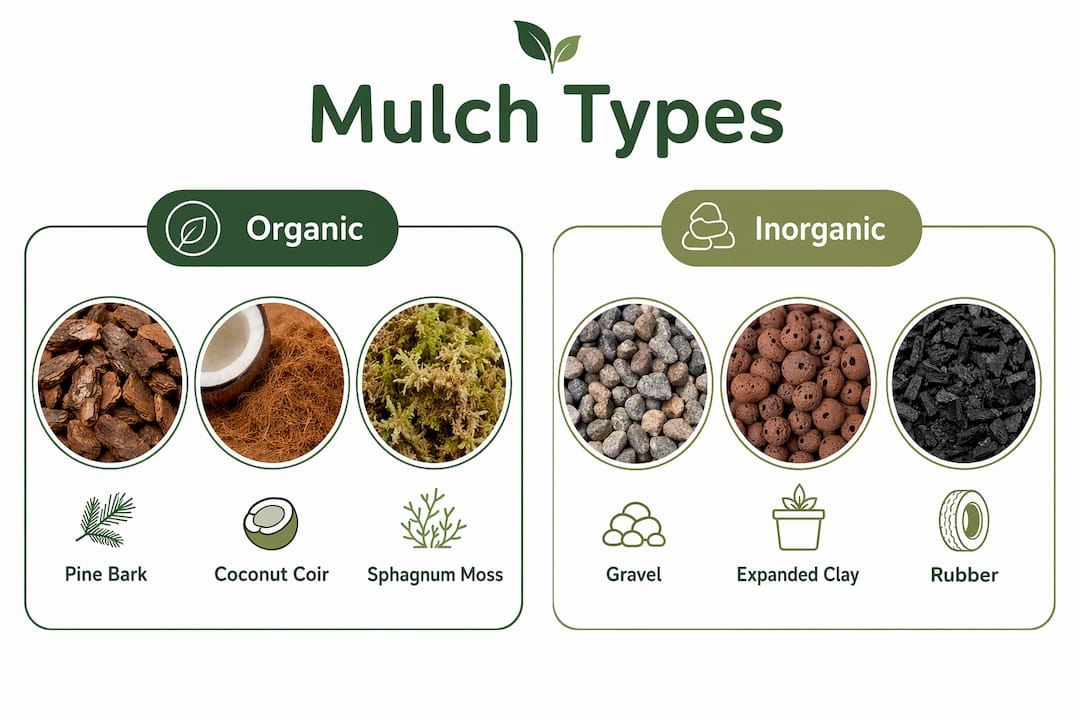
Mulch types for containers fall into two broad categories: organic and inorganic. Each serves different plants and conditions. Picking the wrong type can cause more harm than using no mulch at all.
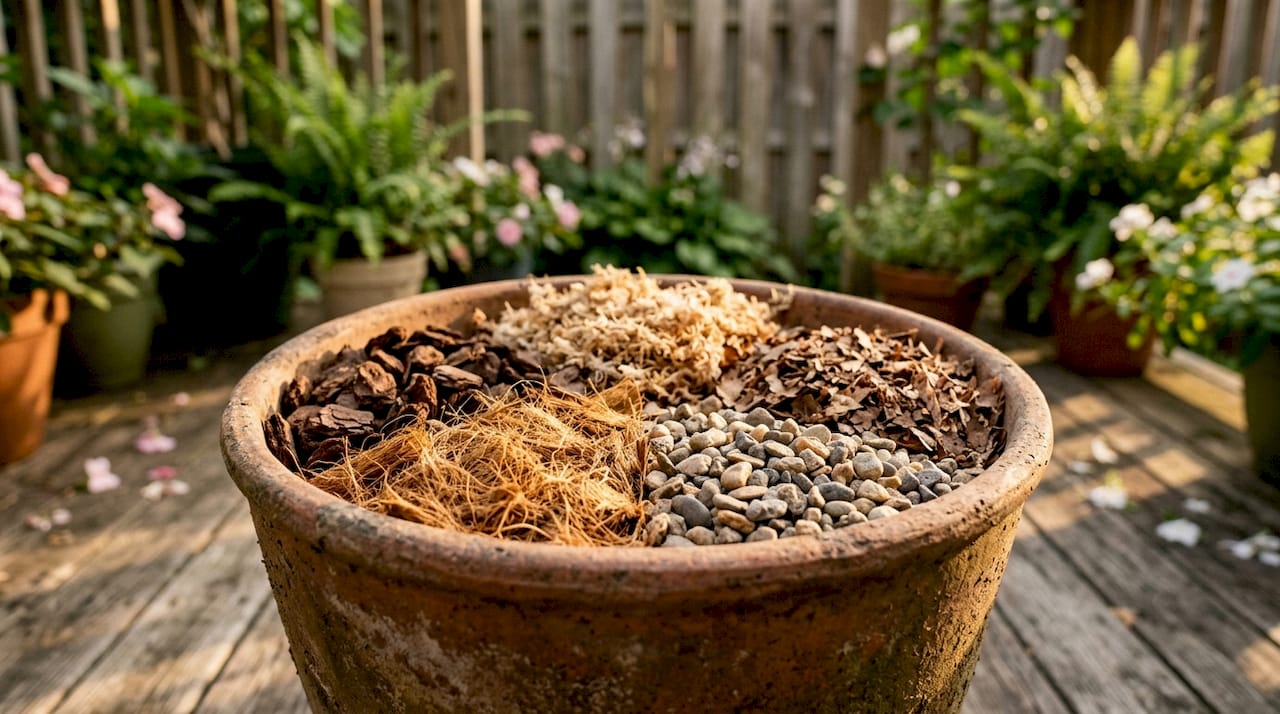
Organic mulches for containers
Organic mulches decompose over time, releasing nutrients that improve container soil structure and fertility. This dual function makes them the best mulch for potted plants in most situations. The top options include:
- Pine bark nuggets: Coarse texture preserves oxygen access to roots. Applied at a 2-inch depth, pine bark nuggets provide near-complete weed control for container weeds like spotted spurge and eclipta. They last 12–18 months and cost roughly $4–$7 per 2 cubic foot bag.
- Coconut coir: Excellent moisture retention with good airflow. Works especially well in terracotta pots that dry out fast.
- Sphagnum moss: Holds water well and looks attractive on indoor plants. Best for moisture-loving tropicals.
- Compost: Adds nutrients quickly as it breaks down. Use a coarse-textured compost to avoid compaction.
- Straw: Light-colored and reflective. Keeps soil cooler in sunny spots, though it breaks down faster than bark.
Inorganic mulches for containers
Inorganic options do not decompose, so they add no nutrients. Their strength is drainage and longevity.
- Decorative stones or gravel: Good for succulents and cacti. They drain fast and look clean.
- Pumice: Lightweight and porous. Excellent for drought-tolerant plants that need sharp drainage.
- LECA (Lightweight Expanded Clay Aggregate): Holds some moisture while keeping air pockets open. Popular for semi-hydroponic setups.
What to avoid
Fine-textured mulches are unsuitable for pots. They restrict gas exchange critical to root health and form near-impermeable crusts when wet inside a sealed container. Cedar-based or dyed mulches can disrupt soil microbiology or introduce compounds that harm sensitive roots. Fresh wood chips fall in the same category. Stick to aged, coarse-textured materials.
| Mulch type | Best for | Key benefit | Avoid when |
|---|---|---|---|
| Pine bark nuggets | Most container plants | Drainage, durability, weed control | Moisture-loving plants need extra watering |
| Coconut coir | Terracotta pots, tropicals | High moisture retention | Succulents or cacti |
| Pumice / LECA | Succulents, cacti | Sharp drainage, airflow | Plants needing consistent moisture |
| Straw | Sun-exposed containers | Heat reflection, cooling | Shaded or humid indoor spots |
| Decorative stones | Ornamental pots | Longevity, aesthetics | Metal pots in full sun |
How to properly apply mulch in containers for maximum benefit
Correct application makes the difference between mulch that helps and mulch that harms. Follow these steps every time you mulch a container.
- Water the soil thoroughly first. Mulch locks in whatever moisture is already present. Applying it to dry soil traps dryness, not hydration. Water until it drains from the bottom, then let the surface settle for 30 minutes.
- Choose the right depth. For pots under 12 inches in diameter, apply 1 inch of mulch. For larger containers, go up to 2 inches. Excess mulch beyond 2 inches impairs gas exchange and traps moisture against roots and stems, causing the same problems it is meant to prevent.
- Apply the mulch donut. Keep a clear, mulch-free circle around the plant stem. The mulch donut technique prevents moisture-related stem rot and fungal disease by maintaining airflow at the plant base. A gap of roughly 1 inch around the stem is enough.
- Leave a gap at the pot rim. The space between the mulch surface and the top of the pot acts as a water reservoir. Without it, water runs off the surface before it can soak in.
- Check moisture before every watering. Push a finger through the mulch and into the soil. Soil moisture beneath the mulch does not always match what the surface looks like. Watering on a fixed schedule after mulching leads to overwatering and root rot.
- Replenish as needed. Organic mulches break down. Check depth every 4–6 weeks and top up when it drops below 1 inch.
Pro Tip: For indoor plants, use a thin layer of sphagnum moss or coconut coir rather than bark. It looks cleaner, controls fungus gnats by keeping the surface drier between waterings, and breaks down slowly enough to last a full growing season.
What are common issues with mulching different container types?
Container material and plant type create specific mulching challenges. A one-size approach fails more often than it succeeds.
- Terracotta pots dry out faster than any other material because the walls are porous. Use high-moisture-retention mulches like coconut coir or pine bark to compensate. Check soil moisture more frequently than you would with plastic pots.
- Metal containers conduct heat aggressively. Decorative stones make this worse by absorbing and radiating heat. Use insulating organic mulches like pine bark or straw to offset the heat conduction and protect roots.
- Succulents and drought-tolerant plants need mulch that drains fast and reflects heat. Light-colored mulches like straw and pumice reflect sunlight and keep root zones cooler in sunny conditions. Avoid coir or sphagnum moss for these plants since retained moisture causes root rot.
- Avoid cedar-based or dyed mulches in any container. Cedar contains natural oils that can harm beneficial soil microbes. Dyed mulches may leach chemicals into a small, contained soil volume where concentrations build up faster than in open ground.
- Overwatering risk increases with mulch. Gardeners who mulch their containers often continue watering on the same schedule as before. The mulch slows evaporation, so the soil stays wet longer. Always use the finger test under the mulch rather than relying on surface appearance or a fixed watering interval.
For container garden drainage to work correctly alongside mulch, the pot must have adequate drainage holes. Mulch cannot compensate for a waterlogged root zone caused by poor drainage design.
Key takeaways
Mulch in container gardening works best when the material matches the pot type, the plant’s water needs, and the local climate.
| Point | Details |
|---|---|
| Moisture retention | A 1–2 inch mulch layer cuts water loss by roughly 33%, reducing watering frequency significantly. |
| Correct depth | Stay within 1–2 inches; deeper mulch blocks gas exchange and causes root and stem problems. |
| Mulch donut method | Keep a clear gap around the plant stem to prevent stem rot and fungal disease. |
| Match mulch to pot material | Use coir for terracotta, organic insulation for metal, and pumice or straw for succulents. |
| Check moisture manually | Always finger-test soil under the mulch before watering to avoid overwatering. |
Why I stopped treating container mulching as an afterthought
Most gardeners I talk to think about mulch the same way they think about a garden bed. They grab whatever is nearby, pile it on, and move on. That approach works poorly in containers, and I learned this the hard way with a collection of terracotta herb pots I kept on a south-facing balcony.
The herbs were struggling despite regular watering. The soil surface looked fine, but the roots were baking. I added a 1-inch layer of pine bark nuggets and within two weeks the basil stopped wilting by midday. The mint doubled in size by the end of the season. The mulch was doing something the watering schedule could not.
The bigger lesson came when I tried using fine-textured compost as mulch on a fiddle-leaf fig. The surface looked tidy, but the compost compacted into a crust after a few waterings. The roots were suffocating. I pulled it off, switched to coarse pine bark, and the plant recovered. That experience confirmed what the research on fine mulches shows: texture matters as much as material type.
The misconception I hear most often is that any mulch is better than none. In containers, that is simply not true. The wrong mulch in a sealed pot creates problems that open garden beds never face. I now treat mulch selection as a deliberate choice tied to the specific pot, plant, and season. I also adjust mulch type between summer and winter. In summer, I prioritize heat reflection and moisture retention. In winter, I lean toward insulating organic materials that protect roots from cold snaps. The importance of mulch in gardening is well established, but the container-specific rules are where most gardeners need to focus their attention.

Lushygardens resources for your container plant care
Lushygardens covers the full picture of container plant health, from soil preparation to seasonal adjustments. If mulching is one piece of your care routine, the plant care routine checklist at Lushygardens gives you a structured daily and weekly framework that integrates watering, mulching, and feeding into a single manageable system. For gardeners growing edibles in pots, the container vegetable gardening guide walks through soil, drainage, and mulch choices specific to food crops. Both resources are built for gardeners who want practical, tested advice rather than generic tips.
FAQ
What is the role of mulch in potting?
Mulch in potting conserves soil moisture, moderates temperature swings, suppresses weeds, and improves soil structure as organic types decompose. These functions are more critical in containers than in garden beds because pots lose water and heat faster.
How deep should mulch be in a container?
Apply 1 inch of mulch in pots under 12 inches in diameter and up to 2 inches in larger containers. Deeper layers block gas exchange and trap excess moisture against roots.
What is the best mulch for potted plants?
Pine bark nuggets are the best all-around choice for most potted plants due to their coarse texture, drainage, and durability. Coconut coir works best for moisture-loving plants in terracotta pots, while pumice suits succulents and cacti.
Does mulch replace watering for container plants?
Mulch reduces watering frequency but does not replace it. Always check soil moisture beneath the mulch with a finger test before watering to avoid overwatering and root rot.
What mulches should I avoid in containers?
Avoid fine-textured mulches, fresh wood chips, cedar-based products, and dyed mulches. Fine textures compact and block root respiration, while cedar oils and dye chemicals can harm soil microbes in the confined volume of a container.
Recommended
- The Role of Compost in Gardening for Healthy Soil – Lushy Gardens
- Understanding Mulching Vegetable Gardens for Healthier Growth – Lushy Gardens
- Complete Guide to the Benefits of Mulching – Lushy Gardens
- Why Mulch Garden Beds: Benefits Every Gardener Should Know – Lushy Gardens

I’m Eleanor, a seasoned gardener with over three decades of experience tending to Mother Nature’s creations. Through Lushy Gardens, I aim to share my wealth of knowledge and help fellow plant enthusiasts uncover the wonders of gardening. Let’s dive into this journey together, one leaf at a time.


