
Table of Contents
Choosing between store-bought fertilizers and homemade compost can leave urban gardeners feeling uncertain, especially when every plant deserves the best care. Understanding the real differences between these two approaches matters for city growers who want healthy, thriving plants in limited spaces. This guide uncovers how nutrient release speed and soil impact set fertilizer and compost apart, helping beginners pick the method that fits their unique gardening goals.
Key Takeaways
| Point | Details |
|---|---|
| Distinction Between Fertilizer and Compost | Fertilizers offer immediate nutrients for rapid plant growth, while compost enhances soil health over time through organic matter enrichment. |
| Nutrient Application Strategy | Combining both fertilizers and compost is advisable to meet immediate plant needs and build long-term soil quality. |
| Potential Risks in Application | Improper use of fertilizers and compost can lead to environmental issues; proper application techniques are essential. |
| Benefits of Composting | Composting contributes to waste reduction and improves ecological sustainability by enhancing soil health and reducing reliance on synthetic inputs. |
Fertilizer and Compost Defined and Debunked
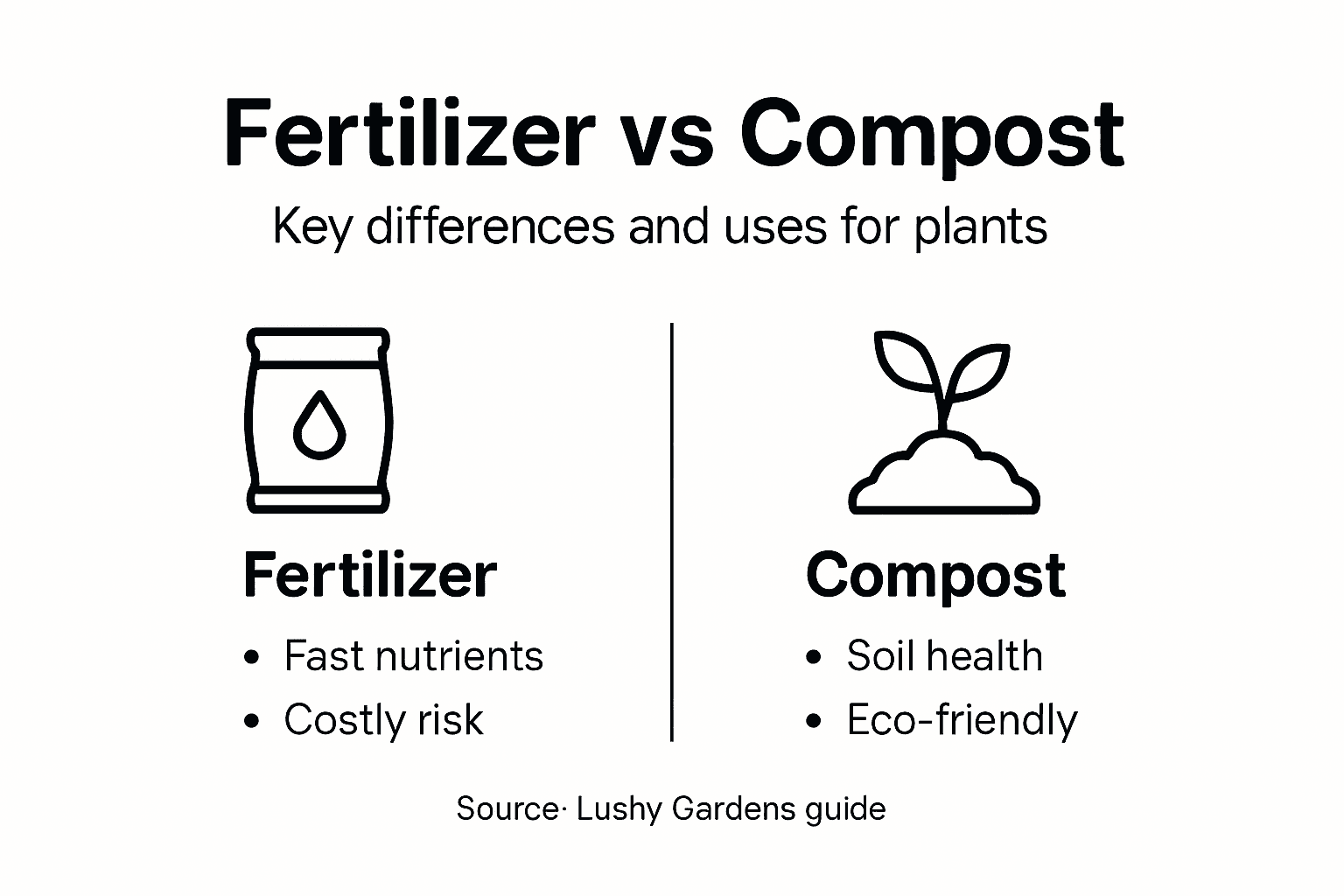
Gardeners often confuse fertilizers and compost, two critical components for nurturing healthy plants. While they might seem similar, these soil amendments serve distinctly different purposes in supporting plant growth and soil health.
A fertilizer is a concentrated nutrient supplement designed to provide immediate nutritional support directly to plants. These products typically contain specific ratios of primary macronutrients: nitrogen (N), phosphorus (P), and potassium (K). Chemical fertilizers deliver quick, targeted nutrition that plants can rapidly absorb, making them ideal for addressing specific nutrient deficiencies or boosting plant growth during critical stages.
In contrast, compost represents a more holistic approach to soil management. Controlled aerobic biological decomposition transforms organic materials into a rich, nutrient-dense soil amendment. Unlike fertilizers, compost works by gradually improving overall soil structure and supporting long-term ecosystem health.
Key differences between fertilizers and compost include:
- Nutrient Release Speed
- Fertilizers: Rapid, immediate nutrient absorption
- Compost: Slow, gradual nutrient cycling
- Soil Impact
- Fertilizers: Primarily target plant nutrition
- Compost: Enhance soil biology, structure, and water retention
- Composition
- Fertilizers: Synthetic or concentrated mineral nutrients
- Compost: Organic matter from decomposed plant and animal materials
Pro tip: For balanced plant nutrition, consider using both fertilizers and compost in a complementary approach that supports immediate plant needs and long-term soil health.
Here’s a concise comparison of fertilizer and compost benefits for different gardening goals:
| Gardening Goal | Fertilizer Advantage | Compost Advantage |
|---|---|---|
| Rapid Plant Growth | Immediate nutrient support | Gradual nutrient improvement |
| Soil Structure Quality | Minimal impact | Significantly improves structure |
| Water Retention | No enhancement | Increases water holding capacity |
| Microbial Activity | Limited stimulation | Boosts beneficial microbes |
Types, How They Work, and Key Features
Gardeners have multiple options when selecting soil amendments, with fertilizers and compost presenting diverse approaches to plant nutrition and soil health. Understanding their types, mechanisms, and characteristics is crucial for making informed gardening decisions.
Fertilizer Types range from organic to synthetic formulations, each designed to address specific plant nutritional needs. Organic fertilizers derive from natural sources like bone meal, fish emulsion, or composted materials, releasing nutrients slowly and improving soil structure. Synthetic fertilizers, in contrast, provide concentrated, immediately available nutrients through precisely engineered chemical compounds.
The primary categories of fertilizers include:
- Granular Fertilizers
- Slow-release pellets
- Easy to apply
- Consistent nutrient distribution
- Liquid Fertilizers
- Rapid nutrient absorption
- Ideal for quick plant boosts
- Requires frequent reapplication
- Organic Fertilizers
- Derived from natural materials
- Improve long-term soil health
- Slower nutrient release
Compost similarly varies in composition and origin. Biological decomposition processes transform organic waste into nutrient-rich soil amendments. Home compost typically incorporates kitchen scraps, yard trimmings, and plant materials, while commercial compost undergoes more controlled production methods.

Pro tip: Match your fertilizer or compost type to your specific plant’s nutritional requirements by conducting a preliminary soil test to understand existing nutrient levels.
Core Differences and Real-World Applications
Understanding the nuanced roles of fertilizers and compost is crucial for successful gardening. Compost and fertilizer serve distinctly different agricultural purposes, with each playing a unique part in plant nutrition and soil health.
In real-world applications, fertilizers provide immediate, concentrated nutrient delivery that directly supports plant growth. These products are engineered to supply specific macronutrients like nitrogen, phosphorus, and potassium in precisely calculated ratios. Gardeners rely on fertilizers when plants require rapid nutritional intervention, particularly for high-demand crops or during critical growth stages.
Compost, by contrast, operates as a long-term soil health strategy. Soil conditioning remains its primary function, with nutrient supply being a secondary benefit. The organic matter in compost improves soil structure, enhances microbial activity, and gradually releases nutrients, creating a sustainable ecosystem for plant growth.
Key differences in real-world applications include:
- Nutrient Concentration
- Fertilizers: High, immediate nutrient availability
- Compost: Low, slow-release nutrient profile
- Soil Impact
- Fertilizers: Targeted nutritional supplementation
- Compost: Comprehensive soil structure improvement
- Application Frequency
- Fertilizers: Periodic, based on plant needs
- Compost: Seasonal or annual soil amendment
Professional gardeners often combine both fertilizers and compost to achieve optimal plant nutrition and soil health.
Pro tip: Create a seasonal gardening calendar that alternates between targeted fertilizer applications and periodic compost additions to maintain balanced soil nutrition.
Selecting the right amendment depends on specific use scenarios:
| Scenario | Fertilizer Recommendation | Compost Recommendation |
|---|---|---|
| Seed Starting | Fast-acting, diluted fertilizer | Limited compost, well-screened |
| Vegetable Production | Balanced NPK formula | Annual compost addition |
| Perennial Beds | Slow-release formulation | Mulch with mature compost |
| Lawn Maintenance | Regular, low-rate fertilizer | Top-dress with compost |
Risks, Costs, and Common Misuses
Gardeners must understand the potential pitfalls associated with fertilizers and compost to make informed soil management decisions. Improper application can lead to significant environmental and economic consequences, making careful approach critical for successful plant cultivation.
Fertilizer misuse represents a substantial risk to both plant health and environmental sustainability. Over-application can result in nutrient runoff, potentially contaminating water systems and causing ecological disruption. Synthetic fertilizers, while providing rapid nutritional support, can create chemical imbalances in soil when used excessively, leading to reduced microbial activity and long-term soil degradation.
Compost application risks are equally nuanced. Improper compost management can introduce significant agricultural challenges, including potential pathogen transmission and nutrient imbalances. Immature or contaminated compost may harm plant growth, reduce soil quality, and potentially introduce harmful bacteria or weed seeds.
Common misuses and associated risks include:
- Fertilizer Misuses
- Excessive application
- Incorrect nutrient ratios
- Inappropriate seasonal timing
- Ignoring soil pH requirements
- Compost Misuses
- Using unfinished/immature compost
- Applying contaminated organic materials
- Expecting compost to replace fertilizer
- Inconsistent application methods
Responsible soil management requires understanding the specific needs of your garden ecosystem and applying amendments thoughtfully.
Pro tip: Conduct a comprehensive soil test before applying any amendments to precisely understand your garden’s nutritional requirements and avoid potential misuse.
Environmental Impact and Long-Term Benefits
Environmental sustainability begins in our own gardens, where mindful soil management can have far-reaching ecological consequences. Composting represents a powerful strategy for reducing waste and supporting global ecosystem health, transforming organic waste into a valuable resource that benefits both local and global environments.
The long-term environmental benefits of compost extend well beyond simple waste reduction. By diverting organic materials from landfills, composting significantly reduces methane emissions, a potent greenhouse gas produced during anaerobic decomposition. Sustainable agricultural practices are increasingly dependent on techniques that enhance soil biodiversity and reduce chemical inputs, with compost playing a crucial role in this ecological transition.
Compost and environmentally conscious fertilizer use contribute to ecosystem resilience through multiple mechanisms:
- Waste Reduction
- Diverts organic materials from landfills
- Minimizes methane emissions
- Creates circular waste management system
- Soil Health Improvement
- Increases organic matter content
- Enhances water retention capabilities
- Supports beneficial microbial communities
- Ecosystem Support
- Reduces dependency on synthetic fertilizers
- Promotes natural nutrient cycling
- Supports biodiversity in agricultural systems
Responsible gardeners recognize that soil management is not just about plant growth, but about nurturing a complex and interconnected ecological system.
Pro tip: Start a home composting system to directly contribute to waste reduction and improve your garden’s environmental sustainability.
Find the Perfect Balance for Your Garden’s Health
Choosing between fertilizer and compost can leave gardeners wondering how to meet both immediate plant nutrition and long-term soil improvement needs. The challenge lies in understanding how to provide rapid nutrient support while nurturing your soil’s structure and microbial life. If you want to avoid common pitfalls like over-application or nutrient imbalances, knowing when and how to use each amendment is vital.
At Lushy Gardens, we offer practical advice tailored to help you master this balance. Explore our Fertilizers – Lushy Gardens section for insights on selecting nutrient-rich solutions and discover how compost can transform your soil in our Soil – Lushy Gardens category. Ready to take your gardening skills to the next level? Visit Lushy Gardens today and start cultivating a thriving garden that feeds your plants and enriches your soil sustainably.
Frequently Asked Questions
What is the main difference between fertilizer and compost?
Fertilizer is a concentrated nutrient supplement that provides immediate nutrition to plants, while compost is an organic matter that gradually improves soil structure and supports long-term soil health.
How do I decide when to use fertilizer versus compost?
Use fertilizer for rapid nutrient delivery during critical growth phases or to address specific deficiencies, while compost should be applied for long-term soil improvement and as a general soil amendment.
Can I use both fertilizer and compost together in my garden?
Yes, combining fertilizer and compost can provide immediate nutritional support while enhancing the soil’s overall structure and health over time.
What are the risks of using too much fertilizer or compost?
Excess fertilizer can lead to nutrient runoff and soil imbalances, while using immature or contaminated compost may harm plant growth and introduce pathogens or weed seeds.
Recommended
- Difference Between Soil and Compost for Gardeners – Lushy Gardens
- Best Compost for Vegetables: Complete Guide – Lushy Gardens
- Is Plant Food the Same as Fertilizer – Lushy Gardens
- Best Compost for Vegetables: Complete Essential Guide – Lushy Gardens

I’m Eleanor, a seasoned gardener with over three decades of experience tending to Mother Nature’s creations. Through Lushy Gardens, I aim to share my wealth of knowledge and help fellow plant enthusiasts uncover the wonders of gardening. Let’s dive into this journey together, one leaf at a time.


