
Table of Contents
TL;DR:
- A light meter measures plant-usable light, specifically PPFD and DLI, to guide indoor gardening decisions. Using spectrally appropriate meters prevents errors that misjudge lighting needs and helps optimize plant growth and energy use. Regular measurements and accurate tools enable better plant health and cost savings.
A light meter is the single most useful tool an indoor gardener can own. It measures the exact amount of plant-usable light reaching your plants, removing all guesswork from lighting decisions. The role of light meter in indoor gardening goes far beyond checking whether a room looks bright. It quantifies two critical metrics, Photosynthetic Photon Flux Density (PPFD) and Daily Light Integral (DLI), that directly control how well your plants grow. Without these numbers, you are making lighting decisions based on how light looks to your eyes, not how it works for your plants.
What are PPFD and DLI, and why do they matter for indoor plants?
PPFD and DLI are the two metrics that actually govern plant growth. PPFD measures the number of photosynthetically active photons hitting a surface each second, expressed in μmol/m²/s. DLI measures the total photon dose a plant receives over a full day, expressed in mol/m²/day. Think of PPFD as the speed of a water tap and DLI as the total water in the bucket by day’s end.
Tropical foliage houseplants need a PPFD of 100–250 μmol/m²/s and a DLI of 4–9 mol/m²/day for healthy growth. Those numbers give you a concrete target to aim for instead of vague advice like “bright indirect light.” The formula is straightforward: PPFD × photoperiod hours × 0.0036 = DLI. Running a light at 200 μmol/m²/s for 12 hours delivers a DLI of 8.64 mol/m²/day, which sits right in the sweet spot for most common houseplants.
The plant care industry is shifting toward measurable metrics like PPFD and DLI rather than subjective terms. This shift matters because two rooms that look equally bright to you can deliver wildly different DLI values. A south-facing window in winter and a grow light on a timer may feel similar to your eyes but differ by a factor of three in actual photon delivery.
Pro Tip: Write down your target DLI before buying or adjusting any grow light. Once you know the number, every lighting decision becomes a simple math problem.
| Plant type | Target PPFD (μmol/m²/s) | Target DLI (mol/m²/day) |
|---|---|---|
| Low-light tropical foliage | 50–150 | 2–5 |
| Medium-light houseplants | 100–250 | 4–9 |
| High-light herbs and vegetables | 250–500 | 10–20 |
| Fruiting crops | 400–600 | 15–25 |
How do light meters work, and what types should indoor gardeners use?
Not all light meters measure the same thing. The type you choose determines whether your readings are actually useful for plant care.
- Lux meters measure light as the human eye perceives it. They are calibrated to the green-yellow range of the spectrum, which is where human vision peaks. Plants use red and blue light most efficiently, so a lux meter systematically undervalues those wavelengths. Lux meters designed for human vision can mislead plant growers without spectral corrections applied.
- Quantum sensors and PAR meters measure photons in the 400–700 nm range, which is exactly the Photosynthetically Active Radiation (PAR) band plants use. These are cosine-corrected, meaning they account for light hitting the sensor at an angle. Quantum sensors are preferred over consumer-grade lux meters because they report plant-usable photons directly.
- Smartphone lux apps use the phone camera as a sensor. They give rough approximations and are useful for quick checks, but smartphone apps are not reliable for program decisions or DLI tracking.
If you use a lux meter and want to estimate PPFD, you need a conversion factor. For sunlight, divide lux by 54. For warm-white LEDs, divide by 70–80. For cool-white LEDs, divide by 60–70. For HPS fixtures, divide by 82. These conversion factors vary by light source, so using the wrong one introduces significant error.
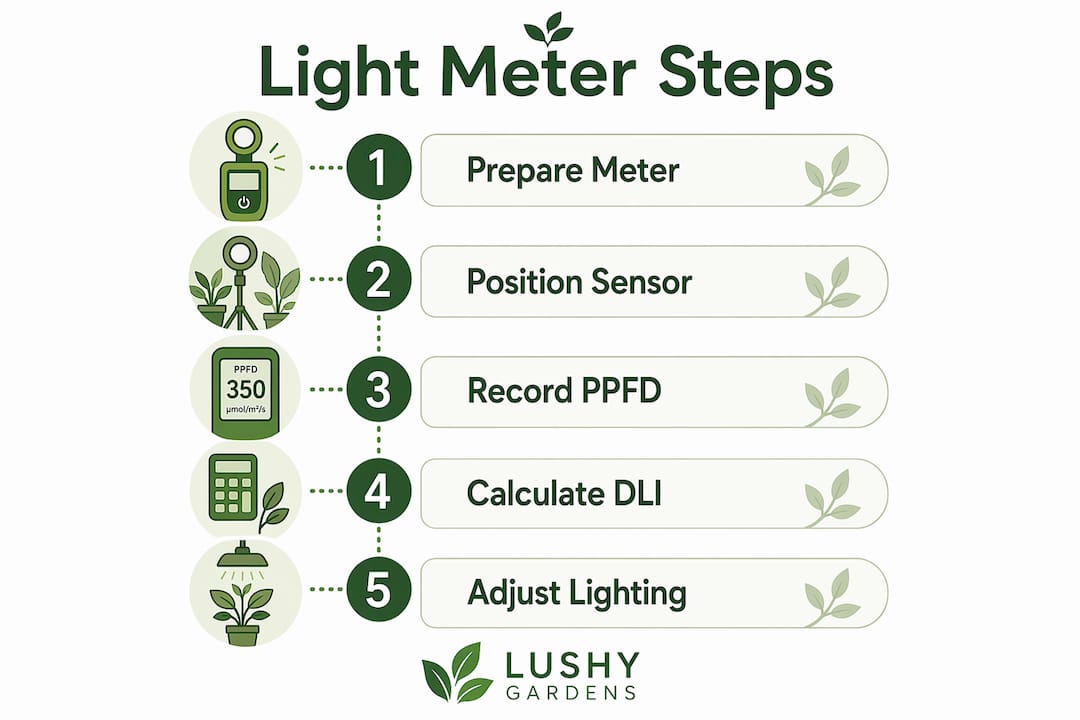
Proper technique matters as much as the meter itself. Hold the sensor at canopy height, pointing directly at the dominant light source. Take readings at five or more points across the canopy and calculate the average. The inverse-square law means that doubling the distance from a window quarters the PPFD, so even small changes in plant position produce large changes in light delivery.
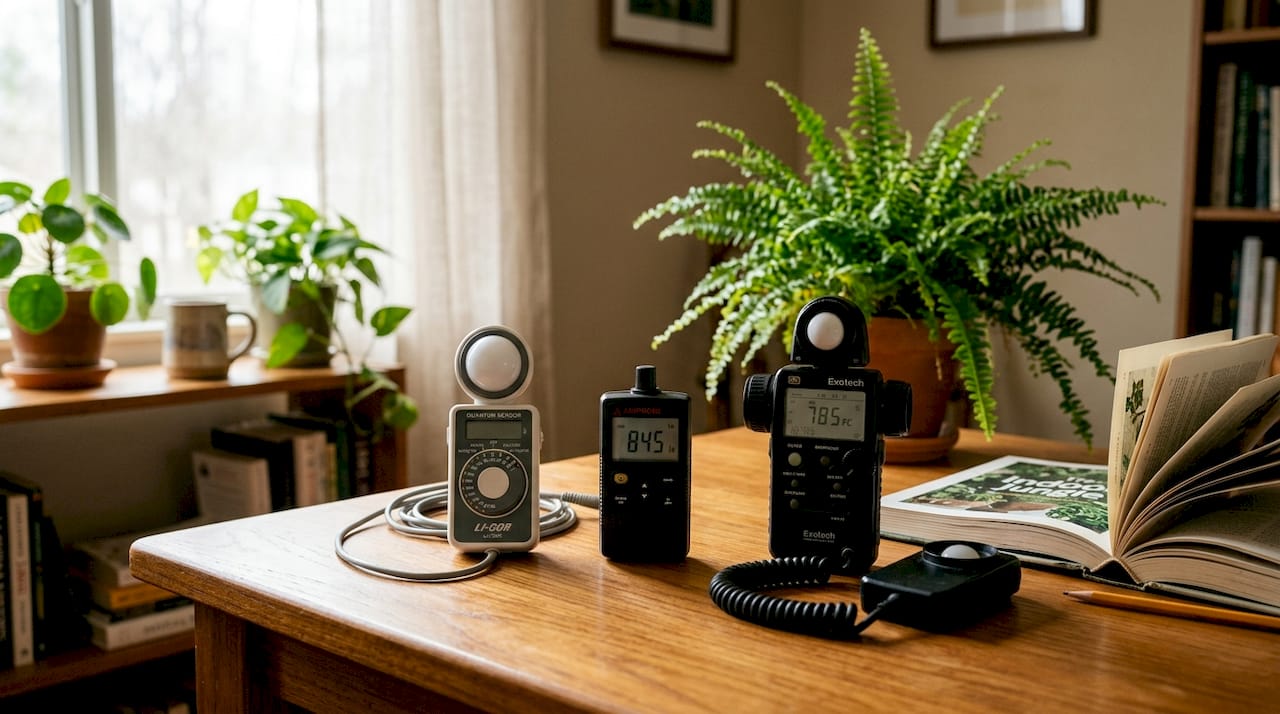
Pro Tip: Entry-level quantum sensors cost $50–$150 and are accurate enough for most home growers. Professional-grade sensors run $300 or more and are worth it only if you are managing multiple grow spaces or tracking data over time.
Common misconceptions about reading light meter data
Misreading a light meter is one of the most common mistakes indoor gardeners make. Understanding where the errors come from helps you avoid them.
- Treating the peak reading as the plant’s light level. A hotspot directly under a grow light can read 2–4 times higher than the average light intensity the whole canopy receives. That single high number does not represent what your plant actually experiences across all its leaves.
- Ignoring lower canopy leaves. Leaves lower in the canopy receive only 25%–40% of the hotspot reading. If you set your light based on the top reading, the lower leaves are chronically underlit. This explains slow growth and yellowing on lower foliage even when the top of the plant looks healthy.
- Using a single reading to represent the whole plant. Practical measurement requires mapping multiple points across the canopy. Average those readings to get a number that reflects actual plant exposure. One reading at the center tells you almost nothing about the edges.
- Confusing lux with PPFD without converting. A reading of 10,000 lux sounds impressive, but without knowing your light source type and applying the correct conversion factor, you cannot translate that into a meaningful PPFD value. Skipping this step leads to both over- and under-lighting.
- Ignoring leaf angle. A leaf tilted 45 degrees away from the light source intercepts far fewer photons than a flat horizontal leaf at the same distance. Meter readings assume a flat, horizontal sensor. Real plant leaves are rarely flat and horizontal.
Accurate light measurement prevents photobleaching from excess light and protects plants sensitive to chronic underlighting. Both problems are invisible until the damage is done, which is exactly why measurement matters before symptoms appear.
How to use light meter data to optimize your lighting setup
Translating meter readings into real lighting decisions is where the work pays off. Here is how to apply what you measure.
Calculate your target photoperiod. Once you know your PPFD reading, use the DLI formula to find the right number of hours. If your meter reads 150 μmol/m²/s and your plant needs a DLI of 8, you need 14.8 hours of light. Set your timer accordingly.
Respect the dark period. Plants need 6–8 hours of darkness daily for sucrose translocation and circadian regulation. Cap your photoperiod at 14–16 hours regardless of how low your PPFD reads. Running lights 24 hours does not compensate for low intensity. It disrupts plant physiology instead.
Adjust light height, not just duration. Moving a grow light 6 inches closer can double the PPFD at canopy level. This is often a faster fix than buying a more powerful fixture. Measure after every adjustment to confirm the change.
Acclimate plants gradually. Acclimating plants under new lighting takes about 4 weeks to prevent stress. Start at 50%–60% of the target PPFD and increase by 10%–15% each week. Use your meter to track the ramp-up precisely rather than guessing. Lushygardens covers this process in detail in its guide on why acclimate plants.
Save energy with accurate data. Optimizing PPFD by 15% on a 10 kW system running 12 hours saves roughly $65 per month at $0.12/kWh. A $600 meter and controller setup can pay for itself within months. For home growers with smaller setups, the savings are proportionally smaller but still real.
| Lighting goal | Action based on meter data |
|---|---|
| Increase DLI without more light | Extend photoperiod by 1–2 hours |
| Reduce DLI without changing timer | Raise light fixture by 6–12 inches |
| Even out canopy exposure | Rotate plant 90 degrees every 3–4 days |
| Acclimate a new plant | Start at 50% target PPFD, increase weekly |
Pair your meter readings with a solid understanding of indoor plant light requirements to match every species to its ideal light zone.
Key takeaways
A light meter gives indoor gardeners the exact PPFD and DLI data needed to prevent plant stress, match species-specific light requirements, and reduce wasted energy.
| Point | Details |
|---|---|
| PPFD and DLI are the key metrics | Measure photon intensity and daily dose, not brightness visible to the human eye. |
| Quantum sensors beat lux meters | PAR meters report plant-usable photons directly; lux meters require conversion factors. |
| Single readings mislead | Map multiple canopy points and average them to get a true picture of plant exposure. |
| Dark periods are non-negotiable | Cap photoperiod at 14–16 hours; plants need 6–8 hours of darkness for healthy physiology. |
| Measurement saves money | Accurate light data prevents wasted electricity and reduces the risk of costly plant loss. |

Why I stopped trusting my eyes for indoor lighting
I spent two years growing tropical houseplants under what I was sure was “bright indirect light.” The plants survived. They did not thrive. When I finally used a quantum sensor to map the actual PPFD across my shelving unit, the numbers were humbling. The top shelf read 180 μmol/m²/s. The bottom shelf read 38. I had been treating both shelves as equivalent.
The biggest shift for me was understanding that PPFD and DLI are not scores where higher always wins. They are targets. A Pothos does not benefit from 400 μmol/m²/s. It gets stressed. A tomato seedling at 80 μmol/m²/s will stretch and weaken. Matching the number to the plant is the whole point.
My honest advice on meter selection: do not buy the cheapest lux meter and assume it works for plants. Spend the extra money on an entry-level quantum sensor. The accuracy difference is significant, and you only need to make that purchase once. If budget is a real constraint, use a lux meter with the correct conversion factor for your specific light source and accept that your PPFD estimate carries some error.
The other thing I have learned is to measure regularly, not just once at setup. Light output from LED fixtures degrades over time. Seasonal changes shift the amount of natural light coming through windows. A reading taken in july tells you nothing about what your plants receive in december. Build a quick monthly measurement check into your plant care routine and your plants will show you the difference.
Lushygardens resources for better indoor lighting
Lushygardens has built a library of guides specifically for indoor gardeners who want to move beyond guesswork. The indoor plant care guide covers lighting alongside watering, humidity, and soil, giving you a full picture of what each plant needs. For gardeners ready to put a complete system in place, the step-by-step garden planning guide walks through how to design a space where light, plant selection, and care routines all work together. Whether you are setting up your first grow light or troubleshooting a plant that refuses to grow, Lushygardens has the practical, species-specific content to help you apply your meter data with confidence.
FAQ
What does a light meter measure for plants?
A light meter for plants measures PPFD, the number of photosynthetically active photons hitting a surface per second, expressed in μmol/m²/s. This tells you how much plant-usable light your plants actually receive, not just how bright the room looks to you.
Is a lux meter good enough for indoor gardening?
A lux meter works as a rough guide but requires a conversion factor to estimate PPFD, and that factor changes depending on your light source type. A quantum PAR meter is more accurate because it measures plant-usable photons directly without conversion.
How often should I take light meter readings?
Take readings at setup, after any change to your lighting or plant position, and once a month during regular maintenance. LED output degrades over time and seasonal window light shifts significantly, so a single reading at setup is not enough.
What is a good PPFD for most houseplants?
Most common tropical houseplants grow well at a PPFD of 100–250 μmol/m²/s. Low-light species like Pothos and ZZ plants thrive at 50–150 μmol/m²/s, while herbs and fruiting crops need 250–500 μmol/m²/s or higher.
Can I run my grow light 24 hours to compensate for low PPFD?
Running lights continuously does not compensate for low intensity and actively harms plant health. Plants require 6–8 hours of darkness daily for essential physiological processes, so photoperiod should never exceed 14–16 hours regardless of PPFD readings.
Recommended
- Light Requirements for Plants: Complete Guide – Lushy Gardens
- Best Indoor Plant Lights for Plant Lovers – Expert Comparison 2025 – Lushy Gardens
- How to choose indoor plant lights for healthy growth – Lushy Gardens
- What Is Light Spectrum for Plants: A Grower’s Guide – Lushy Gardens

I’m Eleanor, a seasoned gardener with over three decades of experience tending to Mother Nature’s creations. Through Lushy Gardens, I aim to share my wealth of knowledge and help fellow plant enthusiasts uncover the wonders of gardening. Let’s dive into this journey together, one leaf at a time.


