
Table of Contents
TL;DR:
- Plants utilize electromagnetic wavelengths from approximately 400 to 750 nanometers, with blue, red, green, far-red, and UV light each influencing growth stages and development. Tailoring the light spectrum to specific growth phases enhances germination, biomass, flowering, and plant health, while broad-spectrum LEDs outperform narrow, monochromatic options. Understanding and controlling light signals at cellular levels allows gardeners to optimize plant growth, flavor, and resilience effectively.
Light spectrum for plants is the range of electromagnetic wavelengths that drive photosynthesis, regulate growth, and control development across every stage of a plant’s life. Most gardeners know plants need light, but the specific wavelengths within that light determine whether your basil grows compact and flavorful or leggy and pale. The scientifically recognized term for the usable range is photosynthetically active radiation, or PAR, covering 400 to 700 nanometers. Beyond PAR, far-red and UV wavelengths also shape plant behavior in ways that matter deeply to anyone growing indoors under LEDs or managing a greenhouse.
What parts of the light spectrum do plants use?
The PAR range of 400 to 700 nm defines the wavelengths that directly excite chlorophyll and power photosynthesis. Within that range, blue and red light do the heaviest lifting, but every band plays a distinct role that affects how your plants look, grow, and produce.
Here is what each spectral band actually does:
- Blue light (400 to 450 nm): Drives chlorophyll excitation, keeps internodes short, and triggers stomatal opening so leaves can absorb CO2 efficiently. This is the band responsible for compact, sturdy seedlings.
- Red light (600 to 700 nm): Powers vegetative growth, supports leaf expansion, and fuels the energy production that builds biomass. Most grow lights emphasize this band because it produces visible results fast.
- Green light (500 to 600 nm): Often dismissed as useless because plants reflect it, but green light penetrates deeper into dense leaf canopies, supporting photosynthesis in lower shaded leaves that blue and red never reach.
- Far-red light (700 to 750 nm): Sits just outside the PAR range but acts as a powerful growth modulator. It triggers shade-avoidance responses, controls flowering timing, and can dramatically increase biomass when added strategically.
- UV light (below 400 nm): Stimulates the production of secondary metabolites and strengthens plant defenses, which translates to better flavor, more antioxidants, and tougher cuticles.
| Wavelength band | Range | Primary effect |
|---|---|---|
| Blue | 400 to 450 nm | Compact growth, stomatal control |
| Red | 600 to 700 nm | Biomass, vegetative development |
| Green | 500 to 600 nm | Canopy penetration, lower leaf photosynthesis |
| Far-red | 700 to 750 nm | Shade response, flowering, biomass boost |
| UV | Below 400 nm | Secondary metabolites, plant robustness |
Pro Tip: If your grow light spec sheet only lists blue and red output, ask the manufacturer for a full spectral chart. Missing green and far-red data is a red flag for incomplete lighting.
How does light spectrum affect plant growth stages?
Plants do not need the same spectral balance from seed to harvest. Spectral tuning should shift with each growth phase, and ignoring this is one of the most common mistakes home growers make.
Blue light is the dominant need during germination and early seedling development. Blue light treatments improve germination rates by up to 180% compared to dark controls, and a red-to-blue ratio of 1:2 prevents the excessive stretching that makes seedlings weak and difficult to transplant. That compact, dark-green seedling you want is almost entirely a product of adequate blue light exposure.
As plants move into vegetative growth, red light becomes more important. It promotes leaf area expansion and drives the biomass accumulation that creates a full, healthy canopy. Far-red light enters the picture most powerfully at the flowering stage. It affects internode extension and controls the timing of flower initiation through phytochrome signaling, which is the photoreceptor system that reads the red-to-far-red ratio as a proxy for day length and canopy shade.
Plants perceive light as physiological signals through photoreceptors, controlling gene expression, defense mechanisms, and secondary metabolite production well beyond simple energy supply. This means the spectrum you provide is not just fuel. It is a set of instructions your plant reads and responds to at the cellular level.
Pro Tip: For seedlings under LED grow lights, run a blue-heavy spectrum for the first two to three weeks, then gradually increase red and far-red output as the plant transitions to vegetative growth. Many modern LED controllers let you do this with a simple dial or app.
Why broad spectrum light outperforms narrow spectrum for most gardeners
The old “blurple” grow lights, named for their pink-purple glow from combining only blue and red LEDs, were a reasonable starting point but a poor long-term solution. Monochromatic light often causes developmental problems, including stunted growth, abnormal leaf morphology, and reduced photosynthesis efficiency across the whole plant.
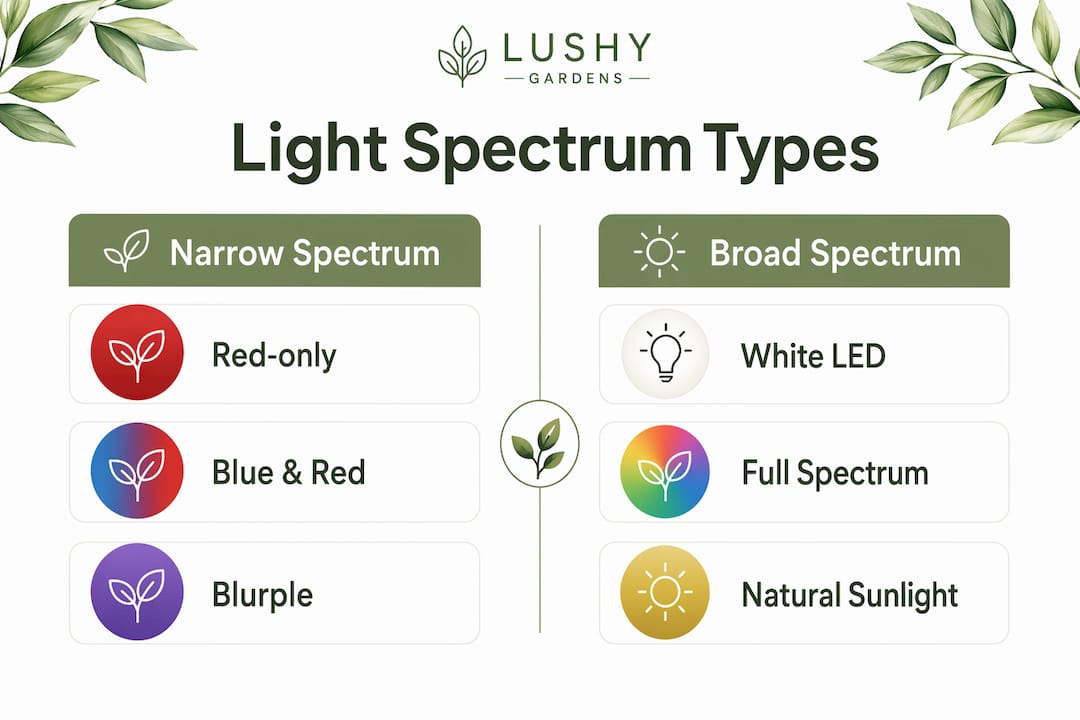
The problem with red-only lighting is particularly well documented. Plants grown under red light alone develop pale, elongated stems and thin leaves because the blue signal that controls cell compactness is absent. Growers sometimes call this “red-light syndrome,” and it is common in budget setups that prioritize cheap red diodes over a complete spectral recipe.
Broad-spectrum or white LED lighting mimics natural sunlight and supports the full range of physiological responses. Lettuce grown under broad-spectrum LEDs with added far-red supplementation shows measurably better results. Far-red supplementation increases fresh biomass by up to 79% in basil and 76% in lettuce compared to white light alone. For microgreens and leafy greens, that difference is the gap between a mediocre harvest and a genuinely productive one.
| Light type | Pros | Cons |
|---|---|---|
| Red-only | Cheap, promotes fast growth | Causes leggy plants, poor morphology |
| Blue-only | Compact seedlings, strong stems | Slow biomass gain, limited flowering support |
| Red plus blue (blurple) | Better than single band | Misses green and far-red benefits |
| Broad spectrum white LED | Mimics sunlight, supports all growth stages | Higher upfront cost |
| Broad spectrum plus far-red | Maximum biomass and flowering performance | Requires quality LED with full spectral output |
Pro Tip: When shopping for indoor grow lights, look for lights that list a color rendering index (CRI) above 90 or explicitly include far-red diodes. These specs indicate a more complete spectrum.
How to choose the right light spectrum for your plants
The best light spectrum for gardening depends on three factors: the species you are growing, the growth stage you are targeting, and whether you are supplementing natural sunlight or replacing it entirely.
For indoor growers, LED technology makes spectral customization practical and affordable. Here is how to approach it by plant type and goal:
- Compact seedlings and herbs: Use a blue-heavy spectrum with a red-to-blue ratio around 1:2. Basil, cilantro, and most leafy herbs stay dense and productive under this setup.
- Flowering vegetables (tomatoes, peppers, cucumbers): Shift toward more red and far-red as plants mature. This triggers the phytochrome responses that initiate and sustain flowering.
- Microgreens and leafy greens: Broad-spectrum white LEDs with some far-red supplementation deliver the best combination of speed and quality. The LED grow light spectrum guide from LED Grow Lights Depot is a practical reference for understanding how different LED configurations compare.
- Ornamental houseplants: Most do well under broad-spectrum white LEDs placed 12 to 24 inches above the canopy. Species from tropical understory environments, like pothos or peace lilies, tolerate lower light but still benefit from a complete spectrum.
- Outdoor supplemental lighting: If you are extending day length or filling in a shaded spot, a full-spectrum LED panel is more effective than a single-band light because it supports all photoreceptor systems simultaneously.
One warning worth repeating: do not overload your plants with far-red. Excess far-red without adequate red and blue causes excessive stem elongation and weak structure. The ratio matters as much as the intensity. You can read more about LED light effectiveness for plants in the Lushygardens deep-dive on the topic.
Practical benefits of understanding light spectrum in everyday gardening
Applying light spectrum knowledge produces results you can see and taste. Here is what changes when you get the spectrum right:
- Better germination: Blue light treatments accelerate and improve germination rates, giving you stronger starts with less thinning required.
- Faster, denser growth: Optimizing red and far-red supplementation increases biomass accumulation, which means more leaves on your lettuce and more fruit on your tomatoes in the same time frame.
- Improved flavor and nutrition: UV-B exposure increases antioxidants and secondary metabolites like flavonoids and glucosinolates. Basil grown under UV-supplemented light tastes noticeably more intense than the same variety grown under standard fluorescent tubes.
- Fewer structural problems: Correct blue light levels prevent the leggy, weak-stemmed growth that makes plants susceptible to pests and physical damage.
- Better visual quality: Full-spectrum light produces truer leaf colors, proper leaf shape, and the kind of lush appearance that makes ornamental plants worth displaying.
- Stronger plant defenses: UV and blue light stimulate the photoreceptor-driven defense pathways that help plants resist fungal infections and insect pressure.
Indoor microgreens are the clearest demonstration of these benefits. Growers who switch from standard shop lights to full-spectrum LEDs with far-red supplementation consistently report faster cotyledon development, deeper color, and longer shelf life after harvest.
Key takeaways
Plants use specific wavelengths across the full spectrum, from UV through far-red, and matching that spectrum to the growth stage is the single most effective way to improve plant health and yield.
| Point | Details |
|---|---|
| PAR is the foundation | Blue and red light within 400 to 700 nm drive chlorophyll excitation and core photosynthesis. |
| Green and far-red matter | Green penetrates canopies; far-red boosts biomass by up to 79% in crops like basil and lettuce. |
| Spectrum needs change by stage | Seedlings need blue-heavy light; flowering plants need more red and far-red for best results. |
| Broad spectrum beats narrow | Monochromatic lights cause developmental problems; full-spectrum LEDs prevent stunting and poor morphology. |
| UV improves quality | UV-B increases antioxidants and secondary metabolites, improving flavor and plant robustness. |
Why I stopped trusting “blurple” lights after one growing season
I ran blurple lights over a four-tier herb rack for about eight months before I admitted the results were mediocre. The plants were alive. Some were even productive. But the basil was pale, the stems on my pepper seedlings were thinner than they should have been, and I kept wondering why my indoor tomatoes flowered so reluctantly.
Switching to broad-spectrum white LEDs with dedicated far-red diodes changed the outcome within two growth cycles. The difference was not subtle. Leaf color deepened, internodes tightened up, and the tomatoes started setting fruit without the coaxing they had needed before. What I had been missing was not more light intensity. It was the right mix of wavelengths telling the plants what to do at each stage.
The mistake most home growers make is treating light as a single variable, as if more lumens always equals better growth. Light is actually a set of signals. Blue tells a seedling to stay compact. Far-red tells a flowering plant to push fruit. Green tells the lower leaves they are not in total darkness. When you remove any of those signals, the plant compensates in ways that usually look like problems you blame on watering or nutrients.
My practical advice: start with a quality broad-spectrum LED that includes far-red output, position it correctly for your canopy height, and then observe your plants for two weeks before adjusting anything else. The light requirements guide at Lushygardens helped me understand what I was actually looking at when my plants responded to spectrum changes. Experiment deliberately, not randomly, and your plants will tell you what they need.
— Povilas
Grow smarter with Lushygardens
Lushygardens has the resources to help you put light spectrum knowledge into practice right away. The beginner gardening guide covers lighting fundamentals alongside soil, watering, and seasonal care in plain language that works whether you are setting up your first grow light or refining an existing indoor setup. For day-to-day plant management, the plant care routine checklist gives you a structured framework that includes light schedule management and growth monitoring. If you are growing vegetables indoors, the indoor vegetable growing guide walks through supplemental lighting choices with practical recommendations for small spaces. Explore these resources and start applying what you know about spectrum to every plant you grow.
FAQ
What is the light spectrum for plants in simple terms?
The light spectrum for plants is the range of wavelengths, primarily 400 to 700 nm, that plants absorb to power photosynthesis and regulate growth. Different wavelengths within this range trigger distinct physiological responses, from seed germination to flowering.
Which light color is best for plant growth?
No single color is best for all growth stages. Blue light (400 to 450 nm) produces compact seedlings, red light (600 to 700 nm) drives vegetative growth and biomass, and far-red (700 to 750 nm) boosts flowering and yield. Broad-spectrum light that includes all three delivers the best overall results.
Does green light help plants grow?
Yes. Green light penetrates deeper into dense leaf canopies than blue or red, supporting photosynthesis in lower shaded leaves that would otherwise receive no usable light. Excluding green from a grow light setup reduces whole-plant light efficiency.
Can UV light benefit my plants?
UV-B light increases the production of secondary metabolites like antioxidants and flavonoids, thickens plant cuticles, and improves overall plant robustness. For culinary herbs and leafy greens, UV supplementation measurably improves flavor intensity and nutritional quality.
How do I know if my grow light covers the right spectrum?
Check the manufacturer’s spectral chart, not just the wattage or lumen output. A quality grow light should show output across blue, green, red, and ideally far-red wavelengths. Lights with a CRI above 90 or explicit far-red diode listings are the most reliable indicators of a complete spectrum.
Recommended
- Best Indoor Plant Lights for Plant Lovers – Expert Comparison 2025 – Lushy Gardens
- Indoor plant care guide: healthier, happier plants at home – Lushy Gardens
- How to Care for Low Light Houseplants – Lushy Gardens
- Light Requirements for Plants: Complete Guide – Lushy Gardens

I’m Eleanor, a seasoned gardener with over three decades of experience tending to Mother Nature’s creations. Through Lushy Gardens, I aim to share my wealth of knowledge and help fellow plant enthusiasts uncover the wonders of gardening. Let’s dive into this journey together, one leaf at a time.


