
Table of Contents
TL;DR:
- F1 hybrid vegetables are first-generation offspring of two distinct inbred parent lines designed for uniformity, high yield, and disease resistance. They rely on controlled pollination methods, which make their seeds more expensive and unsuitable for seed saving, unlike heirlooms or open-pollinated varieties. F1 hybrids offer hybrid vigor, resulting in higher yields and stronger disease resistance, but they require annual seed purchases for consistent performance.
F1 hybrid vegetables are the first-generation offspring of two genetically distinct inbred parent lines, bred to produce uniform, high-yielding, and disease-resistant crops. The “F1” label stands for “first filial generation,” a term rooted in classical genetics. These plants are created through traditional plant breeding, not genetic modification, which separates them clearly from GMOs. Gardeners who understand this distinction make smarter seed choices. Whether you grow tomatoes on a patio or manage a large kitchen garden, knowing what F1 hybrid vegetables are shapes every decision from seed purchase to harvest.
What are F1 hybrid vegetables and how are they produced?
F1 hybrid seed production starts with inbred parent lines. Breeders self-pollinate a single plant for several generations, selecting for specific traits each time. This process stabilizes the genetics of each parent line until it breeds true. The two stable parent lines are then crossed to produce the F1 seed.
Controlled cross-pollination is the most labor-intensive part of the process. Breeders use hand-pollination, detasseling, or male-sterile lines to prevent unwanted pollen from contaminating the cross. Each method requires precision and consistent monitoring across large growing areas. That labor is the primary reason F1 seeds cost significantly more than open-pollinated varieties.
The result is a seed that produces plants with predictable, uniform traits. Every plant in the batch grows to the same height, produces fruit of the same size, and matures at nearly the same time. This uniformity is a direct consequence of the controlled genetics in both parent lines.
Pro Tip: Buy F1 seeds from reputable seed companies that maintain certified parent lines. Cheap, unlabeled “hybrid” seeds may not deliver the uniformity or disease resistance you expect.
| Seed type | Trait uniformity | Seed saving | Typical cost |
|---|---|---|---|
| Inbred line | High, but weak plants | Yes | Low |
| F1 hybrid | Very high, vigorous plants | Not recommended | High |
| Open-pollinated | Moderate | Yes | Low to moderate |
| Heirloom | Moderate | Yes | Low to moderate |
What benefits do F1 hybrid vegetables offer over heirlooms?
Hybrid vigor, known scientifically as heterosis, is the core reason F1 hybrids outperform their parents. Dominant alleles suppress weaker ones in the F1 generation, producing offspring that are stronger, faster-growing, and more productive than either parent alone. This is a natural biological effect, not a laboratory intervention.
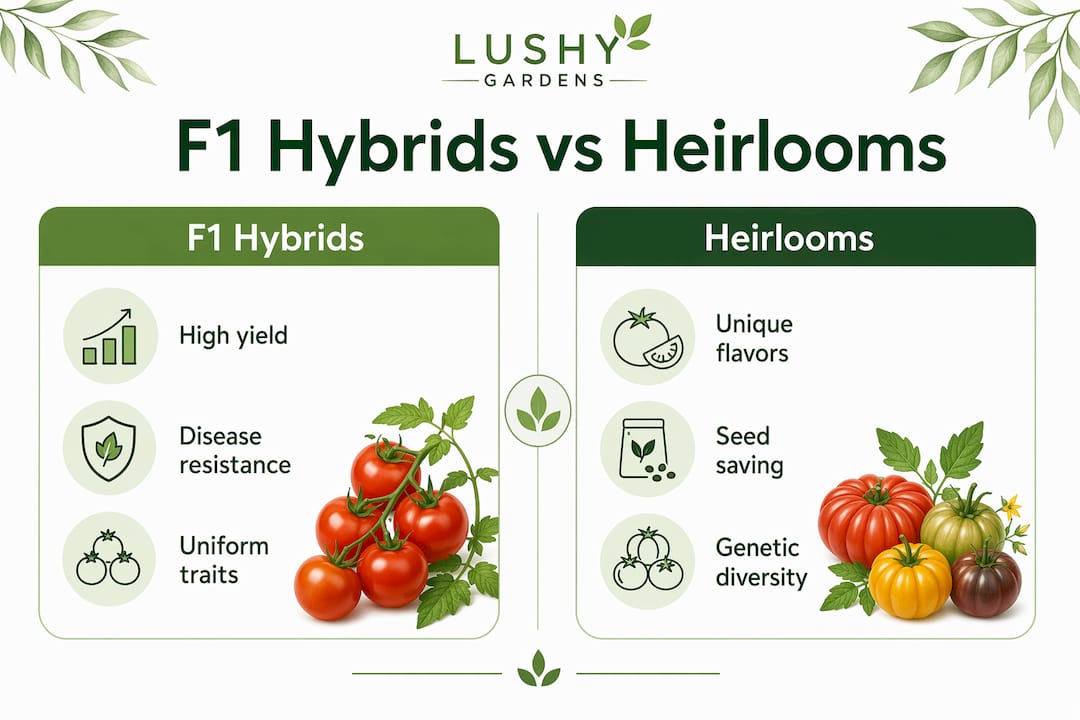
The yield advantage is measurable. Hybrid tomatoes produce 30–40% more fruit per plant than comparable heirloom varieties in disease-prone environments. That gap matters most when blight, mosaic virus, or fusarium wilt pressure is high. Heirlooms in the same conditions often suffer significant crop loss.
Core benefits of F1 hybrid vegetables include:
- Higher yields. Plants consistently produce more fruit per season due to hybrid vigor.
- Disease resistance. Many F1 varieties carry built-in resistance to common pathogens like fusarium wilt, powdery mildew, and tobacco mosaic virus.
- Uniform maturation. F1 plants mature simultaneously, which simplifies harvesting and meal planning.
- Stress tolerance. F1 hybrids handle temperature swings, drought, and heavy rainfall better than most open-pollinated types.
- Consistent size and appearance. Fruits and vegetables look uniform, which matters for market gardeners and home canners alike.
Popular examples include the ‘Early Girl’ tomato, ‘Sugar Snap’ peas, and ‘Marketmore’ cucumber. Each was bred for a specific combination of yield, disease resistance, and flavor that open-pollinated varieties rarely match in a single plant.
| Trait | F1 hybrid | Heirloom | Open-pollinated |
|---|---|---|---|
| Yield | High | Moderate | Moderate |
| Disease resistance | Built-in | Variable | Variable |
| Seed saving | Not recommended | Yes | Yes |
| Flavor complexity | Good | Often superior | Good |
| Uniformity | Very high | Low | Moderate |
One misconception worth correcting: F1 hybrids are not GMOs. No genetic modification techniques are involved. The breeding process relies entirely on controlled natural pollination between selected parent plants. Gardeners who avoid GMOs for personal or philosophical reasons can grow F1 hybrids without conflict.
Can you save seeds from F1 hybrid vegetables?
Saving seeds from F1 hybrids produces F2 generation plants, and the results are unreliable. F2 plants show trait segregation, meaning the uniform genetics of the F1 parent split apart. Some F2 plants may resemble the F1 parent, but most will vary widely in size, yield, disease resistance, and maturation time. The hybrid vigor disappears entirely.
This is not a flaw in the seed. It is basic Mendelian genetics. The F1 generation is uniform because both parent lines are genetically stable and distinct. When F1 plants self-pollinate or cross with each other, those stable parent genetics recombine randomly. The offspring inherit unpredictable combinations of traits.
For gardeners who want to preserve a specific F1 hybrid, vegetative propagation offers a practical solution. Tomatoes can be clonally propagated through stem cuttings, producing plants with identical genetics to the original F1. This method bypasses the seed-saving problem entirely for suitable crops.
The practical implication is straightforward: budget for new F1 seeds each season. The cost is higher than open-pollinated seeds, but the performance consistency justifies it for most food crops. Gardeners who want to save seeds from heirlooms alongside their F1 hybrids get the best of both approaches.
Pro Tip: Reserve seed saving for open-pollinated or heirloom varieties in your garden. Grow F1 hybrids for yield and disease resistance, and grow heirlooms for the seeds you want to carry forward.
How to choose and grow F1 hybrid vegetables successfully
Choosing the right F1 hybrid starts with your local disease pressure. Check which pathogens are common in your region, then look for F1 varieties with coded resistance on the seed packet. Tomato packets, for example, often list “V, F, N, T” codes indicating resistance to verticillium, fusarium, nematodes, and tobacco mosaic virus.
Growth habit matters as much as disease resistance. Determinate F1 tomatoes suit small gardens and container growing because they stop growing at a fixed height. Indeterminate types keep growing all season and need staking or caging. Matching growth habit to your space prevents crowding and maximizes light exposure for every plant.
Key practices for getting the most from F1 hybrid vegetables:
- Time your planting precisely. F1 hybrids mature uniformly, so planting at the right time prevents a glut of ripe produce all at once unless that is your goal for preserving.
- Space plants correctly. Uniform growth means crowding affects every plant equally. Follow spacing recommendations on the packet without cutting corners.
- Feed consistently. Hybrid vigor requires fuel. Apply a balanced fertilizer at planting and side-dress with nitrogen once plants are established.
- Water evenly. Inconsistent watering causes blossom end rot in tomatoes and tip burn in lettuce. Drip irrigation or soaker hoses work well with F1 crops.
- Mix in heirlooms. Growing F1 hybrids alongside heirloom varieties adds flavor diversity and reduces the risk of a single disease wiping out your entire harvest.
Pest management works synergistically with hybrid resistance. F1 varieties with disease resistance still benefit from good sanitation, crop rotation, and companion planting. Resistance reduces risk but does not eliminate it under heavy pressure.
How do F1 hybrids fit into the bigger picture of seed selection?
The seed world divides into four main categories: F1 hybrids, heirlooms, open-pollinated varieties, and GMOs. Each serves a different purpose, and growing both F1 hybrids and heirlooms is the strategy most experienced gardeners recommend. Relying on a single seed type creates vulnerability, whether from disease, climate variation, or supply disruption.
Sustainability is a real consideration with F1 hybrids. Because seeds cannot be saved reliably, gardeners depend on seed companies to maintain parent lines and supply fresh seed each year. That dependency is not a problem for most home gardeners, but it is worth understanding before committing your entire garden to F1 varieties.
Seed labeling standards vary by country, but reputable seed companies and organizations like the Royal Horticultural Society (RHS) provide clear guidance on what “F1” means on a packet. When a packet carries the F1 label from a trusted supplier, you can expect the uniformity, vigor, and resistance traits described.
A balanced seed strategy looks like this:
- Use F1 hybrids for crops where yield and disease resistance are the priority, such as tomatoes, peppers, and brassicas.
- Use heirlooms or open-pollinated varieties for crops where flavor, seed saving, or genetic diversity matters most.
- Avoid assuming that “natural” means better. Heirlooms are not inherently superior to hybrids. They serve different goals.
- Read seed packets carefully. Resistance codes, days to maturity, and growth habit descriptions are your most useful planning tools.

Key Takeaways
F1 hybrid vegetables deliver their greatest value when gardeners understand the biology behind them and match seed choice to specific garden goals.
| Point | Details |
|---|---|
| F1 means first filial generation | F1 hybrids are produced by crossing two stable inbred parent lines for uniform, vigorous offspring. |
| Hybrid vigor drives performance | Heterosis gives F1 plants 30–40% higher yields and stronger disease resistance than heirloom types. |
| Seed saving does not work | F2 plants from saved F1 seeds lose uniformity and vigor due to trait segregation. |
| Higher seed cost is justified | Labor-intensive controlled pollination explains the price premium on F1 seeds. |
| Mix hybrids with heirlooms | Growing both types balances reliability, flavor, and genetic diversity across your garden. |
My honest take on F1 hybrids after years in the garden
I spent my first few seasons as a gardener avoiding F1 hybrids entirely. The higher seed cost felt unnecessary, and I had a vague suspicion that “hybrid” meant something artificial. That was a mistake I corrected quickly once late blight wiped out my entire heirloom tomato crop two years running.
The shift to F1 tomato varieties like disease-resistant hybrids changed my harvests completely. The plants were visibly stronger, the fruit set was heavier, and I stopped losing half my crop to foliar disease by mid-August. That reliability is not glamorous, but it is genuinely useful when you are feeding a family from a backyard plot.
What I have found is that the best gardens use both. My heirlooms give me the flavor complexity and the seeds I want to carry forward. My F1 hybrids give me the bulk of my harvest and the peace of mind that comes from disease resistance. Neither category is superior in every situation. The gardener who treats this as an either-or choice is leaving yield or flavor on the table.
The seed-saving question is the one I get asked most often. My answer is always the same: save seeds from your heirlooms, buy fresh F1 seeds each year, and do not feel guilty about it. The cost is real but modest compared to the value of a reliable harvest.
Grow smarter with Lushygardens
Lushygardens covers the full range of vegetable gardening topics that complement what you have learned about F1 hybrids. The gardening basics guide for beginners walks through soil preparation, seed starting, and planting schedules in plain language. For gardeners ready to go deeper, the seasonal garden maintenance guide covers the month-by-month tasks that keep hybrid and heirloom crops performing at their best. Whether you are planting your first F1 tomato or refining a mixed vegetable garden, Lushygardens has the practical guidance to support every stage of the growing season.
FAQ
What does F1 mean on a seed packet?
F1 stands for “first filial generation,” meaning the seed was produced by crossing two genetically distinct inbred parent lines. The label guarantees uniform, vigorous plants with predictable traits.
Are F1 hybrid vegetables safe to eat?
F1 hybrid vegetables are completely safe. They are produced through traditional plant breeding with no genetic modification involved.
Why are F1 seeds more expensive than regular seeds?
F1 seed production requires maintaining separate parent lines and using controlled pollination methods like hand-pollination or male-sterile lines. That labor-intensive process drives the higher price.
Can I save seeds from F1 hybrid vegetables?
Saving seeds from F1 hybrids produces F2 plants with segregated, unpredictable traits and reduced vigor. Buying fresh F1 seeds each season is the reliable approach.
What is the difference between F1 hybrids and heirloom vegetables?
F1 hybrids are bred for uniform yield and disease resistance but cannot be saved for true-to-type offspring. Heirlooms are open-pollinated, breed true from saved seed, and often offer superior flavor complexity.
Recommended
- What Are Indeterminate Vegetables? A Grower’s Guide – Lushy Gardens
- Heirloom vs Hybrid Seeds: Impact on Your Garden – Lushy Gardens
- Master Fall Vegetable Gardening for a Bountiful Harvest – Lushy Gardens
- What Is a Heritage Vegetable? Benefits and Growing Tips – Lushy Gardens

I’m Eleanor, a seasoned gardener with over three decades of experience tending to Mother Nature’s creations. Through Lushy Gardens, I aim to share my wealth of knowledge and help fellow plant enthusiasts uncover the wonders of gardening. Let’s dive into this journey together, one leaf at a time.


