
Table of Contents
TL;DR:
- Microgreens are young seedlings harvested within 7 to 21 days that are highly nutrient-dense. They grow in soil under light, reducing food safety risks compared to sprouts, which are grown in water. Microgreens offer concentrated vitamins and flavor, making them an efficient, sustainable crop for home and urban gardening.
Microgreens are young vegetable and herb seedlings harvested 7–21 days after germination, just as the first true leaves emerge. They differ from sprouts and baby greens in both cultivation method and nutritional profile, and agricultural researchers classify them as among the most nutrient-dense foods available to home growers. A single tray grown on a windowsill can deliver concentrated vitamins, minerals, and polyphenols that would take far more mature produce to match. Whether you want to improve your diet, grow food in a small space, or add bold flavors to your cooking, microgreens offer a practical and rewarding starting point.
What are microgreens, exactly?
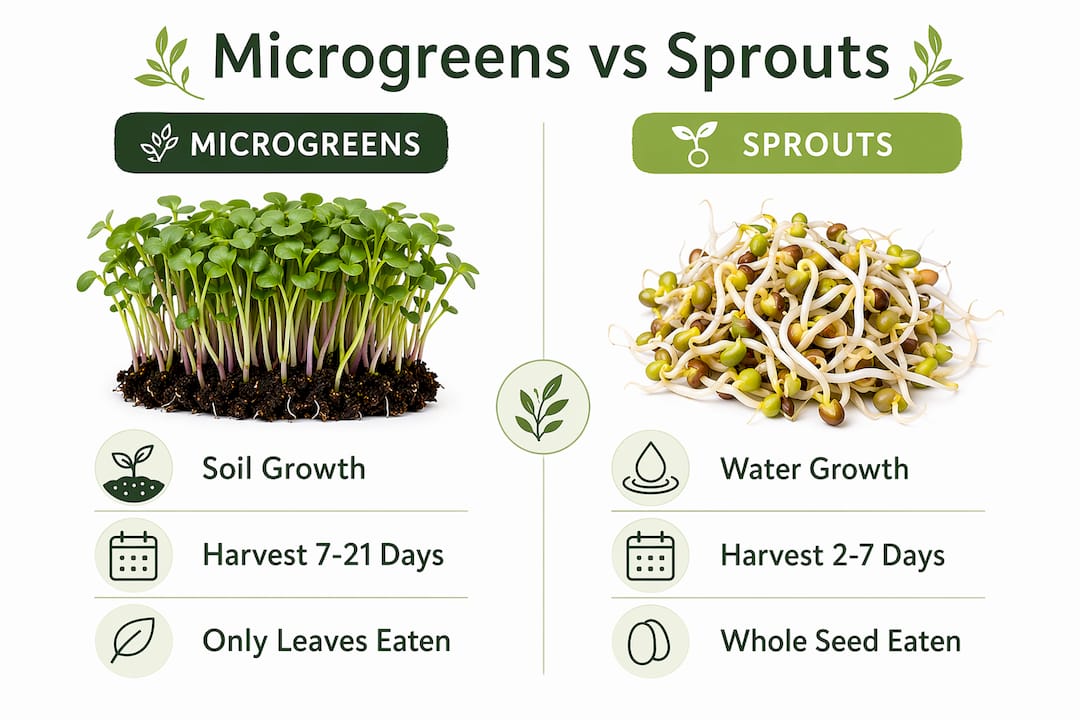
Microgreens are the seedling stage of edible plants, harvested above the soil line once the cotyledons (seed leaves) are fully open and the first true leaves begin to appear. The term “microgreens” is the widely accepted industry name used by nutritionists, chefs, and agricultural scientists alike. They are not the same as sprouts, and the distinction matters both for flavor and food safety.
Sprouts are germinated seeds grown entirely in water with no soil or light. You eat the whole thing: seed, root, and shoot. Because sprouts sit in warm, moist water throughout their growth, they carry a higher microbial risk than microgreens. Microgreens grow in soil or a substrate under light, and only the stem and leaves are consumed. That growing environment significantly reduces food safety concerns.
Baby greens occupy the next stage. They grow for several more weeks until they reach a recognizable leaf shape, like baby spinach or arugula. Microgreens sit between sprouts and baby greens in age, but they often surpass both in nutrient concentration per gram.
| Feature | Sprouts | Microgreens | Baby greens |
|---|---|---|---|
| Growth medium | Water only | Soil or substrate | Soil |
| Light required | No | Yes | Yes |
| Days to harvest | 2–5 | 7–21 | 21–40+ |
| Part consumed | Whole seed, root, shoot | Stem and leaves only | Leaves only |
| Food safety risk | Higher | Lower | Lower |
Are microgreens good for you? The nutrition facts
Microgreens contain 4 to 40 times higher nutrient concentrations than their mature counterparts per gram. That is not a minor difference. It means a small handful of red cabbage microgreens can deliver more vitamin C and vitamin K than a full serving of mature red cabbage.
The key nutrients found in microgreens include:
- Vitamin C — supports immune function and collagen production
- Vitamin K — critical for blood clotting and bone health
- Vitamin E — acts as an antioxidant protecting cells from damage
- Beta-carotene — a carotenoid the body converts to vitamin A
- Polyphenols — plant compounds linked to reduced inflammation
Research on microgreens and human health is still developing. Animal studies show promising effects on inflammation, cholesterol, and blood sugar. However, human clinical trials remain limited, so microgreens are best viewed as a powerful addition to a balanced diet rather than a treatment for any condition.
One practical advantage is convenience. Microgreens help you reach daily vegetable intake targets without lengthy prep. You rinse them, add them to a meal, and you are done. For people who struggle to eat enough vegetables, that simplicity removes a real barrier.
Pro Tip: Add a small handful of sunflower or pea shoot microgreens to a smoothie. They blend almost invisibly while adding measurable nutrition to your morning routine.
How to grow microgreens at home
Growing microgreens at home requires no garden, no special equipment, and very little space. A shallow tray, quality seeds, and a bright windowsill are enough to get started. The full growing cycle spans 7–21 days depending on the variety, making them one of the fastest crops you can grow indoors.
Follow these steps for consistent results:
- Choose your seeds. Always use untreated, food-grade seeds labeled for sprouting or microgreens. Treated seeds contain fungicide coatings that are unsafe to eat. Buying in bulk reduces cost significantly.
- Prepare your tray. Fill a shallow tray with 1–2 inches of potting mix or a purpose-made growing medium. Level the surface evenly. Uneven substrate causes patchy germination and increases fungal risk.
- Sow densely. Spread seeds in a single, even layer across the surface. Press them gently into the medium so they make good contact.
- Cover and begin the blackout period. Place a second tray on top to block light. Experienced growers recommend a blackout period of 2–5 days after sowing. This stretches the stems upward and helps prevent damping off, a fungal disease that kills seedlings at the soil line.
- Move to light. Once stems are 1–2 inches tall, remove the cover and place the tray under a grow light or in a bright window. Aim for 12–16 hours of light daily. Optimized light duration directly increases both nutrient content and flavor intensity.
- Water carefully. Bottom-water by pouring water into a second tray beneath the growing tray. This keeps the surface dry and reduces mold risk. Keep the temperature between 65°F and 75°F for best results.
- Harvest at the right moment. Cut just above the soil line when the first true leaves appear. Use a sharp, clean blade. Crushing the stems during cutting reduces shelf life noticeably.
Pro Tip: Radish microgreens germinate in 3 days and are ready to harvest in under 10. They are the best variety for beginners who want fast, satisfying results.
For a detailed walkthrough of every stage, Lushygardens has a thorough step-by-step growing guide covering seed selection, trays, and troubleshooting.
What culinary uses and flavor profiles do microgreens offer?
Microgreens cover a wide range of flavors, from mild and nutty to sharp and pungent. The variety you grow determines the taste, and that variety is genuinely impressive.
Popular types and their flavor profiles include:
- Radish — spicy and peppery, similar to mature radish but more intense
- Sunflower — mild, nutty, and slightly sweet; one of the most crowd-pleasing options
- Basil — aromatic and sweet, identical in flavor to mature basil leaves
- Kale — earthy and slightly bitter, pairs well with rich dressings
- Cilantro — bright and citrusy, excellent in tacos and Asian dishes
- Pea shoots — sweet and fresh, with a clean green flavor
Chefs use microgreens as garnishes because they add color, texture, and flavor in a single step. Home cooks use them as meal finishers: scattered over scrambled eggs, stirred into soups just before serving, or layered into sandwiches. They work in smoothies, grain bowls, and flatbreads without any cooking required.
Storage is straightforward. Keep unwashed microgreens in a sealed container lined with a dry paper towel in the refrigerator. They stay fresh for up to a week after harvest. Washing before storage speeds up deterioration, so rinse only what you plan to eat immediately.
How do microgreens support sustainable and urban gardening?
Microgreens produce fresh food with minimal space and resources, making them one of the most practical crops for urban growers. A single 10-by-20-inch tray yields a meaningful harvest using less water than almost any other vegetable crop. The short growth cycle means you can produce food year-round regardless of season or climate.
“Microgreens represent a genuine opportunity for urban food production. Their short cycle, low input requirements, and high nutrient output make them a practical tool for food security in cities where traditional agriculture is not possible.”
That potential connects directly to broader food system challenges. As cities grow and arable land shrinks, crops that thrive indoors under artificial light become more relevant. Microgreens fit naturally into sustainable food service models and local sourcing strategies that reduce supply chain distance.
The limitations are real, though. Microgreens cannot replace staple crops. They provide micronutrients but not significant calories, protein, or carbohydrates. Scaling production beyond a few trays requires grow lights, climate control, and consistent labor. For home growers, these constraints are minor. For large-scale food security, microgreens are one piece of a much larger puzzle. Lushygardens covers indoor vegetable growing strategies that put microgreens in context alongside other productive crops for city dwellers.
Key Takeaways
Microgreens deliver 4 to 40 times more nutrients per gram than mature vegetables, making them one of the most efficient foods you can grow at home in under three weeks.
| Point | Details |
|---|---|
| Definition and harvest window | Microgreens are seedlings harvested 7–21 days after germination, just as true leaves appear. |
| Nutrient density advantage | They contain 4 to 40 times more nutrients per gram than their mature plant counterparts. |
| Safer than sprouts | Growing in soil under light reduces microbial risk compared to water-grown sprouts. |
| Blackout period is critical | Cover trays for 2–5 days after sowing to build strong stems and prevent damping off fungus. |
| Culinary and sustainable value | Microgreens add flavor to meals and produce fresh food year-round with minimal space and water. |
Why microgreens changed how I think about home growing
The first time I grew microgreens, I expected a novelty. What I got was a genuinely useful crop that changed how I approach small-space growing. Radish was my entry point, and the speed alone was enough to get me hooked. Ten days from seed to plate is hard to beat when you are used to waiting months for a tomato.
The mistake I see most beginners make is skipping the blackout period. They want to see growth, so they put the tray in the light immediately. The result is weak, leggy stems that collapse before harvest. Cover the tray, be patient for three to five days, and the difference is dramatic.
I also think people underestimate how much flavor variety is available. Sunflower microgreens taste nothing like radish microgreens, which taste nothing like basil microgreens. Building a rotation of two or three varieties keeps meals interesting and gives you a steady supply without overwhelming your counter space.
The sustainability angle is what keeps me most engaged long-term. Growing food indoors with a few trays of water and a grow light feels like a small but meaningful act. Microgreens will not solve food insecurity on their own, but they demonstrate that fresh, nutritious food production does not require land, good weather, or a large budget. That idea is worth taking seriously.

Lushygardens has the growing resources you need
Lushygardens publishes practical, beginner-friendly guides for every stage of home growing, from your first seed tray to a full indoor vegetable setup. If you are ready to start growing microgreens, the beginner gardening guide covers the foundational skills that apply directly to microgreen cultivation. For growers who want to go deeper, the site’s indoor gardening tips section addresses light, watering, and space management for urban environments. Lushygardens also covers optimal watering methods that prevent the most common cause of failed microgreen trays: overwatering.
FAQ
What are microgreens in simple terms?
Microgreens are young seedlings of vegetables and herbs, harvested 7–21 days after germination just as the first true leaves appear. Only the stem and leaves are eaten.
How do microgreens differ from sprouts?
Sprouts grow in water with no soil and the entire seed is eaten, while microgreens grow in soil under light and only the stem and leaves are consumed. Microgreens carry a lower food safety risk as a result.
What types of microgreens are there?
Common types include radish, sunflower, kale, basil, cilantro, pea shoots, and arugula. Each variety has a distinct flavor profile ranging from spicy to sweet to earthy.
How long does it take to grow microgreens?
Most varieties are ready to harvest in 7–21 days depending on the plant. Radish is one of the fastest, often ready in under 10 days.
Are microgreens actually healthier than regular vegetables?
Research shows microgreens contain 4 to 40 times more nutrients per gram than mature plants. Human clinical trials are still limited, so treat them as a nutrient-dense addition to a balanced diet rather than a replacement for whole vegetables.
Recommended
- Growing Microgreens at Home Naturally: Easy Step-by-Step Guide – Lushy Gardens
- What Is Green Manure? A Beginner’s Soil Guide – Lushy Gardens
- Growing Vegetables Indoors: Sustainable Food for City Living – Lushy Gardens
- Boost Plant Success: Microclimate Gardening Made Simple – Lushy Gardens

I’m Eleanor, a seasoned gardener with over three decades of experience tending to Mother Nature’s creations. Through Lushy Gardens, I aim to share my wealth of knowledge and help fellow plant enthusiasts uncover the wonders of gardening. Let’s dive into this journey together, one leaf at a time.


