
Table of Contents
TL;DR:
- Nodes are critical junctions on plant stems that trigger new growth, branching, and rooting. Recognizing and working with these structures enhances pruning, shaping, and propagation success. Properly targeting nodes when cutting or propagating boosts plant health and encourages fuller, more vigorous growth.
Ever pinched back a leggy stem and then watched your plant suddenly explode with new growth from spots that seemed completely dormant before? That moment of surprise is one of the most satisfying experiences in home gardening, and it happens because of a tiny but mighty structure called the node. Nodes are the reason your pothos branches after a trim, why your basil fills out when you pinch the top, and why cuttings either root successfully or fail completely. Once you understand what nodes are and how to work with them, almost every pruning and propagation decision becomes clearer and more effective.
Table of Contents
- What is a node? The basic building block of plant stems
- Node vs. internode: How to spot the difference and why it matters
- Why nodes matter: Growth, shape, and plant care
- Nodes in propagation: The secret to successful cuttings
- Why understanding nodes transforms your gardening results
- Unlock more gardening secrets with Lushy Gardens
- Frequently asked questions
Key Takeaways
| Point | Details |
|---|---|
| Nodes drive new growth | Leaves, branches, and flower buds form at nodes, making them the engine of plant development. |
| Distinguish nodes from internodes | The node is where new action happens, while internodes are simply stem between these busy spots. |
| Pruning at nodes shapes plants | Snipping near a node stimulates new shoots and helps control how a plant grows and looks. |
| Propagate cuttings with nodes | Including a node is crucial for successful plant cuttings since that’s where roots and shoots can emerge. |
What is a node? The basic building block of plant stems
To understand why your plants respond the way they do to cutting and shaping, you need to start at the stem. Specifically, you need to know about nodes.
In plant botany, nodes are points of attachment/03%3A_Plant_Structure/3.03%3A_Stems/3.3.01%3A_Stem_Morphology_(External_Structure)) for leaves on a stem, and they are also the locations where buds can form lateral growth such as axillary shoots. That definition covers a lot. In plain terms, a node is essentially a junction point. Think of the stem as a highway and the nodes as the on-ramps where side roads branch off. Every leaf you see on a plant grew from a node. Every side shoot, every cluster of flowers, every new branch traces back to one of these small but critical regions.
Nodes are not always easy to see at first glance, but once you train your eye, they become obvious. Here are the most reliable visual signs to identify a node on any plant:
- Leaf attachment points: Wherever a leaf petiole (the stalk connecting the leaf to the stem) meets the stem, that is a node.
- Axillary buds: Look for small, rounded bumps sitting in the angle between the leaf and the stem. These are called axillary buds, and they are the engine of future growth.
- Leaf scars: On woody or semi-woody plants, older nodes often leave a visible scar after a leaf drops. These scars are a reliable landmark.
- Slight swelling or color change: On many species, the node region is just slightly thicker or has a subtly different color compared to the rest of the stem.
The region of stem between two nodes has its own name: the internode. Internodes are simply the connecting tissue that gives the stem length and structure. They carry water and nutrients but don’t hold the same growth potential that nodes do. Understanding pruning and plant health starts here, because where you make a cut on the stem determines everything.
Here is a quick reference comparing what you typically see at nodes versus internodes:
| Feature | Node | Internode |
|---|---|---|
| Leaf or bud present | Yes | No |
| Capable of new shoot growth | Yes | Rarely |
| Visible scar after leaf drop | Yes | No |
| Location | Where leaf/bud attaches | Stem region between nodes |
| Tissue density | Slightly denser | More uniform |
“A node is more than just a dot on a stem. It’s the most biologically active region of the plant’s above-ground structure, and nearly every major growth event starts there.”
Learning to spot nodes reliably is a skill that pays off every single time you pick up pruning shears or prepare a cutting for propagation.
Node vs. internode: How to spot the difference and why it matters
Now that you can identify a node, it’s crucial to differentiate it from the often-confused internode, as this distinction changes everything from pruning to propagation.
The stem region between two nodes/03%3A_Plant_Structure/3.03%3A_Stems/3.3.01%3A_Stem_Morphology_(External_Structure)) is called an internode. Internodes vary dramatically in length depending on the plant species and growing conditions. A sun-starved plant will often have very long internodes because it is stretching toward light, which is why etiolated (weak, stretched) houseplants look sparse and leggy. A plant with ideal light will have shorter, tighter internodes, giving it that full, compact look you’re aiming for.
Here’s a direct comparison to help you tell them apart at a glance:
| Characteristic | Node | Internode |
|---|---|---|
| Growth tissue present | Yes, axillary buds | No active growth tissue |
| Where to cut for propagation | Right below the node | Not recommended |
| Appearance after pruning | New shoot emerges | Stub often dies back |
| Role in plant health | Active growth site | Structural spacing |
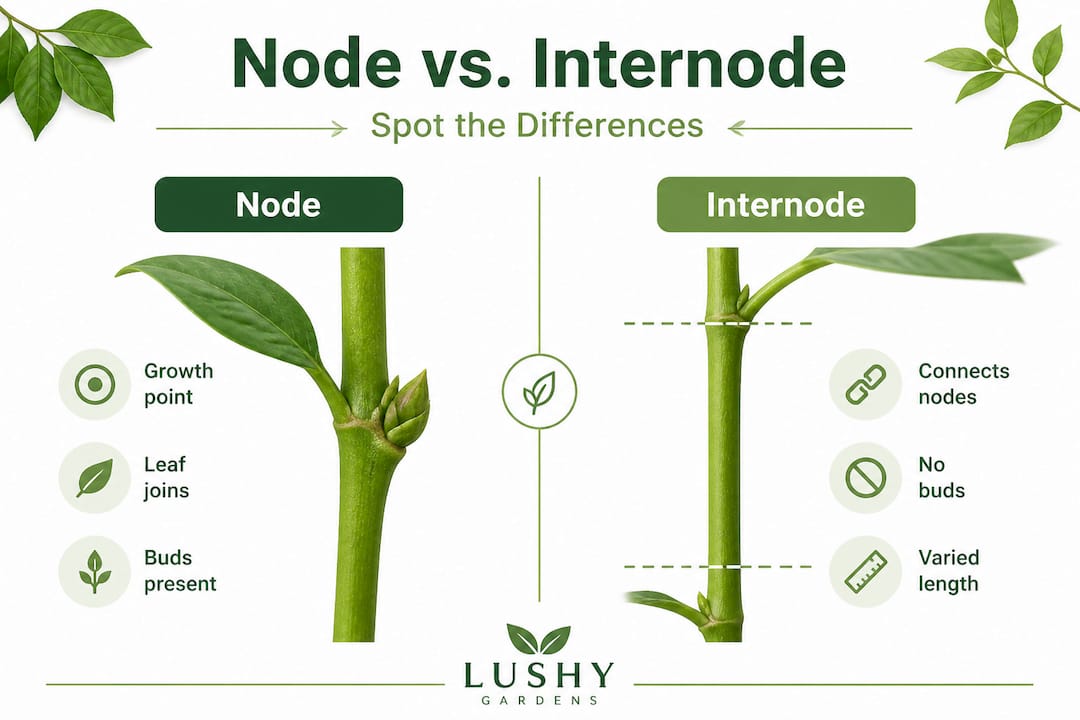
For indoor plants like pothos, philodendrons, monsteras, or tradescantia, nodes are usually easy to spot because leaves are spread fairly evenly. On outdoor shrubs like roses or hydrangeas, you may need to look more carefully at woody stems where leaf scars and visible buds act as your guide.
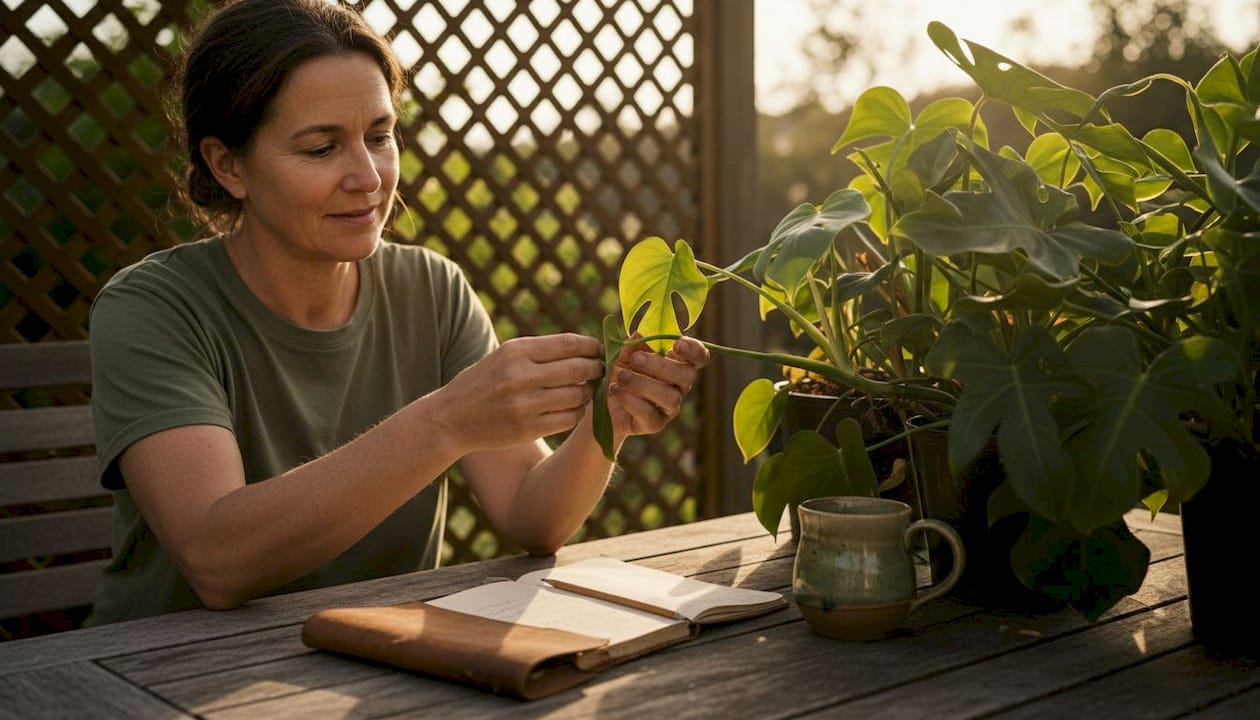
Pro Tip: When preparing a cutting for water propagation, make your cut just below a node, leaving roughly half an inch of internode below it. This gives the node something to work with when it starts forming roots while preventing the very end of the cutting from sitting in a position where it can rot before roots emerge.
The single most common propagation mistake home gardeners make is cutting in the middle of an internode. A nodeless cutting might sit in water or soil for weeks looking perfectly healthy, and then simply do nothing. No roots. No growth. That’s because the internode simply does not have the specialized tissue needed to generate new roots or shoots.
Why nodes matter: Growth, shape, and plant care
With clear node identification, let’s explore why nodes are your best allies for shaping growth and managing healthy plants.
Nodes are the site of axillary buds, which are small buds that sit in the angle between a leaf and the stem. Under normal conditions, many of these buds stay dormant. Why? Because of a process called apical dominance. The growing tip of the plant (the apical meristem) releases a hormone called auxin, which flows downward through the stem and actively suppresses the axillary buds below it. The plant is essentially prioritizing upward growth over sideways branching.
When you prune or pinch the growing tip, you remove the source of that auxin signal. The axillary buds below the cut are suddenly released from suppression. This is why pruning near a node can stimulate branching at those buds, altering the plant’s shape and triggering significantly bushier, fuller growth.
This single principle explains a huge number of common plant care practices:
- Pinching basil: Pinching out the top node regularly keeps basil from going to seed and forces side shoots to grow, giving you a fuller, more productive plant.
- Pruning tomatoes: Removing the growing tip on indeterminate tomato varieties redirects energy into fruit production at existing flower nodes.
- Shaping houseplants: Cutting pothos or philodendron stems back to a healthy node encourages multiple new vines to emerge, making the plant look denser.
- Training climbing plants: Understanding where nodes sit on a vine lets you position the plant on a trellis so new lateral growth fills in the desired space.
- Deadheading flowers: Cutting a spent bloom back to a node below it often triggers a fresh round of flowering from the buds at that junction.
This is why professional horticulturists and skilled home gardeners almost always prune just above a node. It is not random or aesthetic. It is strategic use of the plant’s own biology to achieve a specific result. Using your indoor plant pruning guide with this understanding takes your results to a noticeably different level.
Nodes in propagation: The secret to successful cuttings
Now let’s apply this to multiplying your favorite plants. Understanding nodes empowers you to propagate plants more easily and far more reliably.
When you take a cutting from a plant, your goal is to get that cutting to develop its own roots. For propagating plants by cuttings, including a node is important because nodes and associated bud tissue are key sites for new growth and are the primary targets to promote rooting success. A cutting without a node is like trying to start a fire without a spark. The tissue just is not there.
Most stem cuttings should include at least one node, and ideally two. Here is a reliable step-by-step approach for preparing a cutting:
- Choose a healthy stem. Look for a stem that is not stressed, diseased, or currently blooming. New growth that has recently matured works well for most plants.
- Identify the nodes. Count at least two nodes from the growing tip downward. This gives you a cutting with some established leaf tissue and at least one node that will be submerged in water or soil.
- Make a clean cut just below the lowest node. Use clean, sharp scissors or shears. A ragged cut invites rot and disease. Cut at a slight angle to maximize the surface area for rooting.
- Remove leaves near the lower node. Any leaves that would sit in water or soil should be removed. Submerged leaves rot and can kill your cutting before it roots.
- Place in water or moist propagation mix. Keep the node submerged or in consistent contact with the medium. Roots will form from the node tissue, typically within 1 to 3 weeks depending on the plant.
- Wait and resist the urge to disturb it. Frequent checking by pulling the cutting out will break early root growth. Look for root development through the container if using water propagation.
This process works especially well for popular houseplants. If you are interested in cutting propagation techniques for a wide variety of plants, the node-based approach is the consistent foundation. Even specific plants like propagating snake plant follow the same node-aware principles, though the method adjusts slightly.
Pro Tip: For plants with visible nodes like pothos or monsteras, try water propagation in a clear glass container. Watching the roots develop from the node is genuinely fascinating, and it lets you monitor progress without disturbing the cutting.
Common mistakes to avoid include taking cuttings from stems that are too soft (new growth that wilts easily) or too woody (old hardwood that roots very slowly without hormone treatment), cutting internodes only, overwatering during the rooting phase, and using dirty cutting tools that introduce fungal or bacterial problems.
Why understanding nodes transforms your gardening results
Here is something most gardening content won’t tell you directly: the majority of common plant care frustrations trace back to ignoring nodes. Not to poor soil choice, not to watering mistakes, and not to wrong fertilizer ratios. Overlooking nodes is the quiet culprit behind leggy houseplants that never fill in, propagation attempts that always seem to fail, and pruned plants that come back sparse instead of lush.
The counterintuitive lesson here is that less is often more. A single careful cut at the right node does more work than aggressive trimming in the wrong place. Gardeners who prune frantically, cutting stems without looking for nodes, often end up with dead stubs, weak regrowth, and a plant that looks worse after the cut than before it.
There is also a tendency to focus almost entirely on what is happening at the ends of branches, at the tips where new leaves unfurl, or down at the soil level where roots are working. Nodes sit in the middle, literally and figuratively, and that is why they are so often overlooked. But every branching decision, every cutting attempt, every pinching session is really a conversation you are having with the nodes.
Once you start noticing nodes, you will see them everywhere. On your trailing pothos, your overgrown basil, your favorite rose cane, your climbing bean plant. And every time you notice one, you will recognize an opportunity: a potential new branch, a rooting site, a spot where the plant’s energy is ready to redirect with just a small cut. Exploring plant propagation methods with this lens makes you a genuinely more effective gardener, not just a better informed one.
Track your results. Take photos before and after node-aware pruning. Write down where you made cuts on a propagation. This kind of simple observation builds intuition faster than reading alone ever could.
Unlock more gardening secrets with Lushy Gardens
If you’re ready to put your new knowledge into practice, here’s where you can dive deeper and see results in your garden. At Lushy Gardens, we have guides built for every stage of this journey. Start with gardening basics if you are building your foundation, or move straight into our detailed houseplant propagation guide to try node-based propagation with step-by-step support. If pruning is your current focus, our deep look at the benefits of pruning ties plant biology directly to practical technique. Every guide is written for real gardeners who want clear, actionable advice without the fluff.
Frequently asked questions
How do I find a node on my houseplant?
Look for bumps, scars, or spots along the stem where leaves or buds attach/03%3A_Plant_Structure/3.03%3A_Stems/3.3.01%3A_Stem_Morphology_(External_Structure)). Any place where a leaf connects to the stem, or where a small bud is visible, is a node.
Why don’t new shoots grow between nodes?
New growth comes from axillary buds located at the nodes, not from internodes, because that is where the specialized growth tissue lives. Internodes carry water and nutrients but lack the bud tissue needed to generate new shoots.
Do all plant cuttings need nodes to root?
Most cuttings need a node to successfully produce roots and new growth. A few plants like begonias can root from leaf sections, but stem cuttings for the vast majority of species require at least one node.
What happens if I prune above or below a node?
Pruning just above a node stimulates lateral bud growth and encourages new branching at that location. Cutting too far below a node leaves an exposed internode stub that often dies back without producing any new growth.
Recommended
- Indoor plant care guide: healthier, happier plants at home – Lushy Gardens
- How to Make Spider Plant Bushier: A Step-By-Step Guide for Lush Growth – Lushy Gardens
- Plant Nutrition Basics: Key to Thriving Gardens – Lushy Gardens
- Importance of Pruning – How It Transforms Plant Health – Lushy Gardens
- Why proper tree planting matters: health and sustainability

I’m Eleanor, a seasoned gardener with over three decades of experience tending to Mother Nature’s creations. Through Lushy Gardens, I aim to share my wealth of knowledge and help fellow plant enthusiasts uncover the wonders of gardening. Let’s dive into this journey together, one leaf at a time.


