
Table of Contents
TL;DR:
- Healthy lawn maintenance involves consistent mowing, deep watering, soil testing, and careful fertilization to promote resilience. Following evidence-based practices prevents weeds and pests while reducing reliance on chemicals and conserving water. Patience, observation, and informed decisions are key to achieving a lush, healthy, and environmentally friendly turf.
Healthy grass maintenance is the practice of combining mowing, watering, fertilization, soil testing, and weed control into a system that keeps turf dense, green, and resilient year-round. The EPA frames lawn care as working with nature rather than against it, reducing pesticide dependence through proactive practices. Kansas State University and the University of Maryland both publish research-backed guidance confirming that consistent, well-timed care outperforms reactive fixes every time. The tips for healthy lawns in this guide follow that same evidence-based logic, giving you a clear path from patchy grass to a lawn you’re proud of.
1. What are the best mowing practices for a healthy lawn?
Mowing height is the single most controllable factor in turf health. Set it wrong and you invite weeds, disease, and shallow roots. Set it right and your lawn does most of the defensive work on its own.
Match height to grass type. Kansas State University recommends mowing tall fescue and Kentucky bluegrass to 3–4 inches, while warm-season grasses like Bermuda and zoysia perform best around 2.5 inches. Taller grass shades the soil, which suppresses weed germination and retains moisture longer.
Follow the one-third rule. Never remove more than one-third of the blade in a single mow. Cutting too much at once stresses the plant and forces it to redirect energy from root development to leaf recovery. That stress window is exactly when weeds and disease move in.
Key mowing habits to build into your routine:
- Mow by growth rate, not the calendar. Grass grows faster in spring and slower in summer heat. Adjust your schedule accordingly.
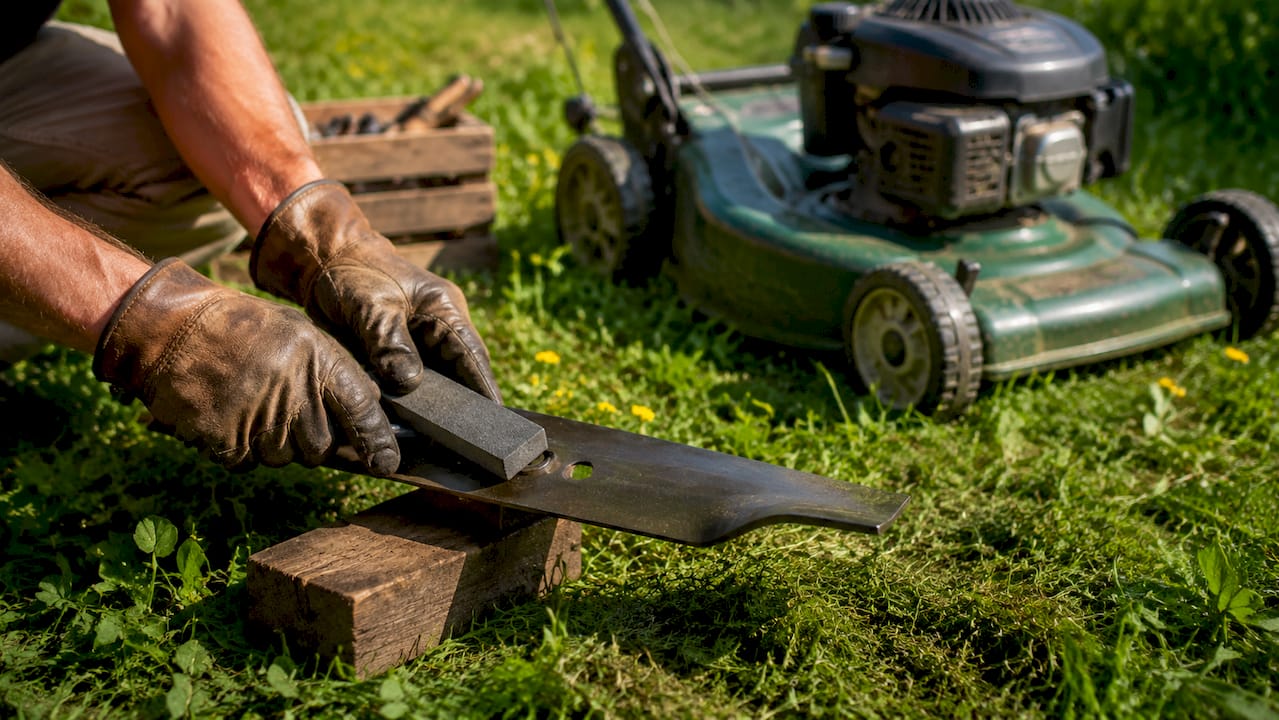
- Keep blades sharp. Dull blades tear grass rather than cut it, leaving ragged edges that turn brown and invite fungal disease.
- Leave clippings on the lawn. Grass clippings decompose quickly and return nitrogen to the soil, reducing your fertilizer needs.
- Alternate mowing directions. Changing your pattern each session prevents soil compaction and encourages upright growth.
Pro Tip: Sharpen your mower blade at least twice per season. A clean cut heals faster and keeps your lawn looking uniform rather than patchy and brown-tipped.
2. How should you water your lawn for deep roots and disease resistance?
Watering timing and frequency shape root depth more than almost any other practice. Shallow, frequent watering trains roots to stay near the surface, making turf vulnerable to heat and drought. Deep, infrequent watering forces roots to follow moisture downward, building the kind of resilience that carries a lawn through dry spells.
Follow these steps to build a smarter irrigation routine:
- Water in the early morning. Morning watering lets the surface dry before nightfall, which dramatically cuts the risk of fungal disease. Nighttime watering keeps grass wet for hours, creating ideal conditions for mold and rot.
- Water deeply but infrequently. K-State recommends watering once every 7–10 days in spring rather than light daily sessions. Each session should wet the soil to a depth of 6–8 inches.
- Read your turf before you water. Wait for visible stress signs: grass that doesn’t spring back after you walk on it, or blades that start to fold lengthwise. These are reliable signals that irrigation is needed.
- Adjust for weather and season. Hot, windy days increase evaporation. Rainy weeks may eliminate the need to water entirely. A fixed schedule ignores these variables and wastes water.
- Use stored or recycled water when possible. During dry periods, drought-browned lawns often recover naturally after rainfall, making heavy irrigation during drought a choice rather than a necessity.
Pro Tip: Push a screwdriver 6 inches into the soil after watering. If it slides in easily, you’ve hit the right depth. If it meets resistance, water longer next session.
3. What fertilization practices keep grass healthy without excess?
Fertilization is one of the most misused tools in lawn care. More fertilizer does not mean greener grass. It often means more thatch, more disease pressure, and nutrients washing into local waterways.
The best lawn fertility practices start with restraint. Fertilize based on what your lawn actually needs, not on a generic bag schedule. Nitrogen is the nutrient most responsible for green color and leaf growth, but applying it at the wrong time causes more harm than good.
Key rules for responsible fertilization:
- Skip early spring and midsummer applications. Early spring nitrogen pushes rapid leaf growth before roots are ready, weakening the plant. Summer applications stress already heat-taxed turf.
- Use a soil test to guide every application. Without a test, you’re guessing. Guessing leads to over-application, which wastes money and risks polluting groundwater.
- Apply nitrogen in fall for cool-season grasses. Fall feeding builds root reserves that carry the lawn through winter and fuel strong spring green-up.
- Sweep fertilizer off driveways and sidewalks immediately. Granules left on hard surfaces wash directly into storm drains and streams. This step takes 30 seconds and protects local water quality.
- During drought, skip nitrogen entirely. Virginia Tech turf expert Dan Sandor warns that nitrogen during drought stresses turf further by pushing growth the plant cannot support without adequate water.
4. How do soil testing and amendments improve lawn health?
Soil testing is the foundation of every other lawn care decision. Without knowing what’s already in your soil, every fertilizer application is a guess. A test tells you the pH, phosphorus, potassium, and organic matter levels so you apply only what’s missing.
Follow this process for accurate results:
- Sample from at least eight spots across your lawn. K-State’s soil testing protocol calls for collecting samples from multiple locations, mixing them together, and submitting one pint for analysis. A single sample from one corner misses the variability across your yard.
- Submit samples to your local extension lab. University extension labs like those at Kansas State or the University of Maryland offer affordable testing with region-specific recommendations. Private labs work too, but extension labs understand local soil conditions.
- Act on the results, not assumptions. Soil tests reveal sufficiency as much as deficiency. If phosphorus is already adequate, adding more wastes money and risks algae growth in nearby water bodies.
- Test every 2–3 years. Soil chemistry changes slowly. Annual testing is rarely necessary unless you’ve made major amendments or notice persistent problems.
| Nutrient | What it controls | Sign of deficiency |
|---|---|---|
| Nitrogen | Leaf color and growth rate | Pale yellow-green turf |
| Phosphorus | Root development | Slow establishment, purple tint |
| Potassium | Drought and disease resistance | Scorched leaf edges |
| pH (6.0–7.0) | Nutrient availability | Poor response to fertilizer |
Understanding your soil testing results turns guesswork into a precise plan that saves money and protects the environment.
5. What strategies prevent weeds and pests while keeping turf natural?
A dense, healthy lawn is your best weed barrier. Thin or stressed turf leaves gaps where weed seeds germinate and establish. The most effective weed prevention strategy is growing grass that crowds weeds out before they get started.
The University of Maryland Extension emphasizes consistent prevention over reactive treatments, noting that a well-maintained lawn recovers from stress faster and needs fewer chemical interventions over time.
Practical weed and pest management steps:
- Time pre-emergent herbicides correctly. Crabgrass preventers work only when applied before germination. K-State cites mid-April as the target window, with the product watered in before May 1 germination. Miss that window and pre-emergents become useless.
- Pull weeds by hand when populations are small. Manual removal is the cleanest method and avoids any chemical contact with surrounding grass.
- Use spot treatments for persistent weeds. Blanket herbicide applications kill more than weeds. Spot-treating individual plants protects beneficial soil organisms and reduces chemical load.
- Adopt integrated pest management (IPM). IPM, the approach endorsed by the EPA’s healthy lawn framework, combines cultural practices, biological controls, and targeted chemical use to minimize environmental impact.
“A healthy lawn is your first line of defense. Dense turf competes directly with weeds for light, water, and nutrients, making chemical intervention the last resort rather than the first.”
For homeowners who want to go further, eco-friendly pest control methods offer practical alternatives that protect both your lawn and local ecosystems. You can also explore organic pest control strategies from Lushygardens for chemical-free approaches that work with your turf’s natural defenses.
Key takeaways
Healthy lawn care works because consistent mowing, deep watering, soil-tested fertilization, and timed weed prevention build turf that resists stress without heavy chemical inputs.
| Point | Details |
|---|---|
| Mow by grass type | Set height to 3–4 inches for cool-season grasses; never remove more than one-third of the blade. |
| Water deeply and infrequently | Water every 7–10 days in spring; always water in the morning to reduce disease risk. |
| Test soil before fertilizing | Sample eight spots, submit one pint, and apply only the nutrients your soil actually lacks. |
| Time weed prevention correctly | Apply pre-emergent herbicides before crabgrass germination; dense turf is your primary weed barrier. |
| Skip nitrogen during drought | Fertilizing stressed, dry turf pushes growth the plant cannot sustain and causes further damage. |
What I’ve learned from watching lawns fail the same way every year
Most lawn problems I see come from one source: doing too much at the wrong time. Homeowners fertilize in early spring because the bag says to. They water every day because the grass looks dry. They mow on Saturday regardless of how much the grass grew that week. None of that is lawn care. It’s just habit dressed up as routine.
The lawns that genuinely thrive are the ones where the owner learned to observe before acting. Brown grass in July is not always a crisis. Drought-browned turf often rebounds naturally after rain, and forcing water or nitrogen onto dormant grass can do more damage than the drought itself. Patience is an underrated lawn care tool.
Soil health is where I’d tell every homeowner to start. You can mow perfectly and water correctly, but if your soil pH is off or your phosphorus is depleted, nothing else works as well as it should. A $20 soil test from your local extension office gives you more useful information than a season of trial and error. I’ve seen lawns transform in a single growing season simply because the owner finally knew what the soil needed instead of guessing.
My honest recommendation: follow a seasonal maintenance schedule and let your lawn tell you what it needs between tasks. Grass communicates clearly if you know what to look for.
— Povilas
How Lushygardens helps you grow a better lawn
Lushygardens publishes practical, research-backed guides for homeowners at every skill level. Whether you’re starting from bare soil or trying to fix a patchy, struggling lawn, the beginner gardening guide walks you through the fundamentals in plain language. For ongoing care, the seasonal maintenance guide gives you a task-by-task schedule so nothing gets missed across spring, summer, fall, and winter. You’ll also find dedicated resources on optimal watering techniques to help you stop guessing and start irrigating with confidence. Explore the full library at Lushygardens and build a lawn care routine that actually works.
FAQ
What is the one-third rule in lawn mowing?
The one-third rule means you should never cut more than one-third of the grass blade in a single mowing session. Removing more than that stresses the plant and slows root development.
How often should I water my lawn in spring?
Kansas State University recommends watering once every 7–10 days in spring, applying enough to wet the soil 6–8 inches deep. Daily light watering produces shallow roots that struggle in summer heat.
When should I apply a crabgrass preventer?
Apply pre-emergent crabgrass herbicide in mid-April and water it in before May 1, when germination typically begins. Applying after germination has no effect on existing seedlings.
Do I need to fertilize if my lawn looks green?
Not necessarily. A soil test may show that nutrient levels are already sufficient. Adding fertilizer without testing risks over-application, which wastes money and can pollute nearby waterways.
Should I water my lawn during a drought?
Grass lawns generally survive drought by going dormant and recovering naturally after rainfall. If you choose to water, do so deeply and infrequently in the early morning, and avoid applying nitrogen fertilizer until conditions improve.
Recommended
- Seasonal Garden Maintenance: Step-by-Step Success Guide – Lushy Gardens
- Seasonal plant care tips: year-round guide for gardeners – Lushy Gardens
- Home – Lushy Gardens
- Plant care routine checklist: your daily guide for healthy gardens – Lushy Gardens

I’m Eleanor, a seasoned gardener with over three decades of experience tending to Mother Nature’s creations. Through Lushy Gardens, I aim to share my wealth of knowledge and help fellow plant enthusiasts uncover the wonders of gardening. Let’s dive into this journey together, one leaf at a time.


