
Table of Contents
TL;DR:
- Yellow grass results from various issues like water problems, nutrient deficiencies, pests, or disease.
- Proper diagnosis involves quick tests: screwdriver soil check, tugging turf, and pattern observation.
- Targeted treatments based on diagnosis are more effective and prevent unnecessary expenses.
Yellow grass is one of those lawn problems that tricks you into thinking there’s one simple fix. Grab some fertilizer, water more, done. Except it’s almost never that straightforward. The truth is, yellowing grass can stem from a handful of very different problems, including too much water, too little, a nutrient deficiency, soil pH problems, pest damage, or fungal disease. Treating the wrong cause doesn’t just waste your money. It can actually make things worse. This guide walks you through a practical, step-by-step approach to figure out exactly what’s wrong with your lawn and fix it the right way.
Table of Contents
- How to identify the cause of yellow grass
- Watering woes: Too much or too little?
- Nutrients, soil, and pH: The foundation for green grass
- Pests and diseases: When the problem is alive
- Why most advice on yellow grass doesn’t work (and what does)
- Get more gardening solutions with Lushy Gardens
- Frequently asked questions
Key Takeaways
| Point | Details |
|---|---|
| Diagnosis is key | Start with simple tests to identify whether water, nutrients, or pests are the cause before treating yellow grass. |
| Watering mistakes matter | Yellow grass often signals watering issues, so adjust your habits based on soil and weather. |
| Soil health underlies green lawns | Regular soil tests and nutrient care prevent many grass problems and enable faster recovery. |
| Pests require specific action | If pests are found, fast targeted treatment is crucial to save your lawn. |
| Expert guidance saves time | Following proven troubleshooting steps keeps your lawn lush and avoids wasted effort on the wrong fixes. |
How to identify the cause of yellow grass
The biggest mistake homeowners make is skipping straight to treatment. You spot yellow patches, grab a bag of fertilizer, and hope for the best. Sometimes that works. More often, it doesn’t, because yellowing grass rarely has just one cause. Understanding yellowing leaf causes across all plants can actually sharpen your lawn diagnostic instincts, since the underlying biology is often similar.
Here’s how to run three simple tests before you spend a dime on products:
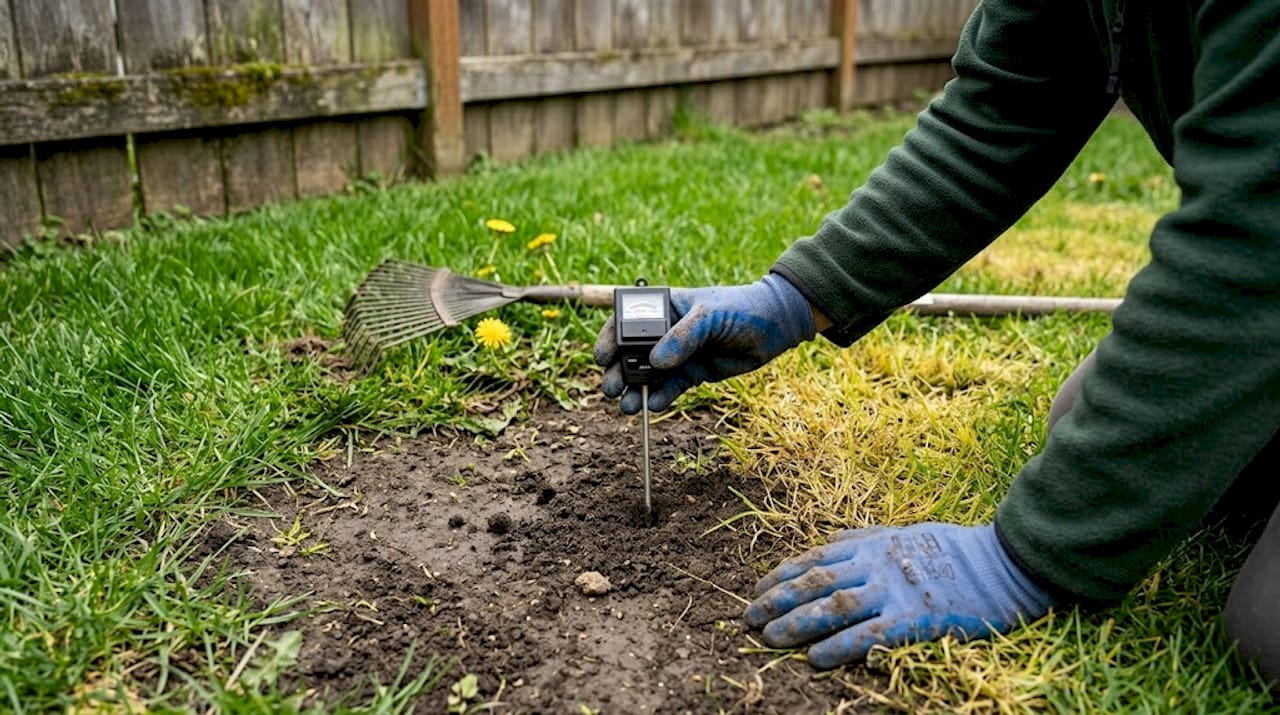
- Screwdriver test: Push a standard screwdriver about six inches into the soil. If it goes in easily, the soil is wet. If you have to force it, the soil is dry. This tells you immediately whether moisture is your issue.
- Tug test: Grab a handful of yellowed grass and pull firmly. Healthy grass resists. If the turf lifts like a loose carpet, grubs or other root-feeding pests may have destroyed the root system underneath.
- Visual pattern check: Scattered yellow blades suggest nutrient deficiency. Irregular patches that spread suggest disease. Uniform yellowing across large areas often points to watering problems or compaction.
A quick soil test kit from your local garden center, or through a university extension office, can confirm pH and nutrient levels. According to extension experts, running the screwdriver and tug tests first narrows your diagnosis fast and saves you from chasing the wrong fix.
Here’s a quick reference to match what you’re seeing to the most likely cause:
| Symptom | Likely cause |
|---|---|
| Uniform pale yellow across lawn | Nitrogen deficiency or overwatering |
| Yellow with soft, soggy soil | Overwatering or poor drainage |
| Patchy yellow, lifts like carpet | Grub or pest damage |
| Yellow edges, green centers | Underwatering or heat stress |
| Yellowing spreading in circles | Fungal disease |
| Yellow on older blades only | Iron or potassium deficiency |
Pro Tip: Before buying any product, run all three tests and note your results. Many homeowners who struggle with misdiagnosing yellow grass end up re-treating the same lawn two or three times because they skipped this step.
Watering woes: Too much or too little?
Once you’ve run your initial diagnostics, watering is the first major variable to examine. It’s also the most misunderstood. Both overwatering and underwatering produce yellow grass, but they look and feel different once you know what to check.
Signs of overwatering:
- Soil feels consistently wet or spongy
- Mushrooms or moss appearing near yellow areas
- Yellow blades that pull off easily at the base
- A slightly sour or musty smell near the turf
Signs of underwatering:
- Soil is hard and cracked (fails the screwdriver test)
- Grass blades fold or curl along their length
- Yellow or brown edges, especially during hot afternoons
- Footprints remain visible on the lawn for longer than usual
The key difference: overwatered grass tends to yellow uniformly across large areas, while underwatered grass often shows stress at the tips and edges first. Recognizing the signs of overwatering early can prevent the secondary problems that come with saturated soil, including root rot and fungal infections.
“Most home lawns need about one inch of water per week, including rainfall. Watering deeply but less frequently encourages roots to grow deeper and makes grass more drought-resistant.” — Utah State University Extension
Pro Tip: Adjust your watering schedule when the weather changes. A schedule that works perfectly in spring can overwater your lawn when fall temperatures drop. Check the screwdriver test weekly and modify your sprinkler run time accordingly.
Knowing the difference between overwatering vs underwatering effects on plants also helps you train your eye to read grass stress signals faster. The same principles apply, whether you’re dealing with a lawn or a potted plant.
For most cool-season grasses, watering in the early morning reduces evaporation and gives blades time to dry before evening, which lowers the risk of fungal issues. Warm-season grasses like Bermuda and Zoysia can handle slightly less frequent watering once established.
Nutrients, soil, and pH: The foundation for green grass
Water isn’t always the culprit. Even a well-watered lawn turns yellow when the soil is nutrient-poor or when the pH is off. Grass pulls minerals from the soil through its roots, and if those minerals aren’t available or the pH locks them out, the grass starves regardless of how much you water.
The three most common nutrient issues in home lawns are:
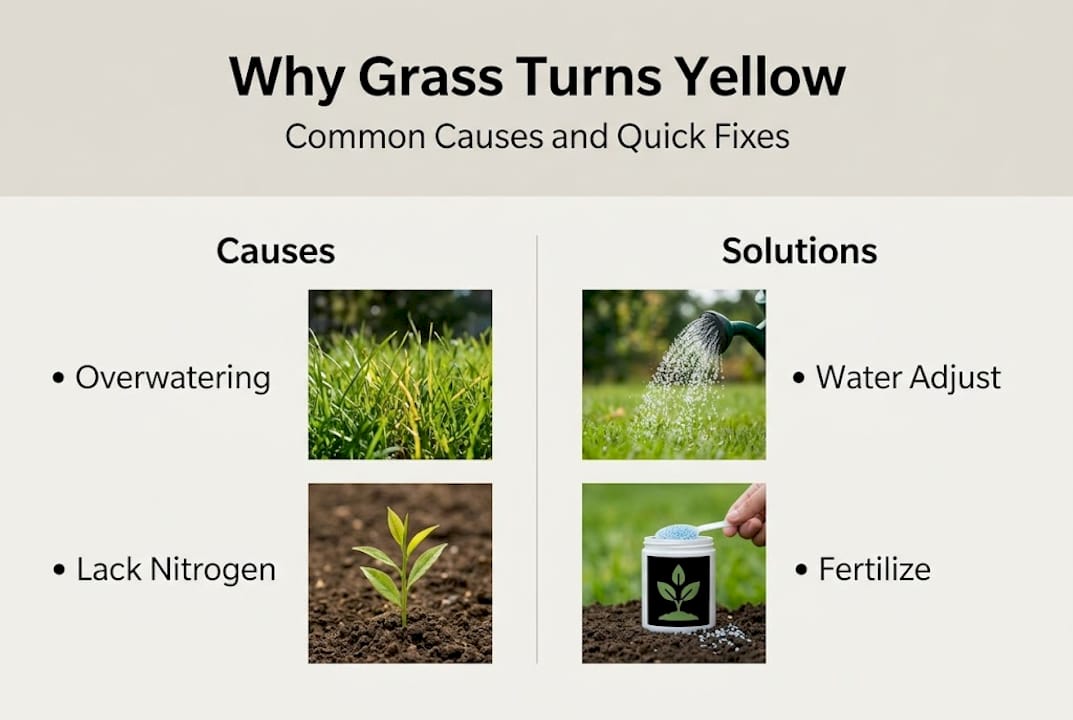
- Nitrogen deficiency: This is the most frequent cause of general yellowing. Grass needs nitrogen to produce chlorophyll, the green pigment. Pale, uniformly yellow grass across the whole lawn is a classic sign.
- Iron deficiency: Shows up as yellowing between the veins of grass blades while the veins themselves stay green. This is called interveinal chlorosis, and it’s more common in alkaline soils.
- Potassium deficiency: Produces yellowing and browning along the edges of blades. Grass also becomes more vulnerable to drought and disease when potassium is low.
Soil pH directly affects how well your grass absorbs nutrients. Most lawn grasses thrive between pH 6.0 and 7.0. Outside that range, even a nutrient-rich soil can starve your grass. A basic soil test, which you can get through the soil test guidance resources at your state extension office, gives you both pH and nutrient data in one report.
| Nutrient | Visual symptom | Fix |
|---|---|---|
| Nitrogen | Uniform pale yellow | Apply slow-release nitrogen fertilizer |
| Iron | Yellow between veins | Apply chelated iron or lower pH |
| Potassium | Yellow/brown blade edges | Apply potassium-rich fertilizer |
| Magnesium | Older leaves yellow first | Apply Epsom salt or dolomite lime |
Understanding how plant leaf yellowing and soil quality connect gives you an edge beyond lawns. The same deficiencies that yellow your grass also affect your garden beds, and fixing one often helps you spot problems in the other. For example, the tips around tomato leaf yellowing for soil tips translate surprisingly well to reading grass blade symptoms.
To fix nutrient issues, first confirm the deficiency with a test. Then amend accordingly: compost improves overall soil structure, lime raises pH in acidic soils, sulfur lowers it in alkaline ones, and targeted fertilizers address specific deficiencies. Avoid guessing, because adding too much nitrogen to already nitrogen-rich soil can burn your grass and create fresh yellow patches.
Pests and diseases: When the problem is alive
Nutrient and water issues aside, living organisms often cause the most frustrating kind of lawn yellowing because the damage looks similar to other problems but won’t respond to watering or fertilizer fixes.
The most common lawn pests and disease culprits include:
- Grubs (beetle larvae): Feed on grassroots from below, severing the connection between roots and blades. Grubs cause yellow patches that lift off the ground easily, like peeling back a loose rug.
- Chinch bugs: Tiny insects that suck moisture from grass blades. They cause irregular yellow patches that spread outward and are most active in hot, dry conditions.
- Dollar spot fungus: A fungal disease that creates small, silver-dollar-sized yellow or tan patches. Common when nights are cool and mornings are dewy.
- Brown patch fungus: Larger, irregular brown-ringed circles. Often triggered by high humidity, warm nights, and excessive nitrogen.
Here’s how to check for pests step by step:
- Perform the tug test on yellow areas. If turf lifts easily, suspect grubs.
- Part the grass at the border of a yellow patch and look closely at the soil line for small insects.
- Check for irregular spreading patterns that suggest fungal disease.
- Note when the yellowing appeared: after heavy rain or a dry spell both increase pest and fungal activity.
For mild grub infestations, beneficial nematodes (microscopic organisms available at garden centers) offer an organic treatment option. For fungal issues, reduce evening watering and improve air circulation by dethatching. Knowing the care mistakes causing yellowing helps you understand which conditions invite pests in the first place.
Pro Tip: Keep an eye out for sudden yellow patches appearing rapidly after heavy rain or an extended dry stretch. These are prime conditions for both grub activity and fungal outbreaks. Early action limits spread significantly. For severe infestations, consult a local extension office or lawn care professional before applying pesticides broadly.
For a broader look at common causes and fixes across garden plants, you’ll notice many pest and disease patterns repeat themselves, which makes you a faster diagnostician over time.
Why most advice on yellow grass doesn’t work (and what does)
Here’s the honest truth: most online advice on yellow grass fails because it assumes your lawn has one problem with one obvious fix. Fertilize it. Water it more. Water it less. The advice isn’t wrong, exactly. It’s just incomplete in a way that sends homeowners on expensive, frustrating loops.
The real issue is that skipping proper diagnosis is baked into the generic advice. Very few guides tell you to test before you treat. But the misdiagnosis rates in lawn care are high precisely because people apply solutions without confirming the problem first.
What actually works is treating diagnosis as the first, non-negotiable step. Run the screwdriver test. Pull the turf. Look at the pattern. Test the soil. These steps take fifteen minutes and cost almost nothing, but they change everything. Once you know whether you’re dealing with compaction, drought, pests, or a pH imbalance, the fix becomes obvious. You stop wasting money on fertilizer when the real issue is grubs, or on pesticides when the lawn is simply thirsty.
A systematic approach isn’t just more effective. It’s genuinely less stressful, because you stop second-guessing every product you apply.
Get more gardening solutions with Lushy Gardens
With this knowledge in hand, you’re already ahead of most homeowners struggling with the same yellow grass frustration. But good lawn care doesn’t stop at troubleshooting one problem. It builds over time through better habits, smarter seasonal routines, and a deeper understanding of what your plants actually need.
At Lushy Gardens, we’ve put together resources to help you at every stage. Start with the gardening basics guide if you want to build a strong foundation across all your garden care, or head straight to the seasonal garden maintenance guide to keep your lawn healthy through every season. Whether you’re a first-time gardener or someone ready to go deeper, there’s a guide waiting for you.
Frequently asked questions
Can yellow grass be saved, or is it permanent?
Most yellow grass recovers with proper diagnosis and targeted treatment. The exception is severe root destruction from heavy pest damage or prolonged drought, which may require reseeding.
How long does it take for yellow grass to turn green again?
With the right fix in place, you can typically see improvement within one to three weeks. Recovery time varies based on the severity of the problem and current growing conditions.
Does mowing height affect grass yellowing?
Yes. Cutting grass too short removes too much of the blade at once, stressing the plant and triggering yellowing. Keep your mowing height above 2.5 inches for most grass types.
Is yellow grass contagious to other lawns?
Yellow grass itself doesn’t spread, but the underlying causes sometimes do. Fungal diseases and pests like chinch bugs can migrate across lawn boundaries if left untreated.
Recommended
- Problems With Yellowing Leaves – Causes and Solutions – Lushy Gardens
- Why is my succulent turning yellow? Causes and fixes – Lushy Gardens
- Why Are My Plants Leaves Turning Yellow? Solutions That Work – Lushy Gardens
- Why Plants Turn Yellow: Common Causes and Easy Fixes – Lushy Gardens

I’m Eleanor, a seasoned gardener with over three decades of experience tending to Mother Nature’s creations. Through Lushy Gardens, I aim to share my wealth of knowledge and help fellow plant enthusiasts uncover the wonders of gardening. Let’s dive into this journey together, one leaf at a time.


