
Table of Contents
TL;DR:
- Growing your own herb garden ensures access to fresh, flavorful leaves harvested exactly when needed, saving money and reducing frustration. Proper site preparation, choosing suitable layouts like raised beds or containers, and grouping herbs by water needs prevent common failures. Prioritizing accessibility and personal practicality over aesthetic perfection leads to a more sustainable, productive herb-growing experience.
There’s nothing more frustrating than buying a fresh bunch of basil at the grocery store, using a few leaves, and watching the rest turn black within days. Store-bought herbs are expensive, often harvested too early for peak flavor, and almost always inconvenient when you need just a sprig mid-recipe. Growing your own herb garden changes all of that. You get peak-flavor leaves steps from your kitchen, harvested exactly when you need them, at a fraction of the long-term cost. This guide walks you through proven design strategies, site preparation, layout options, and companion planting principles to help you build a productive, beautiful herb garden from scratch.
Table of Contents
- Essential conditions for thriving herb gardens
- Choosing the right layout and beds for your space
- Selecting herbs: perennial anchors and annual flavor boosters
- Companion planting and grouping: maximizing flavor and health
- Troubleshooting and optimizing: common mistakes and advanced tips
- A fresh perspective: design wisdom most guides miss
- Enhance your gardening journey with expert resources
- Frequently asked questions
Key Takeaways
| Point | Details |
|---|---|
| Sun and drainage are crucial | Herb gardens thrive in 6+ hours sun and soil that drains in under 4 hours. |
| Layout impacts access and growth | Choose raised beds, containers, or spirals based on your space and herb needs. |
| Mix perennials and annuals | Anchor gardens with perennials and supplement with annuals for flavor diversity and easy care. |
| Companion grouping simplifies maintenance | Organize herbs by water needs and simple companions for efficient and healthy growth. |
| Observe and adapt your garden | Monitor site patterns and adjust layout and care for optimal results. |
Essential conditions for thriving herb gardens
Before you dig a single hole or buy a single seedling, your site needs to meet a few non-negotiable requirements. Getting these right from day one saves you from the most common herb garden failures.
Herb gardens require full sun of at least 6 hours daily, well-drained soil with a pH between 6.0 and 7.5, and herbs grouped by their water needs. Mediterranean herbs like rosemary, thyme, and oregano prefer drier conditions, while herbs like parsley, cilantro, and mint do better with consistent moisture. Ignoring these groupings is one of the fastest ways to lose plants.
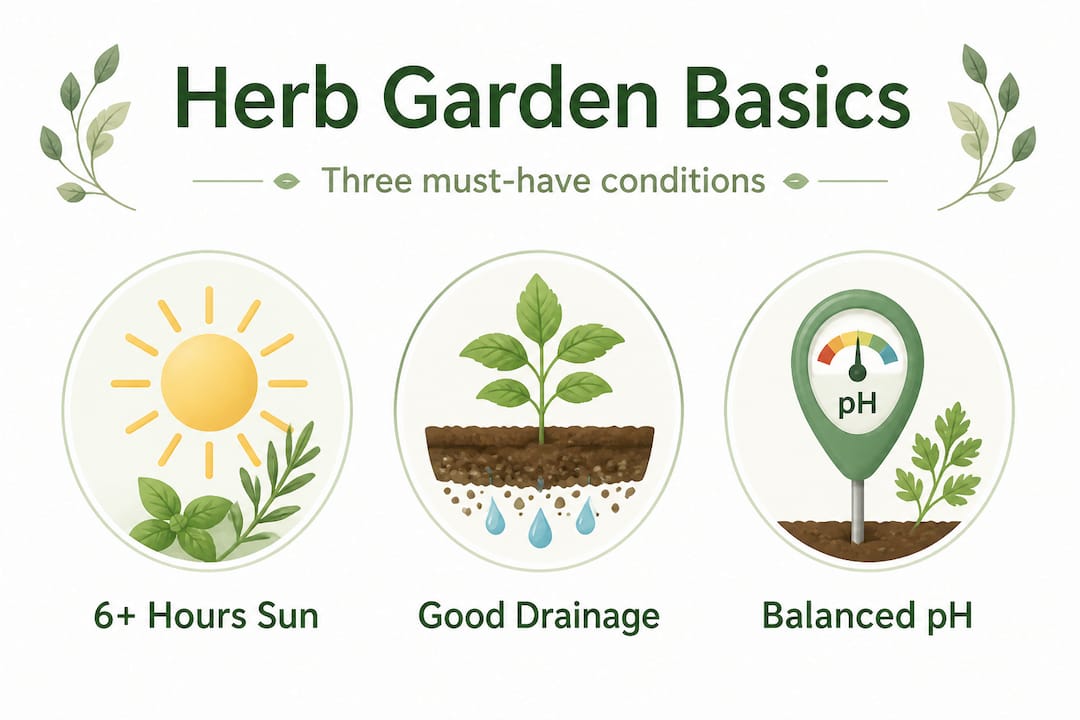
Sunlight, soil, and water at a glance:
| Condition | Requirement | Notes |
|---|---|---|
| Sunlight | 6+ hours daily | South-facing spots ideal |
| Soil pH | 6.0 to 7.5 | Test with a basic kit |
| Drainage | 2 to 4 hours for water to drain | Use the hole test |
| Soil mix | 40% sand, 40% silt, 20% clay | Adjust as needed |
| Moisture grouping | Mediterranean vs. moisture-loving | Separate beds help |
To check drainage, dig a hole about 12 inches deep, fill it with water, and time how long it takes to drain. Water draining in 2 to 4 hours indicates good drainage. If your soil is heavy clay, amend it with compost and perlite. A proper mix of 40% sand, 40% silt, and 20% clay is the sweet spot, and getting there can cut root rot risk by 22%.
If you’re working with limited outdoor space, check out these urban gardening tips for making the most of small plots. For those growing inside, these indoor herb garden tips offer practical solutions for window sills and countertops.
Pro Tip: Don’t plant based on one day’s observation. Watch your site across an entire day, and across different seasons if you can. What looks like a sunny corner in the morning may be deep shade by 2 p.m., which completely changes what you can grow there.
Key requirements by herb type:
- Mediterranean herbs (rosemary, thyme, sage, oregano): Full sun, sandy or loamy well-drained soil, minimal water
- Cool-season herbs (cilantro, dill, parsley): Partial shade tolerant, consistent moisture, avoid intense summer heat
- Moisture-loving herbs (mint, chives, lemon balm): Rich soil, regular watering, some afternoon shade in hot climates
Choosing the right layout and beds for your space
With site requirements established, selecting the right layout is your next design step. The layout you choose affects how easy your garden is to maintain, how productive it is, and whether it actually gets used throughout the growing season.
Place tall herbs like rosemary and sage at the back or center of your garden, and shorter herbs like thyme and chives toward the front. Aim for roughly one plant per square foot to allow enough airflow and access. For small spaces or invasive herbs like mint, raised beds, spirals, herb wheels, and containers are all smart solutions.
Layout comparison for home herb gardens:
| Layout type | Best for | Pros | Cons |
|---|---|---|---|
| Raised bed | Most gardeners | Good drainage, easy access | Upfront cost |
| Container | Small spaces, invasives | Flexible, portable | Dries out faster |
| Herb spiral | Diverse needs, microclimates | Space-efficient, beautiful | Needs good construction |
| Herb wheel | Decorative gardens | Visual appeal | Limited plant count |
| In-ground bed | Large spaces | Low cost, natural | Harder to control drainage |
Raised beds are the top pick for most beginners. They warm up faster in spring, drain better than native soil, and give you full control over your growing medium. If you’re short on ground space, explore these container gardening ideas for creative solutions on patios and balconies.
A vertical herb garden is another strong option if you’re wall-mounting planters indoors or along a fence. You can fit a surprisingly large herb collection into a few square feet of vertical space.
- Raised beds work best at least 30 cm (about 12 inches) deep to accommodate root growth
- Containers should have drainage holes and be large enough for the mature plant size
- Spirals and wheels are fun conversation pieces but require more thought to build correctly
Selecting herbs: perennial anchors and annual flavor boosters
Once you’ve chosen your layout, it’s time to pick and organize your herb varieties. The most productive home herb gardens combine two distinct categories: perennials that provide year-round structure, and annuals that you replant each season for peak flavor.
Perennials reduce workload by coming back each year, while annuals supplement with fresh, intense flavors. Always choose non-invasive varieties where possible, and keep confirmed spreaders like mint in containers.
How to mix perennials and annuals effectively:
- Start with perennial anchors. Plant rosemary, thyme, sage, chives, and oregano first. These define the permanent structure of your garden and rarely need replacing.
- Add annual flavor herbs. Fill gaps and containers with basil, cilantro, dill, and parsley. These are your seasonal workhorses.
- Isolate invasive spreaders. Mint, lemon balm, and tarragon expand aggressively. Keep them in their own containers rather than open beds.
- Map your harvest plan. Think about which herbs you cook with most. No point in growing a big patch of tarragon if you mostly cook Italian food.
- Label everything clearly. Young herb seedlings look remarkably similar. Small plant labels save a lot of confusion at harvest time.
Top perennials and annuals for home cooks:
- Perennials: Rosemary, thyme, sage, oregano, chives, mint (contained), lemon balm (contained)
- Annuals: Basil, cilantro, dill, parsley, summer savory, borage
For growing herbs alongside vegetables, the container gardening for veggies guide pairs well with herb growing techniques. You’ll also want to check the companion planting guide before finalizing your plant selections.
Pro Tip: Succession-sow fast-bolting annuals like cilantro and dill every 3 to 4 weeks from early spring through midsummer. This gives you a constant supply instead of one big harvest that quickly goes to seed.
Companion planting and grouping: maximizing flavor and health
With your herbs selected, grouping them thoughtfully can boost both flavor and pest resistance. Companion planting is the practice of placing plants near each other for mutual benefit, whether that’s better growth, pest deterrence, or improved flavor.
Basil planted near tomatoes is the classic example, reportedly improving tomato flavor and deterring aphids. Dill pairs well with cabbage and other brassicas, attracting beneficial insects that prey on common pests. However, fennel is the one herb that almost every other plant dislikes. Keep it away from the rest of your garden entirely.
“Group by needs over strict companions for beginners.” Knowing that basil and tomatoes do well together is helpful, but it’s more important that all your plants share similar water and sun requirements. Mismatched growing conditions kill plants faster than any companion rule can save them.
Beginner-friendly groupings:
- Mediterranean bed: Rosemary, thyme, sage, oregano (full sun, low water)
- Kitchen staples bed: Basil, parsley, chives (moderate water, full sun to partial shade)
- Cool-season bed: Cilantro, dill, parsley (partial shade in summer, consistent moisture)
- Isolated container: Mint, lemon balm (aggressive growers, kept separate)
- Avoid altogether near others: Fennel (inhibits most nearby plants)
Learning more about what is companion planting can help you understand the science behind these pairings and give you confidence to experiment beyond the basics. More specific pairings are also covered in detail in the companion planting tips guide.
The biggest mistake beginners make with companion planting is over-complicating it. Group by water and sun first. Companion rules are the bonus layer, not the foundation.
Troubleshooting and optimizing: common mistakes and advanced tips
Even with the right layout and groups, troubleshooting and refinement are key to an herb garden that thrives season after season. Most problems come down to a handful of recurring mistakes that are easy to fix once you know what to look for.
Herb spirals create distinct microclimates, with a dry, warm top that suits rosemary and thyme, and a cooler, moister base for mint and parsley. But they only work with a proper drainage layer inside the structure, a height of 3 to 4 feet, and correct orientation to the sun. In very cold or very wet climates, spirals can cause more problems than they solve.
Raised beds warm up faster than in-ground plots, drain better, and give you full control over soil composition. They’re particularly valuable in areas with heavy clay or compacted native soil.
Common problems and quick fixes:
- Yellowing leaves on rosemary or thyme: Almost always overwatering or poor drainage. Reduce irrigation and check for standing water.
- Leggy, pale basil: Needs more light. Move containers to a sunnier spot or supplement with a grow light indoors.
- Cilantro bolting too fast: Caused by heat stress. Plant in a location with afternoon shade and succession-sow regularly.
- Mint escaping its container: Repot into a larger container with no drainage holes near garden soil, or double-pot it.
- Slow growth on perennials: Often over-fertilized. Back off the nitrogen and let them settle.
Pro Tip: Most perennial herbs like rosemary, thyme, and sage actually produce more flavorful leaves when stressed slightly. Minimal fertilizer and lean soil push them to concentrate their essential oils, which is exactly where the flavor lives.
Keeping a consistent care schedule is easier with a reliable routine. The plant care routine checklist is a practical tool for staying on top of watering, feeding, and pruning without guessing.
A fresh perspective: design wisdom most guides miss
Most herb garden guides hand you a layout diagram and a plant list and call it a day. The assumption is that if you follow the template, success will follow. In our experience at Lushy Gardens, that’s only half the story.
The most successful herb gardens we’ve seen weren’t the ones built to a perfect spiral or a symmetrical raised-bed plan. They were the ones placed 10 feet from the kitchen door, with a clear path to walk out in slippers on a rainy Tuesday night to grab a few sprigs of thyme for soup. Accessibility beats aesthetics every time. A beautiful garden you can’t easily reach stops being used by October.
The rigid companion planting rules you read about were largely developed for farm-scale systems. At home garden scale, the variables are different. Your soil, your microclimate, your watering habits all matter more than whether you have exactly the right neighbor for each plant. Yes, keep fennel away from everything. Yes, basil loves being near tomatoes. But beyond those clear guidelines, grouping by water and sunlight needs is the more reliable organizing principle.
There’s also a myth worth busting: that you need a large, dedicated garden bed to grow meaningful quantities of herbs. One 4-by-4-foot raised bed, well-planned and properly maintained, can supply a home cook with more fresh herbs than they can use in a season. Start small, learn what thrives in your specific conditions, and expand deliberately. Scaling up a system that’s already working is far more satisfying than troubleshooting a sprawling garden that’s half-thriving and half-struggling.
The best herb gardens are personal and practical, not just pretty. Design around garden transformation ideas that fit your lifestyle, not someone else’s Pinterest board.
Enhance your gardening journey with expert resources
Ready to go further? Lushy Gardens has you covered at every stage, whether you’re just getting started or refining a garden you’ve been growing for years. The gardening basics guide is the ideal starting point if you want a solid foundation before you dig in. Once you have your herbs established, explore simple garden design ideas to keep your space productive and visually appealing through every season. And to stay consistent with watering, pruning, and feeding, the plant care routine checklist makes it easy to build habits that actually stick. Your most flavorful, convenient, and rewarding garden is just a few smart decisions away.
Frequently asked questions
Which herbs grow best together in a home garden?
Basil with tomatoes and dill with cabbage are excellent beginner combinations; avoid planting fennel near other herbs as it inhibits their growth.
Is full sun mandatory for all herbs, or can I plant in partial shade?
Most herbs prefer full sun, but parsley, cilantro, and mint can tolerate partial shade and still produce well, making them good choices for shadier spots.
How can I improve drainage in my garden soil for herbs?
Amend clay soil with compost or perlite and aim for the 40% sand, 40% silt and 20% clay ratio for ideal drainage results.
Should I use containers for any herbs?
Yes, mint and other invasives should always be grown in containers to prevent them from spreading aggressively through your garden beds.
What’s the easiest design for a beginner herb garden?
Raised beds and containers are the easiest options for beginners, offering simple access, reliable drainage, and the flexibility to move or adjust plants as you learn.
Recommended
- Hydroponics for Home Gardeners: Grow Fresh Herbs Indoors – Lushy Gardens
- 7 Smart Indoor Herb Garden Tips for Home Gardeners – Lushy Gardens
- Vertical Herb Garden: Growing Fresh Herbs Indoors – Lushy Gardens
- Basic Garden Design Principles for Urban Homes – Lushy Gardens

I’m Eleanor, a seasoned gardener with over three decades of experience tending to Mother Nature’s creations. Through Lushy Gardens, I aim to share my wealth of knowledge and help fellow plant enthusiasts uncover the wonders of gardening. Let’s dive into this journey together, one leaf at a time.


