
Table of Contents
TL;DR:
- Pollinator-friendly gardening involves creating diverse, pesticide-free habitats that support all pollinator life stages, from nectar sources to nesting sites. It emphasizes planting accessible blooms throughout the season, providing host plants, and avoiding harmful chemicals to sustain healthy pollinator populations. Incorporating habitat features like bare soil, log piles, and water sources enhances conservation efforts, especially in fragmented urban areas.
Pollinator-friendly gardening is the intentional practice of designing and maintaining gardens that provide food, shelter, and safe environments for pollinators like bees, butterflies, and hummingbirds. Known in ecological circles as habitat gardening or wildlife gardening, this approach goes far beyond planting a few flowers. It addresses every life stage of pollinators, from nectar sources for adults to host plants for larvae, while eliminating the pesticide exposure that kills beneficial insects before they can do their work. Pollinators support roughly one-third of the global food supply, making this one of the most impactful things a home gardener can do. The core practices covered here include plant diversity, habitat creation, and pesticide management.
What is pollinator-friendly gardening and why does it matter?
Pollinator-friendly gardening is built on three pillars: food, habitat, and safety. Food means a continuous sequence of nectar and pollen plants from early spring through late fall. Habitat means physical features that support nesting, overwintering, and reproduction. Safety means a garden free of systemic insecticides that harm pollinators even when applied to unrelated plants.
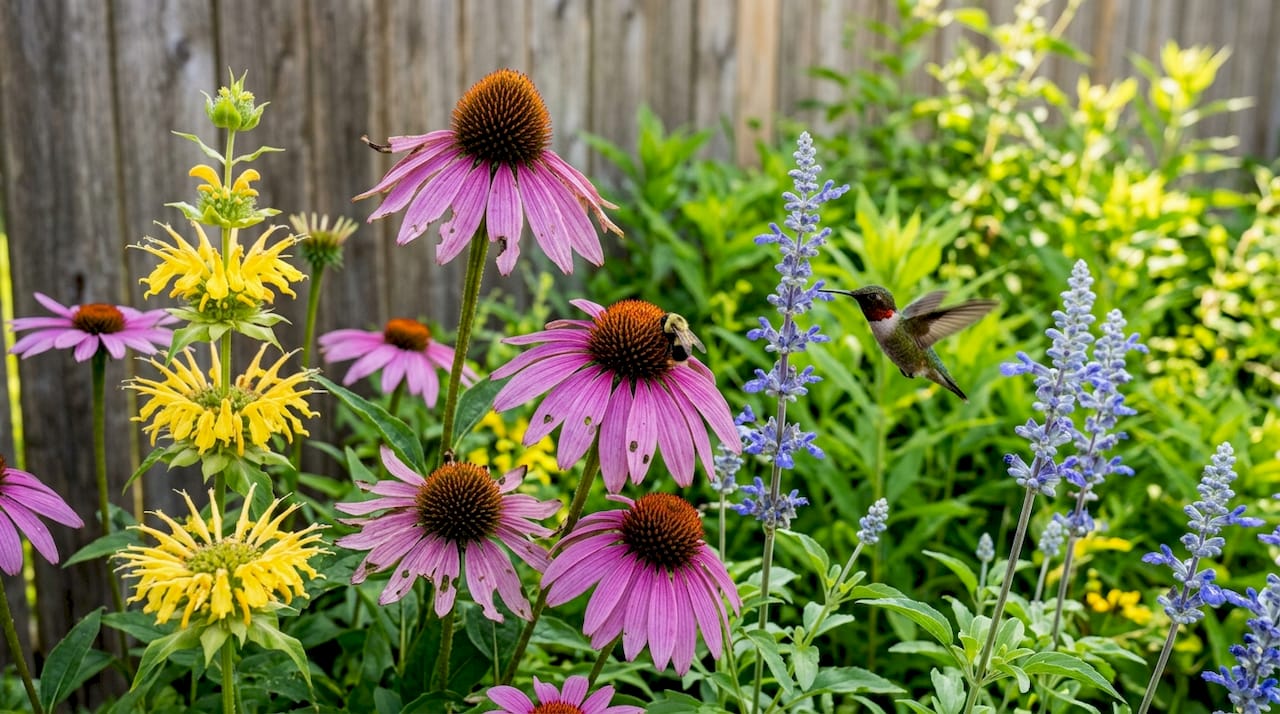
The ecological significance of this practice extends well beyond your yard. Bees, butterflies, moths, beetles, and hummingbirds collectively pollinate the flowering plants that anchor local food webs. When these populations decline, the effects ripple through gardens, farms, and wild ecosystems alike. A home garden designed with pollinators in mind becomes a genuine conservation corridor, especially in urban and suburban areas where natural habitat is fragmented.
The term “pollinator-friendly” is sometimes used loosely to mean simply “has flowers.” The real standard, as defined by organizations like the Xerces Society, requires habitat design addressing all life stages and a pesticide-free environment. That distinction matters when you are choosing plants, managing weeds, or deciding whether to buy pre-treated nursery stock.
What are the essential components of a pollinator-friendly garden?
A garden that genuinely supports pollinators delivers four things consistently: a sequence of blooms, host plants for reproduction, physical habitat features, and freedom from harmful chemicals.
Bloom sequence is the foundation. Year-round pollinator support requires plants that flower in early spring, midsummer, and late fall, covering the full active season for most bee and butterfly species. Snowdrops and crocuses feed early-emerging bumblebees. Coneflowers and bee balm carry the midsummer load. Asters and goldenrod sustain migrating monarchs and native bees into October.
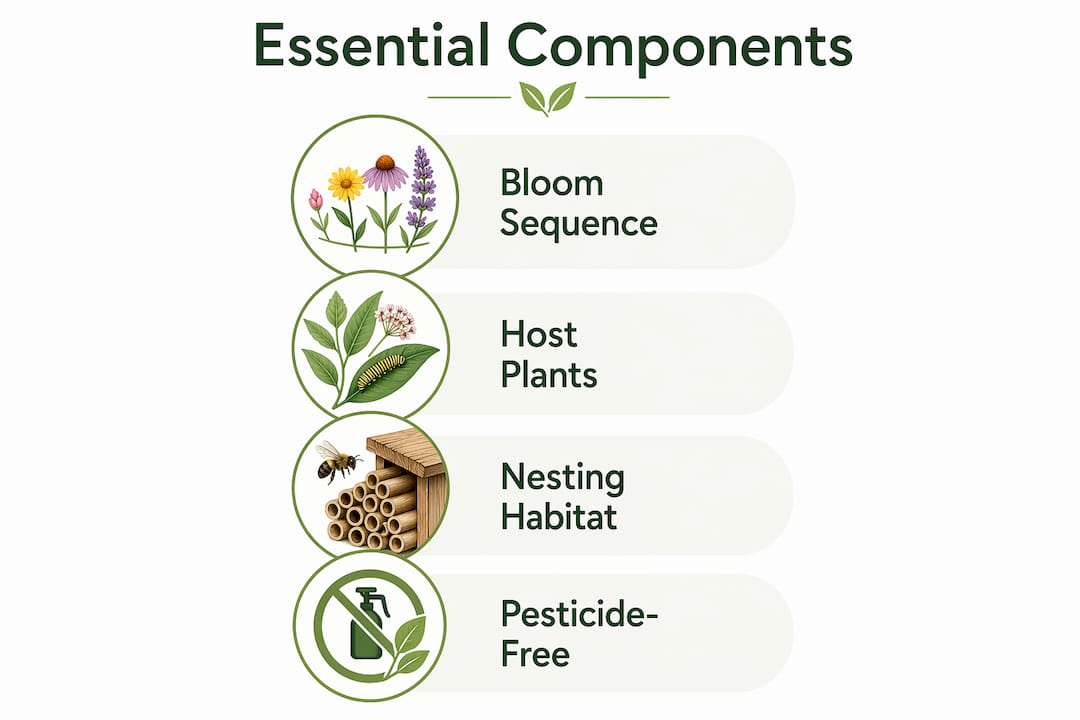
Host plants are non-negotiable for butterflies and moths. Adult butterflies need nectar, but caterpillars require specific host plants to complete their life cycle. Milkweed is the sole host for monarch caterpillars. Parsley, dill, and fennel host black swallowtails. Without these plants, butterflies feed in your garden but cannot reproduce there.
The physical habitat side of a pollinator garden includes features most gardeners overlook:
- Bare soil patches: Ground-nesting bees, which represent roughly 70% of native bee species, require exposed, undisturbed soil to excavate nest tunnels.
- Log and rock piles: Bumble bees and solitary bees use cavities in decaying wood for overwintering and nesting.
- Leaf litter: Many butterfly pupae and moth cocoons overwinter in fallen leaves. Removing all leaf litter in fall eliminates an entire generation.
- Water sources: A shallow dish with pebbles placed at ground level gives bees and butterflies a safe place to drink without drowning. Refresh it every two to three days to prevent mosquito breeding.
Pro Tip: Before buying nursery plants, check the label for phrases like “protected” or “treated.” These indicate systemic neonicotinoid insecticides that persist in plant tissue and harm pollinators that feed on the flowers.
How do native plants compare to cultivated varieties for pollinators?
The conventional wisdom says native plants are always superior for pollinators, and for the most part, that is correct. Native wildtype plants co-evolved with local pollinators, offering the exact flower shapes, bloom times, and chemical signals those insects recognize. A native purple coneflower (Echinacea purpurea) provides more accessible pollen than a double-flowered cultivar bred for ornamental appeal, because the extra petals physically block pollinator access.
That said, recent research complicates the all-or-nothing native argument. A 2026 study from Northwestern University and the Chicago Botanic Garden found that cultivated varieties attract pollinators comparably to wild plants in several cases. Black-eyed Susan ‘Goldsturm’, one of the most widely planted cultivars in American gardens, performed on par with its wild counterpart in attracting native bees. This matters because many gardeners find the “natives only” rule intimidating, and a rigid approach can discourage participation entirely.
| Plant type | Pollinator value | Best use case |
|---|---|---|
| Native wildtype | Highest; co-evolved with local species | Priority choice for any garden bed |
| Cultivar with open flowers | Moderate to high; accessible pollen and nectar | Good complement when wildtype unavailable |
| Double-flowered cultivar | Low; pollen and nectar blocked by extra petals | Avoid in pollinator-focused plantings |
| Non-native species | Variable; depends on flower structure | Use only if bloom gap cannot be filled otherwise |
The practical takeaway is to prioritize natives, especially for host plants, but treat well-chosen cultivars as a legitimate complement rather than a compromise. You can find plant selection guidance that covers both categories with specific variety recommendations.
Pro Tip: When buying cultivars, choose single-flowered forms over double-flowered ones. The difference is visible: single flowers have one layer of petals and an open center, while double flowers look full and dense with no visible stamens.
Which plants best support diverse pollinators through the seasons?
Different pollinator groups have distinct preferences, and a well-designed garden accounts for all of them. Bees favor blue, purple, and yellow flowers with open, accessible centers. Hummingbirds target tubular red and orange flowers like salvia, trumpet vine, and cardinal flower. Butterflies prefer flat-topped or clustered flowers in pink, orange, and purple, such as milkweed, lantana, and Joe-Pye weed.
Planting in clumps of at least three to five plants of the same species dramatically increases foraging efficiency. Pollinators learn flower types and return to familiar patches. A single coneflower surrounded by unrelated plants gets far fewer visits than a cluster of ten.
Here is a seasonal planting framework organized by bloom time and target pollinator:
| Season | Plant | Target pollinator |
|---|---|---|
| Early spring | Crocus, willow, redbud | Bumblebees, mason bees |
| Late spring | Wild geranium, columbine | Native bees, hummingbirds |
| Midsummer | Coneflower, bee balm, milkweed | Bees, monarchs, swallowtails |
| Late summer | Goldenrod, anise hyssop | Native bees, migrating butterflies |
| Fall | Asters, ironweed, sedum | Bumblebees, migrating monarchs |
For gardeners with limited space, container gardening works effectively on balconies and patios. A 12-inch pot with lavender, trailing verbena, and a compact salvia variety can attract bees and butterflies to a fifth-floor apartment balcony. The key is choosing plants with high nectar output and placing containers where pollinators already travel, near windows, railings, or existing plantings.
Butterfly host plants deserve a dedicated spot even in small gardens. A single milkweed plant in a container supports monarch reproduction. A pot of flat-leaf parsley doubles as a kitchen herb and a black swallowtail nursery. These plants do not need to be ornamental centerpieces. They just need to be present.
How to create pollinator habitats beyond planting
Physical habitat and chemical safety are where most pollinator gardens fall short. Planting the right flowers is the visible part. The less visible work determines whether pollinators can actually live, nest, and reproduce in your space.
Follow these steps to build a complete habitat:
- Leave a bare soil patch. Choose a sunny, south-facing spot and remove mulch from an area roughly two feet square. Ground-nesting bees need loose, undisturbed soil. Avoid this area when weeding.
- Build a brush pile or log stack. Stack untreated logs, thick branches, or large rocks in a corner of the garden. The Xerces Society recommends leaving parts of the garden wild with fallen branches and rock piles to support cavity-nesting and ground-nesting bees.
- Install a bee box. Mason bee and leafcutter bee houses with tubes of 5/16-inch diameter attract solitary bees that are highly effective pollinators. Mount them facing east or southeast, four to six feet off the ground.
- Set up a water station. Use a shallow ceramic dish, fill it with clean pebbles or marbles, and add water to just below the pebble surface. Bees land on the pebbles to drink. For a more sustainable setup, passive water harvesting techniques can keep water features topped off with minimal effort.
- Stop using broad-spectrum pesticides. The U.S. Fish and Wildlife Service identifies neonicotinoid insecticides as a primary threat to pollinator health. Replace them with targeted organic alternatives like insecticidal soap for aphids or neem oil for fungal issues, applied in the evening when pollinators are inactive.
- Delay fall cleanup. Wait until temperatures consistently reach 50°F in spring before cutting back stems and removing leaves. Hollow stems house mason bee eggs. Leaf litter shelters moth pupae and overwintering bumblebee queens.
Pro Tip: When mulching garden beds, leave a two-inch gap around plant stems and avoid covering any bare soil patches you have designated for ground-nesting bees. Heavy mulch over the entire bed eliminates nesting habitat even in an otherwise well-planted garden.
For pesticide alternatives that protect both your plants and your pollinators, Lushygardens covers eco-friendly pest control methods that work without harming beneficial insects.
Key takeaways
Pollinator-friendly gardening requires food, habitat, and a pesticide-free environment working together across all pollinator life stages.
| Point | Details |
|---|---|
| Bloom sequence is non-negotiable | Plant for early spring, midsummer, and fall to support pollinators year-round. |
| Host plants enable reproduction | Include milkweed, parsley, and native trees so butterflies and moths can complete their life cycles. |
| Habitat features matter as much as plants | Bare soil, log piles, and leaf litter support nesting and overwintering for the majority of native bee species. |
| Cultivars can complement natives | Single-flowered cultivars like black-eyed Susan ‘Goldsturm’ attract pollinators comparably to wildtype plants. |
| Pesticide avoidance is the baseline | Systemic neonicotinoids in nursery plants and garden sprays harm pollinators even when applied to non-target plants. |

Why I think most pollinator gardens stop halfway
Most gardeners who commit to pollinator-friendly practices nail the planting side. They research native wildflowers, add milkweed, and feel good about the coneflowers blooming in July. What they rarely address is the habitat infrastructure, and that is where the real conservation value lives.
I have seen beautifully planted gardens with zero ground-nesting habitat because every square inch was mulched. I have seen gardeners buy pre-treated nursery plants labeled “pollinator-friendly” without realizing the neonicotinoids in the soil would harm the very bees they were trying to attract. The flower selection gets all the attention. The soil, the debris, the chemical history of the plants, those get ignored.
The research from Northwestern and the Chicago Botanic Garden is genuinely liberating for gardeners who feel paralyzed by the natives-only standard. You do not need a perfect wildflower meadow to make a difference. A thoughtfully chosen mix of natives and open-flowered cultivars, combined with bare soil, a water dish, and zero systemic pesticides, outperforms a “pure native” garden that is heavily mulched and chemically maintained.
Start with one change. Skip the fall cleanup this year. Leave the stems standing and the leaves where they fall. That single decision protects more overwintering pollinators than adding ten new plant species. Build from there. The ecological rewards compound quickly, and so does the satisfaction of watching a garden that genuinely functions as habitat.
— Povilas
How Lushygardens helps you build a thriving pollinator garden
Lushygardens is built for gardeners who want practical, research-backed guidance rather than generic advice. Whether you are starting your first pollinator bed or refining an established garden, the resources here cover every stage. The plant care routine checklist gives you a daily and weekly maintenance framework that keeps pollinator-friendly plants healthy through the season. For timing your bloom sequence correctly, the seasonal plant care guide walks through what to plant, prune, and protect month by month. You can also explore the full pollinator gardening resource to deepen your understanding of how plant diversity drives garden ecosystem health.
FAQ
What is the simplest definition of pollinator-friendly gardening?
Pollinator-friendly gardening is the practice of designing a garden to provide food, nesting habitat, and a pesticide-free environment for pollinators like bees, butterflies, and hummingbirds. It addresses all pollinator life stages, not just adult feeding.
What plants attract bees most effectively?
Bees are most attracted to blue, purple, and yellow open-centered flowers including lavender, coneflower, bee balm, borage, and goldenrod. Native wildtype plants generally outperform double-flowered cultivars because their pollen and nectar are physically accessible.
Do I need a large yard to create a pollinator habitat?
No. Container gardening with high-nectar plants like lavender, salvia, and verbena works on balconies and small patios. A single milkweed plant in a pot supports monarch butterfly reproduction.
Are cultivated garden plants useful for pollinators?
Yes, with conditions. Research from Northwestern University shows that single-flowered cultivars like black-eyed Susan ‘Goldsturm’ attract pollinators comparably to wild plants. Double-flowered cultivars with blocked pollen access are the ones to avoid.
How do I avoid accidentally harming pollinators in my garden?
Stop using broad-spectrum and systemic insecticides, and check nursery plant labels for “treated” or “protected” language indicating neonicotinoid use. The Xerces Society identifies pesticide avoidance as the single most important factor in a successful pollinator garden.
Recommended
- Planting for Pollinators: Boost Your Garden Biodiversity – Lushy Gardens
- Best pollinator plants for home gardens in 2026 – Lushy Gardens
- 7 Must-Have Pollinator Friendly Plants for Urban Gardens – Lushy Gardens
- Importance of Pollinators: Boosting Garden Health and Yield – Lushy Gardens

I’m Eleanor, a seasoned gardener with over three decades of experience tending to Mother Nature’s creations. Through Lushy Gardens, I aim to share my wealth of knowledge and help fellow plant enthusiasts uncover the wonders of gardening. Let’s dive into this journey together, one leaf at a time.


