
Table of Contents
TL;DR:
- Most garden insects are harmless or beneficial, and they support plant health through pest control and pollination. Building habitat diversity and practicing integrated pest management promote natural pest regulation and resilience in your garden. Patience, observation, and habitat support lead to a thriving ecosystem that reduces reliance on chemicals.
Beneficial insects are defined as insects that perform services supporting plant health, including pollination, pest predation, and parasitism of harmful species. The role of beneficial insects in any garden is far larger than most gardeners realize. About 90% of garden insects are not destructive, with only 1%–10% classified as pests. That means the vast majority of insects you see in your beds are either harmless or actively working in your favor. Understanding this changes how you garden entirely.
How do beneficial insects control garden pests naturally?
Beneficial insects control pests through two primary mechanisms: direct predation and parasitism. Predators physically consume pest insects, while parasitoids lay eggs inside or on pest insects, killing them as the larvae develop. Both strategies reduce pest populations without any chemical input from you.
Predatory insects include some of the most recognizable garden visitors:
- Ladybugs consume aphids, mites, and small caterpillars at every life stage.
- Lacewings are especially aggressive as larvae, earning the nickname “aphid lions.”
- Ground beetles hunt soil-dwelling pests like cutworms and slugs overnight.
- Spiders are not insects but function as critical predators. Gardens with 1,000 spiders per 100 square meters can eliminate over 300,000 insects annually. That level of control is impossible to replicate with sprays alone.
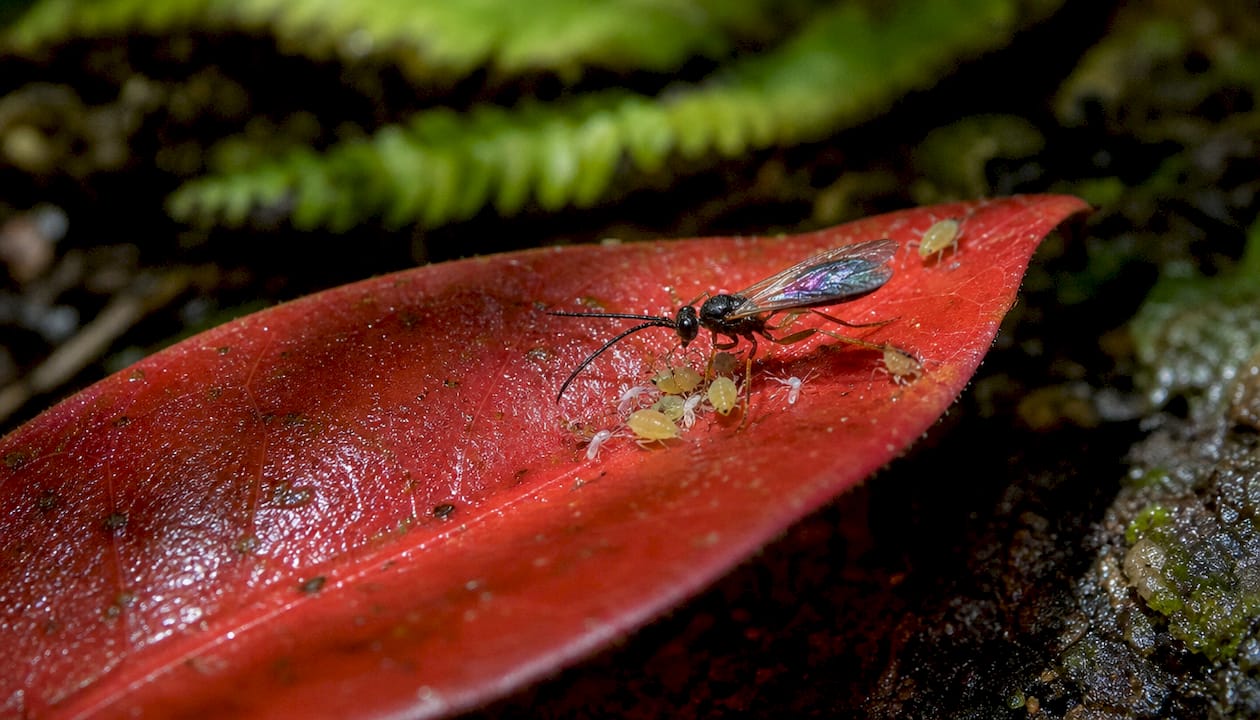
Parasitoid wasps operate more quietly but just as effectively. A female wasp lays her eggs inside an aphid or caterpillar. The larvae consume the host from within, killing it. Tan-colored aphid corpses, called “mummies,” are the visible sign that parasitoid wasps are working in your garden. Leave those mummies in place. Removing them eliminates the next generation of your best pest controllers.
A single hoverfly larva can consume 100–300 aphids during its development. That is a meaningful dent in an aphid colony before the pest even reaches damaging numbers.
Pro Tip: Avoid broad-spectrum pesticides even when pest pressure feels urgent. These sprays kill predatory beetles, lacewings, and spiders alongside the target pest, leaving your plants more vulnerable in the weeks that follow.
What is the pollination role of beneficial insects?
Pollinators are the most visible beneficial insects, and their impact on garden productivity is direct and measurable. Bees, butterflies, and hoverflies transfer pollen between flowers, enabling fruit set, seed production, and vegetable yields. Without them, most food crops produce little or nothing.
Pollinator diversity matters as much as pollinator numbers. Different species visit different flower shapes and bloom times. A garden visited by bees, native solitary bees, butterflies, and hoverflies achieves far more complete pollination than one relying on a single species. This is why monoculture plantings underperform even when bees are present.
Key pollinators to support in your garden include:
- Honeybees and native bees, which are the primary pollinators for most vegetables and fruit trees.
- Bumblebees, which use buzz pollination to release pollen from tomatoes and peppers that other bees cannot access.
- Hoverflies, which mimic bees in appearance and serve as critical backup pollinators when bee populations are low.
- Butterflies and moths, which pollinate many flowering perennials and support broader ecosystem biodiversity.
Planting flowering plants with accessible nectar supports pollinator populations throughout the season. Shallow, open-faced flowers are especially important because many pollinators have short mouthparts and cannot reach nectar in tubular blooms.
How to attract and sustain beneficial insects in your garden
Creating a garden that supports beneficial insects year-round requires more than planting a few flowers. It requires thinking about food, shelter, water, and lifecycle needs across every season.
Follow these steps to build a genuinely supportive habitat:
- Plant a succession of blooms from april through october. Continuous bloom succession from spring to fall prevents beneficial insects from leaving your garden due to food gaps. When one plant finishes flowering, another should be starting.
- Choose umbel-family plants. Beneficial insects with short mouthparts prefer shallow, open flowers from the Umbelliferae family. Dill, fennel, parsley, and Queen Anne’s lace are all excellent choices. Lavender and yarrow also perform well.
- Leave undisturbed soil patches. Many solitary bees nest in bare ground. A small patch of undisturbed soil near your beds gives them a place to overwinter and reproduce.
- Add brush piles or hollow stems. Lacewings, beetles, and parasitoid wasps overwinter in plant debris. Cutting back all stems in fall removes their shelter. Leave some standing through winter and cut them in late spring instead.
- Provide a shallow water source. A dish with pebbles and clean water gives small insects a place to drink without drowning. Refresh it every few days to prevent mosquito breeding.
- Learn to identify larvae. Lacewing larvae look nothing like adult lacewings. They are small, spiny, and often mistaken for pests. Killing them by mistake is one of the most common errors gardeners make.
Planting succession blooms and leaving bare soil patches can reduce aphid pressure by approximately 50% within two seasons. That result comes from habitat design, not chemical intervention.
Pro Tip: Resist the urge to deadhead every flower immediately. Seed heads and spent blooms provide food and shelter for beneficial insects well into fall. A slightly “untidy” garden is often a healthier one.
What is Integrated Pest Management and how does it use beneficial insects?
Integrated Pest Management, or IPM, is the recommended framework for balancing pest control with preserving beneficial insect populations. IPM involves identifying pests, setting damage thresholds, and choosing methods that minimize risk to beneficial species. It treats chemical intervention as a last resort, not a first response.
The core IPM principles that protect beneficial insects are:
- Correct identification first. Many gardeners spray at the sight of any insect. Correct identification separates a pest from a predator before any action is taken. Lushygardens offers a detailed pest identification guide to help you tell them apart.
- Set a damage threshold. A few chewed leaves do not justify a spray. Damage thresholds define the point at which pest pressure actually threatens plant health, not just aesthetics.
- Monitor before acting. Watch your plants for several days before intervening. Beneficial insects often arrive and reduce pest numbers within a week if given the chance.
- Choose targeted controls. When intervention is necessary, use the lowest-risk option. Insecticidal soap targets soft-bodied pests without the broad kill of synthetic pyrethroids.
- Avoid spraying during bloom or when beneficial activity is visible. Spraying while pollinators are active causes direct mortality. Early morning or evening applications reduce collateral damage.
IPM leads to gardens that become more resilient each season. Pest outbreaks grow less severe as predator populations establish and stabilize. Tolerating some early pest presence allows beneficial insect populations to build a food base and sustain themselves long-term. This is the counterintuitive truth that separates experienced ecological gardeners from beginners.
For gardeners managing pests without synthetic chemicals, eco-friendly pest solutions that work alongside beneficial insects are worth understanding before any outbreak occurs.
Common misconceptions about beneficial insect roles
Several persistent myths cause gardeners to accidentally undermine the very insects helping their plants. Clearing them up protects your garden’s natural defenses.
- Myth: All insects are pests. The reality is that 90% of garden insects are beneficial or harmless. Treating every insect as a threat destroys the ecosystem your plants depend on.
- Myth: Eliminating all pests immediately is best. Killing every pest removes the food source that keeps predatory insects in your garden. No prey means no predators. The next pest wave arrives with no natural check.
- Myth: Any flowering plant attracts beneficial insects. Not all flowers are equally useful. Double-flowered cultivars bred for appearance often have inaccessible nectar. Species-type flowers and natives consistently outperform ornamental hybrids for insect support.
- Myth: Pesticides only kill the target pest. Chemical pesticides disproportionately harm predatory arachnids and interfere with natural pest regulation through bioaccumulation across the food chain. The predators that return slowest after a spray are often the most valuable ones.
- Myth: Results should be immediate. Ecological balance develops over multiple seasons. A garden redesigned to support beneficial insects in year one will show measurably better pest control by year two or three. Patience is not optional. It is the method.
Learning to identify common vegetable pests accurately is the fastest way to stop treating beneficial insects as threats.
Key Takeaways
Beneficial insects control pests, pollinate plants, and build garden resilience, and supporting them requires habitat design, correct identification, and tolerance for short-term pest presence.
| Point | Details |
|---|---|
| Most insects are beneficial | About 90% of garden insects are harmless or helpful; only 1%–10% are true pests. |
| Predators and parasitoids do heavy lifting | A single hoverfly larva consumes up to 300 aphids; parasitoid wasps leave “mummies” as proof of control. |
| Bloom succession is non-negotiable | Continuous flowers from april through october keep beneficial insects fed and present all season. |
| IPM protects your allies | Setting damage thresholds and avoiding broad-spectrum sprays preserves the predators doing your pest control. |
| Patience builds resilience | Ecological balance takes multiple seasons; tolerating early pest presence allows predator populations to establish. |

What I’ve learned from letting the garden do its own work
I spent years reaching for a spray bottle the moment I spotted aphids on my fennel. The results were predictable: the aphids came back faster each time, and the ladybugs I used to see everywhere slowly disappeared. It took one season of deliberate restraint to understand what I had been doing wrong.
The shift that changed everything was learning to read the garden as a system rather than a collection of individual plants. When I stopped spraying and started planting dill, yarrow, and parsley in succession, the hoverflies arrived within weeks. By midsummer, the aphid colonies that had plagued my brassicas for years were visibly smaller, and I had done nothing except stop interfering.
The hardest part is not the planting. It is the waiting. Watching a pest population build while trusting that predators are coming requires a kind of confidence that only experience gives you. I now treat a moderate aphid infestation as a sign that something good is about to happen, not a crisis. That mindset shift is, in my view, the real skill in ecological gardening.
My honest recommendation: spend one season doing nothing but observing. Note which insects appear, when they arrive, and what they do. You will learn more from that observation than from any spray schedule. The garden already knows how to balance itself. Your job is to stop getting in the way.
How Lushygardens helps you work with beneficial insects
Lushygardens covers the practical side of building a garden that works with nature rather than against it. The gardening basics guide walks beginners through foundational decisions, including plant selection and pest management, with beneficial insect support built into the advice from the start. For gardeners ready to go further, the organic pest management guide covers targeted, low-risk control methods that preserve your predator populations. Whether you are starting your first bed or refining an established garden, Lushygardens gives you the specific, research-grounded guidance to make it work.
FAQ
What are the main types of beneficial insects?
Beneficial insects fall into three categories: pollinators (bees, butterflies, hoverflies), predators (ladybugs, lacewings, ground beetles), and parasitoids (parasitic wasps and flies). Each group performs a distinct function in supporting plant health and controlling pests.
How do I know if beneficial insects are already in my garden?
Look for ladybug adults and larvae on aphid colonies, tan “mummy” aphids indicating parasitoid wasp activity, and hoverflies hovering near open flowers. These are reliable signs that natural pest control is already operating.
Will beneficial insects eliminate all pests?
Beneficial insects reduce pest populations significantly but rarely eliminate them entirely. A low level of pest presence is normal and necessary to sustain predator populations through the season.
Do I need to buy beneficial insects, or will they come naturally?
Purchased insects often disperse quickly if the habitat does not support them. Planting the right flowers, reducing pesticide use, and providing shelter attracts and retains local populations far more reliably than purchased releases.
How long does it take for beneficial insects to make a difference?
Noticeable pest reduction typically appears within one to two seasons after habitat improvements. Tolerating some early pest presence during this period allows predator populations to establish and sustain themselves.
Recommended
- Importance of Pollinators: Boosting Garden Health and Yield – Lushy Gardens
- Planting for Pollinators: Boost Your Garden Biodiversity – Lushy Gardens
- Master Natural Pest Control for a Thriving Garden – Lushy Gardens

I’m Eleanor, a seasoned gardener with over three decades of experience tending to Mother Nature’s creations. Through Lushy Gardens, I aim to share my wealth of knowledge and help fellow plant enthusiasts uncover the wonders of gardening. Let’s dive into this journey together, one leaf at a time.


