
Table of Contents
TL;DR:
- Getting outside to garden teaches children responsibility, science skills, and patience through real-world experiences.
- Choosing fast-growing, dramatic plants, age-appropriate activities, and engaging tools help sustain their interest throughout the season.
Getting outside, away from screens, and into the dirt is one of the best things you can do with your kids. Gardening with children does more than fill an afternoon. It builds science skills, encourages healthy eating, and teaches patience in a way no app can replicate. School garden participation has been shown to increase science achievement and environmental awareness in children ages 8 to 12. This guide covers everything from setting up a safe garden space to choosing the right plants and keeping kids engaged week after week.
Table of Contents
- Key takeaways
- Gardening with children: setting up for success
- Activities matched to your child’s age
- Choosing the best plants for kids
- Keeping kids engaged through the whole season
- Handling common challenges
- My take on what this really teaches
- Start your family garden with the right resources
- FAQ
Key takeaways
| Point | Details |
|---|---|
| Age-segmented activities work best | Match gardening tasks to your child’s developmental stage to keep them genuinely engaged. |
| Fast-growing plants build momentum | Choose plants like marigolds and beans that show results quickly so kids stay motivated. |
| A garden journal deepens learning | Recording observations links cause and effect and reinforces math and science skills naturally. |
| Setup matters for safety and fun | Child-sized tools and raised beds make gardening safer and more accessible for small hands. |
| Failure is part of the lesson | Dead plants and pest problems are low-stakes chances to practice resilience and problem-solving. |
Gardening with children: setting up for success
Before seeds touch soil, a little preparation goes a long way. The right tools and space make the difference between a child who loves the garden and one who loses interest after day two.
Choosing the right tools and space
Ergonomic tools with child-sized handles protect small hands and give kids real control over their work. Look for lightweight trowels, small rakes, and watering cans with narrow spouts so water goes where it is aimed. Avoid toy sets that break easily. Real tools scaled for kids build confidence and respect for the work.
For space, raised beds are the single best investment you can make. Raised beds reduce soil compaction and give children a clearly defined area that feels like theirs. If you have no yard, containers on a balcony or patio work just as well. A five-gallon bucket can grow a tomato plant. A window box can grow herbs. Space is rarely the real obstacle.
| Tool or Setup | Best Age Range | Safety Note |
|---|---|---|
| Lightweight watering can | 2 and up | Choose a size that holds under one liter to avoid spills |
| Child trowel and fork | 4 and up | Supervise digging near hard surfaces |
| Raised bed (8 inches deep) | All ages | Prevents bending fatigue and defines boundaries |
| Container or bucket garden | All ages | Check for drainage holes to avoid root rot |
| Hand rake | 5 and up | Avoid metal tines for children under 7 |
Safety basics to cover before you start:
- Always wash hands after handling soil, especially before eating
- Keep garden tools stored safely after each session
- Avoid commercial pesticides in shared garden spaces with children
- Teach children to ask before touching unfamiliar plants
Pro Tip: Repurpose old colanders, wooden crates, or even rain boots as planters. Children find quirky containers irresistible, and it makes the garden feel personal and playful from the start.
Activities matched to your child’s age
One of the biggest mistakes parents make when starting a garden with kids is treating a four-year-old and a ten-year-old the same. Experts recommend age-segmented gardening activities because the tasks that thrill a toddler will bore a preteen, and the tasks that challenge a preteen will overwhelm a toddler.
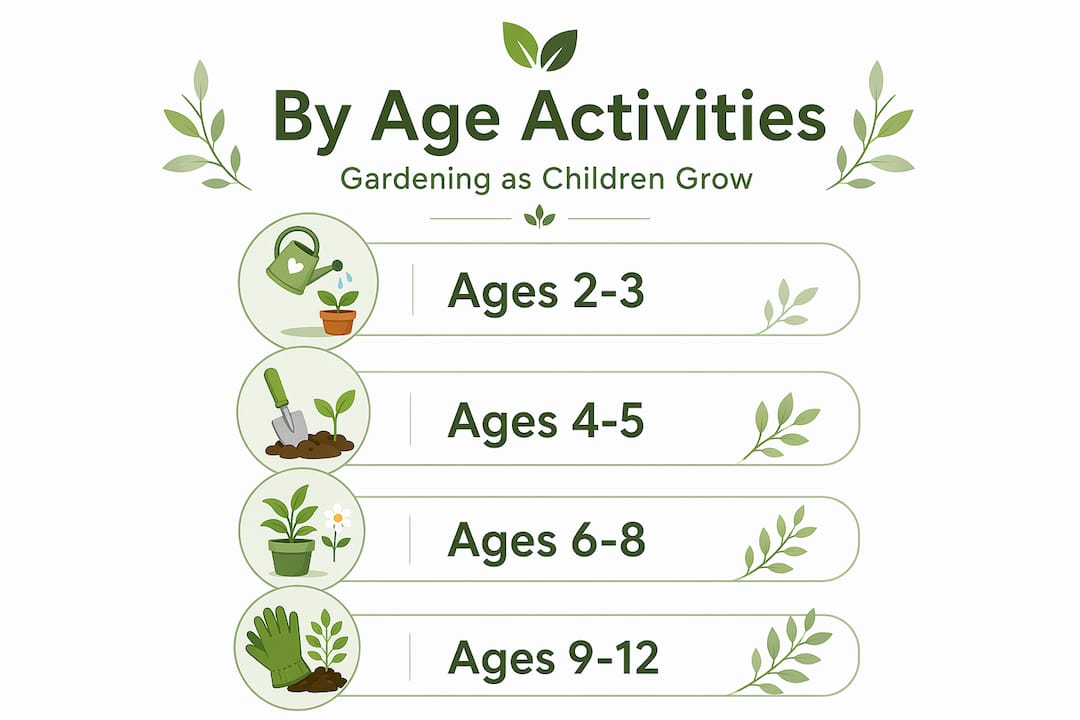
Toddlers (ages 2 to 4)
At this age, the goal is sensory engagement, not results. Toddlers learn through touch, smell, and movement.
- Fill a sensory tub with potting soil, small rocks, and leaves for free exploration
- Let them water plants with a small watering can, even if they overdo it
- Collect leaves, sort them by size, and press them in a notebook
- Poke holes in soil with their fingers before you drop in seeds
Young children (ages 5 to 8)
Children in this range are ready for real tasks with visible outcomes. Seed planting and watching germination are deeply satisfying at this age.
- Plant sunflower or bean seeds and track their height weekly with a ruler
- Run a garden scavenger hunt (find something yellow, something with a bug, something fuzzy)
- Water on a set schedule and check off a simple chart after each session
- Help harvest herbs and use them in a meal the same day
Preteens (ages 9 to 12)
This group can handle complexity and loves a challenge or competition.
- Start a composting system and take responsibility for turning it weekly
- Design a pollinator garden by researching which flowers attract bees and butterflies
- Measure plant growth over time and create a simple graph
- Run a “biggest vegetable” challenge with a sibling or neighbor
Pro Tip: When a child shows strong interest in one aspect of the garden, dig deeper there instead of pushing a balanced curriculum. A kid obsessed with worms will learn more biology following that obsession than from a structured lesson plan.
For mixed-age families, pair a younger child with an older one for a specific task. The older child feels responsibility, and the younger one gets a model to follow. Both stay engaged longer.
Choosing the best plants for kids
Plant selection is where many family gardens quietly fail. Parents choose what they want to grow, and children lose interest when nothing exciting happens for three weeks. The fix is simple: choose plants that respond fast and look dramatic.
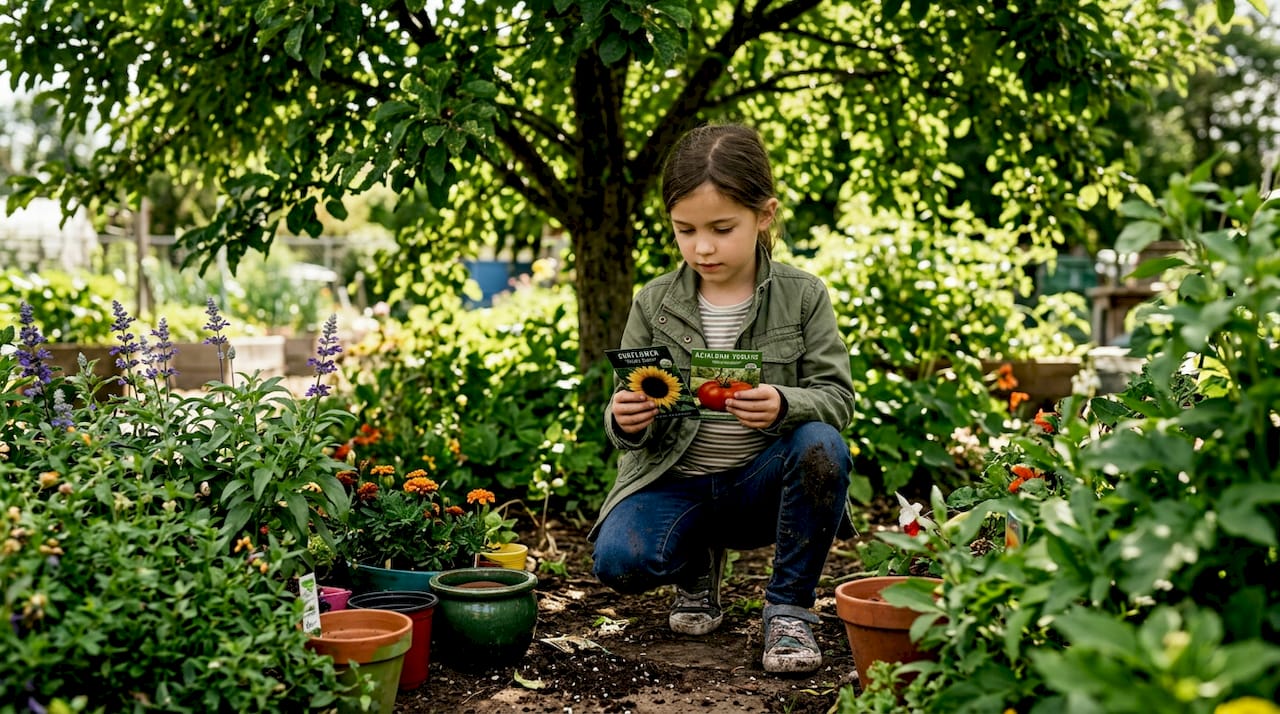
Marigold seeds germinate in 7 to 14 days, making them one of the best first plants for children. Sunflowers grow tall enough to become a landmark in the yard, and bean seeds swell visibly within days of planting, which is practically magic to a six-year-old. For vegetables, radishes are ready to harvest in as few as 25 days. Cherry tomatoes produce fruit all season and are perfect for picking and eating straight from the vine.
| Plant | Days to Germinate | Why Kids Love It |
|---|---|---|
| Marigold | 7 to 14 days | Bright color, fast bloom, edible petals |
| Sunflower | 7 to 10 days | Grows taller than adults, dramatic presence |
| Runner bean | 7 to 14 days | Seeds visibly sprout quickly, satisfying harvest |
| Radish | 3 to 7 days | Ready to eat in under a month |
| Cherry tomato | 6 to 14 days | Long harvest window, sweet reward |
For indoor options or smaller spaces, herbs like basil, mint, and chives grow quickly in a sunny windowsill. They connect children to cooking in a direct way, and you can find more kid-safe indoor options if you are working with limited outdoor access.
One underrated strategy: let children pick the plants. Give them two or three options and let them choose. Ownership over that decision translates directly into motivation to care for the plant. Children who grow their own vegetables consume 2 to 3 additional servings of fruits and vegetables per week, with benefits lasting over six months. The act of choosing what to grow is part of what makes that happen.
Keeping kids engaged through the whole season
Getting children excited on planting day is easy. Keeping them engaged six weeks later when the garden hits a slow stretch is where most family gardens stall. These strategies help maintain momentum across the full growing season.
Set short-term goals that create a sense of competition or achievement. Challenge your child to grow the longest bean, count how many bees visit the flowers in ten minutes, or find the most interesting bug. These mini-challenges make routine garden visits feel purposeful.
A garden journal is one of the most effective tools available. Journals with drawings and measurements sharpen observation skills and reinforce math concepts in a hands-on way. Ask your child to draw the plant each week and write down its height. Over a month, that journal becomes a record of real scientific data they collected themselves.
Introduce composting gradually. Children as young as three or four can participate in basic composting by adding vegetable scraps to a bin. Older children can manage turning and monitoring. It teaches the full cycle of growing food without adding pressure.
- Keep visits short: 15 to 20 minutes is plenty for most children
- Let children lead at least part of every session
- Celebrate small wins, like the first sprout or first flower bud
- Photograph progress to show how far the garden has come
Pro Tip: During slow growth periods, shift focus to the soil, the bugs, and the ecosystem around the plants rather than the plants themselves. A magnifying glass can turn a boring week into a fascinating one.
You can also explore gardening journal benefits in more detail if you want to build a stronger documentation routine with older children.
Handling common challenges
Even the best-planned family garden runs into trouble. Knowing how to handle it without frustration makes all the difference.
Mess is the number one concern for parents. Accept it early. Soil on clothes, muddy boots, and overwatered pots are part of the process. Keep a set of dedicated garden clothes for each child and the cleanup becomes a ritual rather than a fight.
Attention spans vary wildly. A child who was thrilled to plant seeds may show no interest in watering two weeks later. This is normal. Avoid forcing garden visits. Instead, bring the garden to the child occasionally by harvesting herbs to use in dinner or cutting flowers to put on the table.
When plants fail or pests appear, resist the urge to fix it before the child notices. Gardens demonstrate delayed gratification and failures teach recovery and problem-solving in a low-stakes environment. A plant eaten by slugs becomes an investigation. Where did they come from? How do we protect the next plant?
“The garden is one of the few places children experience real consequences and real rewards without any adult manufacturing the outcome.”
Supervision matters most with tools and soil. Keep a simple rule: tools go back in the basket before anyone goes inside. For very young children, supervise any digging with pointed tools directly. And always, always end a garden session with handwashing.
My take on what this really teaches
I have spent years watching children in gardens, and the thing that strikes me most is how different the garden is from almost every other learning environment children experience. In my experience, the biggest breakthroughs come not from structured lessons but from the moments no one planned.
I have seen a seven-year-old spend thirty minutes watching a bee visit the same flower repeatedly and come away with more genuine curiosity about biology than any worksheet would produce. I have watched a nine-year-old cry over a dead tomato plant and then, unprompted, ask what went wrong and how to do it better next time. That is the kind of learning that sticks.
What I have found is that parents often underestimate how little they need to teach and how much they just need to show up. Your job is to create the conditions and then get out of the way. A child who is trusted with a real task in a real garden builds self-confidence alongside their plants.
The garden teaches responsibility because the plants actually depend on the child’s care. It teaches science because the questions the garden raises are genuinely interesting. And it teaches patience in the only way patience can be taught: by requiring it.
My strongest advice is to resist the pressure to make every garden session educational in an obvious way. Let it be play. Let it be messy. The learning is already there.
— Povilas
Start your family garden with the right resources
If this article has you ready to dig in, Lushygardens has the practical guides to back you up at every step. The beginner’s gardening guide is the best starting point for parents who are new to growing anything and want a clear, no-stress path forward. For keeping your garden healthy season to season, the seasonal maintenance guide walks you through what to do and when. You will also find a full overview of raised bed gardening and step-by-step support for setting up a vegetable garden from scratch. Lushygardens is built for gardeners at every level, including the ones who are just getting started with a curious five-year-old and a packet of sunflower seeds.
FAQ
What age can children start gardening?
Children as young as two can participate in simple gardening activities like watering and sensory soil play. More structured tasks like seed planting and harvesting are suitable from around age four or five.
What are the easiest plants for kids to grow?
Marigolds, sunflowers, runner beans, and radishes are among the best choices because they germinate quickly and produce visible results within days or weeks. Fast results keep children motivated and connected to the process.
How do you keep kids interested in the garden all season?
Short-term challenges, a garden journal, and child-led exploration help maintain engagement. Keeping sessions brief and fun, around 15 to 20 minutes, prevents burnout during slower growth periods.
Is composting safe for young children?
Basic composting, like adding fruit and vegetable scraps to a bin, is safe for children as young as three or four with adult supervision. Older children can take on more active roles like turning the compost and monitoring moisture.
How does gardening benefit children’s education?
School garden participation improves science test scores and environmental awareness for children ages 8 to 12. The garden also reinforces math, observation, and critical thinking in a hands-on context that classroom lessons rarely match.
Recommended
- Step-by-step garden planning guide for home growers – Lushy Gardens
- Seasonal Garden Maintenance: Step-by-Step Success Guide – Lushy Gardens
- Vegetable gardening basics: step-by-step guide for beginners – Lushy Gardens
- Step-by-step beginner vegetable garden setup guide – Lushy Gardens

I’m Eleanor, a seasoned gardener with over three decades of experience tending to Mother Nature’s creations. Through Lushy Gardens, I aim to share my wealth of knowledge and help fellow plant enthusiasts uncover the wonders of gardening. Let’s dive into this journey together, one leaf at a time.


