
Table of Contents
TL;DR:
- Interplanting involves deliberately growing multiple plant species together to promote ecological benefits and optimize space. Success relies on careful planning of timing, spacing, and resource needs, with benefits including improved biodiversity, soil health, and potential yield increases. Effective implementation requires observation, adjustment, and understanding that outcomes vary based on local conditions and management practices.
Mixing plants together sounds like a simple win. Throw in some basil next to your tomatoes, tuck flowers between your beans, and watch your garden thrive. Many home gardeners do exactly this, assuming that any combination of plants will automatically lead to bigger harvests and fewer pests. The reality is more nuanced. Scientific research confirms that interplanting, which means growing two or more species in the same space, delivers real benefits, but only when you choose the right plants, time them well, and design your layout with intention. This guide breaks down exactly how to make it work.
Table of Contents
- What is interplanting? Definitions and core concepts
- How does interplanting work? Methods, examples, and common myths
- Ecological and yield benefits: what research tells us
- How to design an interplanted garden: Practical steps and pitfalls
- Our take: What most guides miss about interplanting
- Helpful resources to fuel your gardening journey
- Frequently asked questions
Key Takeaways
| Point | Details |
|---|---|
| True definition | Interplanting means growing different crops together, but success depends on thoughtful planning. |
| Evidence-based results | Yield and ecological benefits vary by plant pairing, garden design, and management. |
| Planning is crucial | Choose compatible plants and adjust spacing and timing for your conditions to maximize benefits. |
| Avoid one-size-fits-all | Not all combinations work everywhere; test and adapt for your garden’s unique needs. |
| Measure success | Use tools like land equivalent ratio or side-by-side harvests to see what works best in your setting. |
What is interplanting? Definitions and core concepts
Interplanting means deliberately growing two or more plant species in the same area at the same time, with the goal of gaining mutual benefits. The key word is “deliberately.” This is not accidental crowding. It is a planned strategy for making your garden space work harder.
You have probably heard related terms like companion planting and intercropping. These overlap but are not identical. Intercropping is typically used in agricultural contexts to describe growing two or more crops in rows or patches simultaneously. Companion planting refers more broadly to pairing plants believed to help each other. Interplanting sits between both ideas, often used by home gardeners to describe any intentional mixing of species.
All of these concepts belong under a larger umbrella called polycultures. As Illinois Extension notes, interplanting is part of a broader idea of polycultures, diversifying crops in the same area to support soil coverage, biodiversity, and sometimes pest and pollinator balance. That framing helps you see the big picture: you are not just trying to get tomatoes and basil to “like” each other. You are building a more resilient growing system.
Here is what interplanting is designed to achieve:
- Better soil coverage: Ground-level plants fill gaps and reduce moisture loss and weed pressure.
- Increased biodiversity: More plant species attract more beneficial insects and support a balanced ecosystem.
- Pest and pollinator support: Diverse plantings can disrupt pest cycles and draw in helpful bugs.
- More efficient use of space: Tall and short plants can share vertical and horizontal zones without competing directly.
“Polyculture thinking is not about magic pairings. It is about designing diversity that serves real ecological functions in your specific garden.”
One point worth emphasizing early: no plant combination works universally. What succeeds in a garden in Virginia may not produce the same results in a Minnesota plot. Soil type, climate, and plant varieties all change the outcome. That is why companion planting explained is best understood as a flexible framework, not a fixed recipe. If you want to build a solid foundation before experimenting with specific pairings, the companion planting guide at Lushy Gardens is a helpful starting point.
How does interplanting work? Methods, examples, and common myths
Understanding the concept is one thing. Seeing how it plays out in actual soil is another. The most successful interplanting designs rely on three factors: timing, spacing, and compatible resource needs.
Timing means staggering plant growth stages so crops do not compete during their peak periods. A fast-maturing radish planted alongside slow-growing carrots uses and leaves space before the carrots need it. This is called temporal interplanting, and it is one of the easiest ways to add yield without adding square footage.
Spacing ensures that taller plants do not shade out shorter ones that need full sun, and that root systems with similar depths are not fighting for the same nutrients. Corn, beans, and squash, the classic “Three Sisters” planting from Native American agricultural tradition, work partly because each crop occupies a different vertical and horizontal niche.
Compatible resource needs is where most beginners go wrong. Plants that both demand heavy nitrogen, high moisture, and full sun will compete intensely, often reducing yields for both. Matching plants with complementary needs is the real engine behind interplanting success.
Research backs this up. Intercropping benefits are real, but context dependent and can vary by year, species pairing, and management. This is important: do not let any gardening article or social media post convince you that a specific pairing is guaranteed to work in your garden.
Here are four practical interplanting methods ranked from simplest to most complex:
- Row interplanting: Alternate rows of two different crops. Great for beginners.
- Strip interplanting: Grow crops in alternating wider strips, preserving the ability to manage each crop separately while reducing the monoculture effect.
- Mixed planting: Scatter or blend two or more species throughout a bed. Works well for pollinator support and aesthetic gardens.
- Relay planting: Introduce a second crop partway through the first crop’s growth cycle. Maximizes temporal efficiency.
| Method | Skill level | Best for | Main challenge |
|---|---|---|---|
| Row interplanting | Beginner | Small vegetable plots | Matching row spacing |
| Strip interplanting | Intermediate | Larger raised beds | Managing transitions |
| Mixed planting | Intermediate | Flowers and vegetables | Weed identification |
| Relay planting | Advanced | Succession harvests | Timing coordination |
Now for the myths. The most persistent one is that basil repels tomato pests. This makes intuitive sense because basil smells strong to us. But garden-scale evidence is limited and not consistent across growing conditions. The UC Master Gardener resource points out that companion planting is not always the same as interplanting, and many commonly repeated companion claims lack strong garden-scale evidence. Outcomes depend on densities, ratios, and relative planting times.
Pro Tip: Instead of relying on traditional companion planting lists, choose two plants whose root depths, light preferences, and nutrient needs differ clearly. That gives you a measurable reason to expect compatibility, not just folklore.
When you are figuring out vegetable garden layouts, plan your interplanting zones before you plant, not after you realize you have empty gaps.
Ecological and yield benefits: what research tells us
This is where interplanting gets genuinely exciting for sustainable gardeners. The benefits go well beyond “maybe you get a few more tomatoes.”
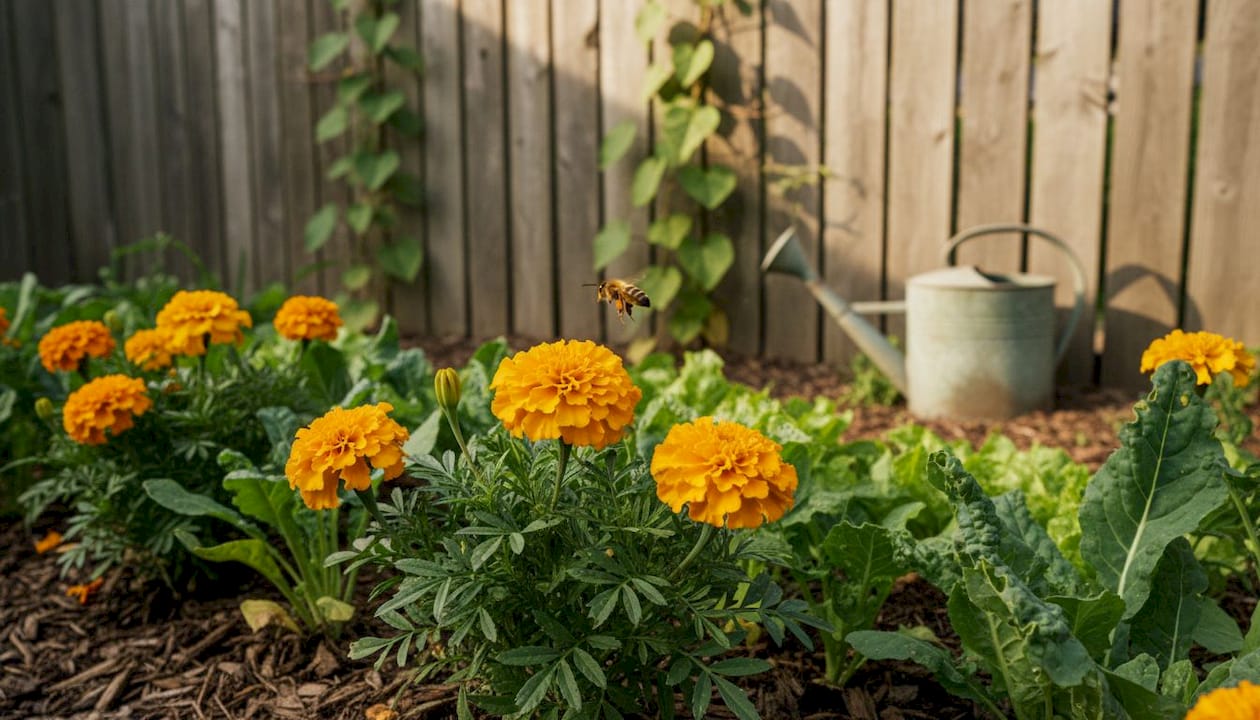
Ecologically, interplanted gardens consistently outperform monocultures in several ways. They support more pollinators. Mixed plantings attract a wider range of bee and butterfly species by offering diverse flower shapes and bloom times. They create more complex habitats for beneficial predatory insects like lacewings and parasitic wasps, which naturally reduce pest populations. There is also strong evidence that diverse plantings slow the spread of soil-borne diseases by physically separating vulnerable plants.
Intercropping research confirms that it can improve ecological outcomes and sometimes yield, though benefits are context dependent. That context-dependency is not a weakness of interplanting. It is simply an honest description of how ecosystems work.
One of the most useful research tools for evaluating interplanting is the land equivalent ratio, or LER. LER compares the productivity of a mixed planting to that of growing each crop alone. An LER above 1.0 means the interplanted combination produces more total yield than either crop would on its own in the same space. An LER of 1.2, for example, means you would need 20% more land to match that output using monocultures. For home gardeners working with limited space, an LER above 1.0 is a real advantage.
| LER value | What it means | Practical implication |
|---|---|---|
| Below 1.0 | Interplanting reduces total yield | Reconsider the pairing |
| Exactly 1.0 | No gain or loss | Pairing is neutral |
| 1.1 to 1.3 | Moderate yield advantage | Solid choice for small spaces |
| Above 1.3 | High yield advantage | Excellent interplanting success |
Interplanting does not have to increase yield to be valuable. Improved soil health, weed suppression, and pollinator support are meaningful outcomes in themselves.
Beyond yield, interplanting also supports long-term soil health. Ground-covering plants reduce erosion and water runoff. Deep-rooted plants bring up subsoil nutrients while shallow-rooted companions access the topsoil layer. This layered root architecture mimics natural ecosystems and builds organic matter over time.
For a broader look at how plant diversity supports garden health, pest control with diversity and crop rotation advantages both connect directly to the principles behind effective interplanting. And just as interplanting improves a garden’s internal ecology, the environmental benefits of planting trees show how the same diversity principles apply at a larger landscape scale.
How to design an interplanted garden: Practical steps and pitfalls
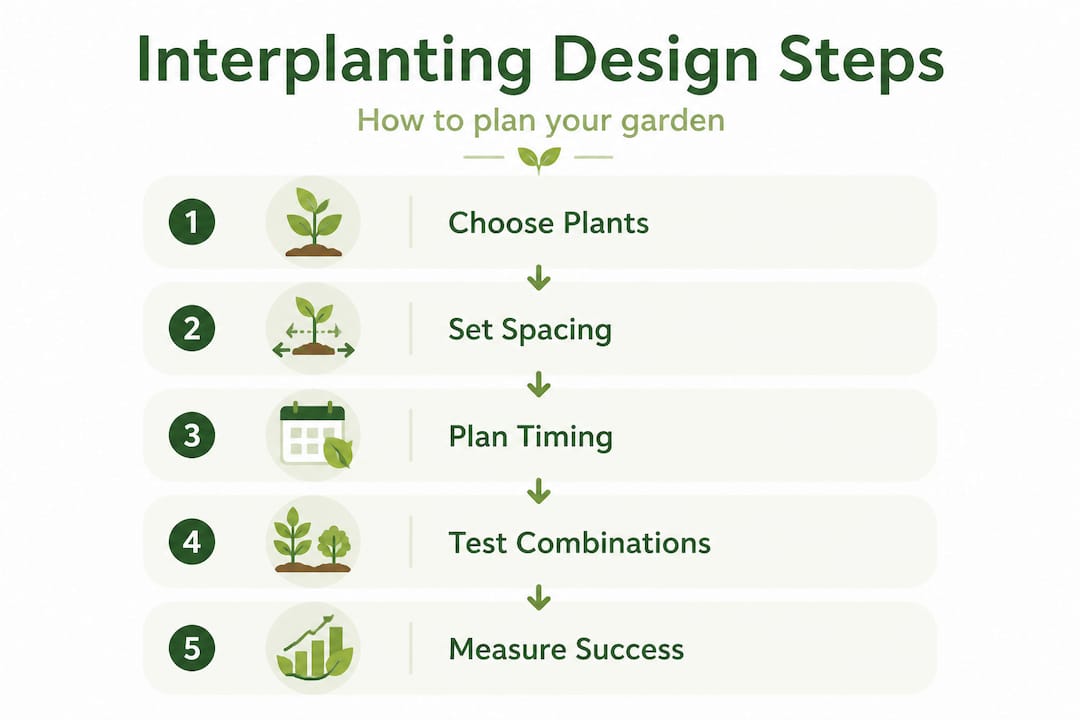
Now the rubber meets the road. Designing an interplanted garden is not complicated, but it does require thinking ahead. Here is a practical workflow that works for most home vegetable growers.
- List your planned crops and their key traits. For each crop, note its height at maturity, root depth, light requirement, water need, and nitrogen preference. This becomes your compatibility checklist.
- Group crops by compatible profiles. Pair deep-rooted crops with shallow-rooted ones. Pair heavy feeders with nitrogen-fixers like beans or clover. Pair tall sun-lovers with low shade-tolerant plants.
- Map out timing. Identify which crops mature quickly and which are slow. Use fast crops to fill space while slow ones develop.
- Sketch your bed layout. Assign rows, strips, or zones before planting. Leave clear pathways so you can access every plant without stepping on roots or compacting soil.
- Plant and observe. Keep simple notes on which plants look stressed, which seem thriving, and where competition appears. Adjust spacing or timing in future seasons based on what you see.
The Virginia Cooperative Extension guide offers an important warning: avoid assuming any pairing is universally beneficial, especially when plants compete for similar resources. Design the overlap in space, light, nutrients, and water to reduce competition and match similar needs.
Here are the most common pitfalls and how to avoid them:
- Planting too close together: This is the number one mistake. Give each plant the space it needs individually before layering in a companion.
- Ignoring shade effects: Tall plants can inadvertently shade out sun-loving companions. Always position taller plants on the north side of shorter ones in the Northern Hemisphere.
- Choosing pairings based on folklore alone: Some traditional combinations work, but test them rather than assuming them.
- Neglecting soil fertility for multiple crops: Two crops in one space means both need adequate nutrients. Amend soil generously before planting a mixed bed.
- Forgetting to adjust water delivery: Different crops may have different irrigation needs. Drip irrigation with zoned delivery works better than a single sprinkler for complex interplanted beds.
If you want measurable outcomes, evaluating interplanting success using LER indices gives you real data to refine your approach over time.
Pro Tip: Start with just two species in a small test bed. Track both individually and in combination over one full growing season. This gives you your own LER data and tells you more than any generic pairing list ever could.
For more plant pairing tips tailored to home gardeners, Lushy Gardens has you covered.
Our take: What most guides miss about interplanting
Here is an honest observation after years of gardening research and hands-on testing: the internet is full of confident interplanting advice that is almost entirely based on repetition, not evidence. The same ten plant pairings appear on thousands of websites, rarely with any acknowledgment that results vary by location, soil type, and season.
The biggest misconception is that interplanting is passive. Many guides present it as something you set up once and then harvest from effortlessly. But the gardeners who see consistent gains from interplanting are the ones who observe, adjust, and experiment systematically. They track what works in their specific microclimate. They notice when a combination causes stress and change it the following year.
The “magic plant” narrative also does real harm. When gardeners try a hyped pairing, see no improvement, and give up on interplanting entirely, they miss the genuine ecological value that a well-designed polyculture delivers. It is not magic. It is resource management at the plant level.
Our strongest advice is this: start skeptical, stay curious, and measure what you can. Use layout designs for maximum yield as a starting framework, then adapt based on what your own garden tells you. Your local conditions, your soil biology, your specific pest pressures, all of these shape what works. Nobody else’s garden is yours.
The gardeners who get the most from interplanting are not the ones with the longest companion planting lists. They are the ones paying close attention to their plants and making small, informed adjustments every season.
Helpful resources to fuel your gardening journey
Interplanting is just one piece of a bigger, more rewarding approach to growing food and flowers sustainably. At Lushy Gardens, there are resources designed to support every stage of your gardening practice, from the very first bed to advanced polyculture designs. If you are new to the garden, the gardening basics guide gives you the foundation you need to approach any technique with confidence. Ready to grow food? The vegetable gardening basics guide walks you through the process from soil prep to harvest. And once you have plants growing, keeping them healthy is easier with a solid plant care routine checklist to follow. Every resource is written to make sustainable, productive gardening approachable for real people with real gardens.
Frequently asked questions
Is interplanting the same as companion planting?
They are closely related but not identical. As the UC Master Gardener resource explains, many companion planting claims lack strong garden-scale evidence, and outcomes depend heavily on plant densities, ratios, and timing.
What is the main benefit of interplanting for home gardeners?
The top benefits are increased biodiversity, better soil coverage, and potential yield gains when plants are paired thoughtfully. Illinois Extension highlights that polyculture approaches support soil coverage, biodiversity, and pest and pollinator balance.
Does interplanting always increase harvest yields?
No, and that expectation can lead to disappointment. Research confirms that benefits are context dependent and vary by year, species pairing, and management, so some combinations can reduce yields when plant needs conflict.
How can I tell if my interplanting design is successful?
Track plant health and harvest weight across your whole bed, then compare to a solo-grown control if possible. Using a land equivalent ratio gives you a precise, measurable way to evaluate whether your mix is outperforming a monoculture.
What’s the biggest mistake gardeners make with interplanting?
Assuming any pairing will help, without checking whether plants compete for the same light, water, or nutrients. Virginia Cooperative Extension advises designing the spatial overlap carefully to reduce competition and match compatible plant needs.
Recommended
- Smart Container Gardening Ideas for Urban Gardeners – Lushy Gardens
- Master Plant Propagation Techniques for Thriving Gardens – Lushy Gardens
- Master Plant Propagation Methods for Thriving Gardens – Lushy Gardens
- Companion Planting Guide: Simple Tips for Healthy Gardens – Lushy Gardens
- Deep Root Fertilization: Boost Your Tree’s Health Today

I’m Eleanor, a seasoned gardener with over three decades of experience tending to Mother Nature’s creations. Through Lushy Gardens, I aim to share my wealth of knowledge and help fellow plant enthusiasts uncover the wonders of gardening. Let’s dive into this journey together, one leaf at a time.


