
Table of Contents
Grow lights work because indoor light almost never cuts it. Windows filter and scatter sunlight, and even a south-facing window in winter delivers less than 10% of outdoor light intensity to your plants. That gap is exactly what grow lights fill. They supply photosynthetically active radiation (PAR), the specific band of light energy plants use to photosynthesize, at the intensity and duration your plants actually need.
Here is why indoor gardeners reach for grow lights:
- Year-round growth: Supplemental lighting prevents winter dormancy and keeps foliage actively growing through short days.
- Flexible placement: You can grow plants anywhere in your home, not just near windows.
- Stronger seedlings: Starting seedlings early with grow lights prevents the weak, leggy growth typically caused by insufficient winter light.
- Flowering and fruiting support: The right spectrum triggers blooming and fruit set in plants that would otherwise stall indoors.
- Energy savings with LEDs: Modern LED grow lights run up to 50,000 hours before dimming, and their daily operating cost often runs lower than a standard household incandescent bulb.
For anyone growing herbs on a kitchen shelf, propagating cuttings, or nursing tropical plants through a Minnesota winter, grow lights are not a luxury. They are the difference between plants that survive and plants that thrive. Lushygardens covers indoor plant care tips in depth, and lighting is consistently the factor that separates struggling plants from healthy ones.
Why use grow lights: the three main types explained
Not all grow lights perform the same way, and the type you choose shapes everything from your electricity bill to how close you can hang the fixture above your plants.
LED grow lights are the clear choice for most home gardeners today. They run up to 50,000 hours before dimming to 70% of their original output, produce far less heat than older technologies, and use less energy than any traditional greenhouse light, according to Oklahoma State University Extension. Because heat escapes through a heat sink rather than radiating from the surface, you can position LEDs closer to your plants without scorching leaves. They also offer color tuning, letting you dial in the exact spectrum your plants need at each growth stage.
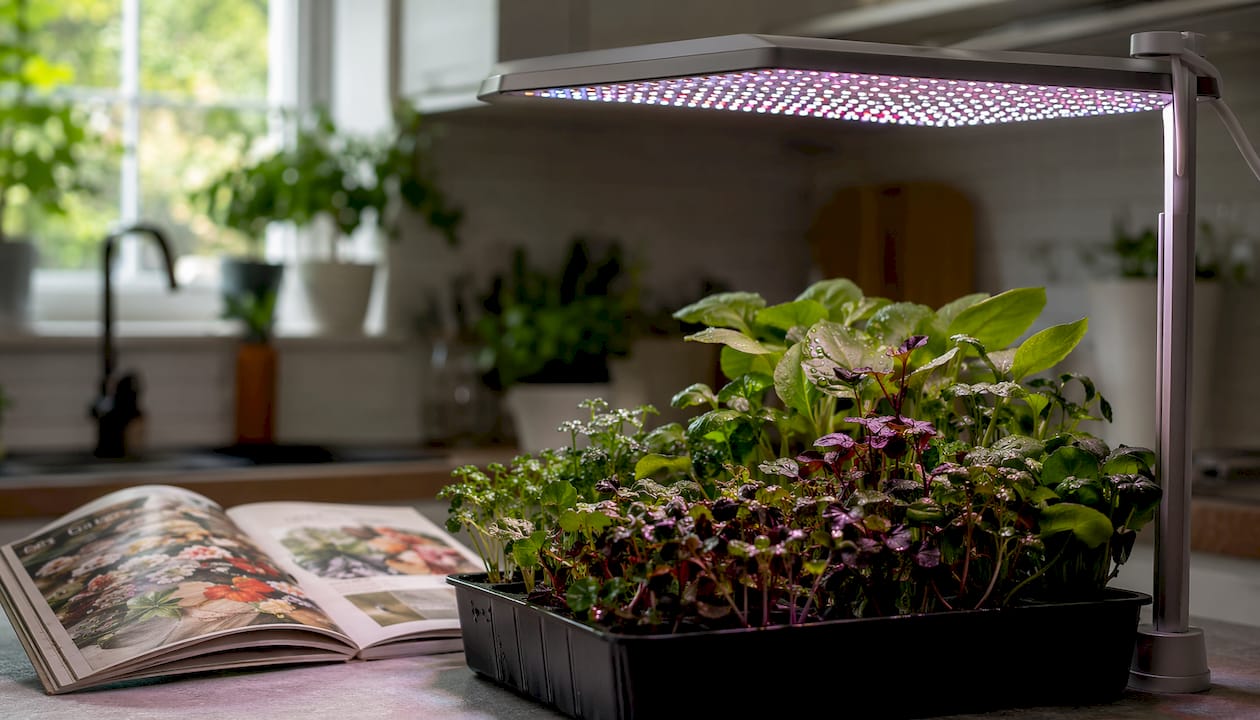
Fluorescent grow lights were the standard for decades and still show up in many home setups. They provide a usable full spectrum and cost less upfront than LEDs. The tradeoff is efficiency and longevity: fluorescents burn out faster and consume more electricity for the same light output. T5 fluorescent tubes remain popular for seed starting and low-light plants, where their gentler output is actually an advantage.
HID (high-intensity discharge) lights deliver serious power. Metal halide bulbs push blue-spectrum light ideal for vegetative growth, while high-pressure sodium (HPS) bulbs favor the red spectrum that drives flowering. The problem for home use is heat. HID lights emit substantial heat and require ventilation to avoid cooking your plants or overheating a small room. They make sense in a dedicated grow room with proper airflow, not on a living room shelf.
Here is a quick comparison to help you choose:
- LED: Best for most home gardeners. Long lifespan, low heat, tunable spectrum, higher upfront cost.
- Fluorescent (T5/T8): Good for seedlings and low-light plants. Lower upfront cost, shorter lifespan, less efficient.
- HID (metal halide or HPS): Best for dedicated grow rooms. High intensity, high heat, requires ventilation.
Pro Tip: If you are just starting out, a full-spectrum LED panel covers seedlings, vegetative growth, and flowering without swapping bulbs or fixtures.
How light spectrum and color shape what your plants do
Plants do not respond to light as a single thing. They respond to specific wavelengths, and getting the spectrum right is what separates a plant that grows from one that thrives.
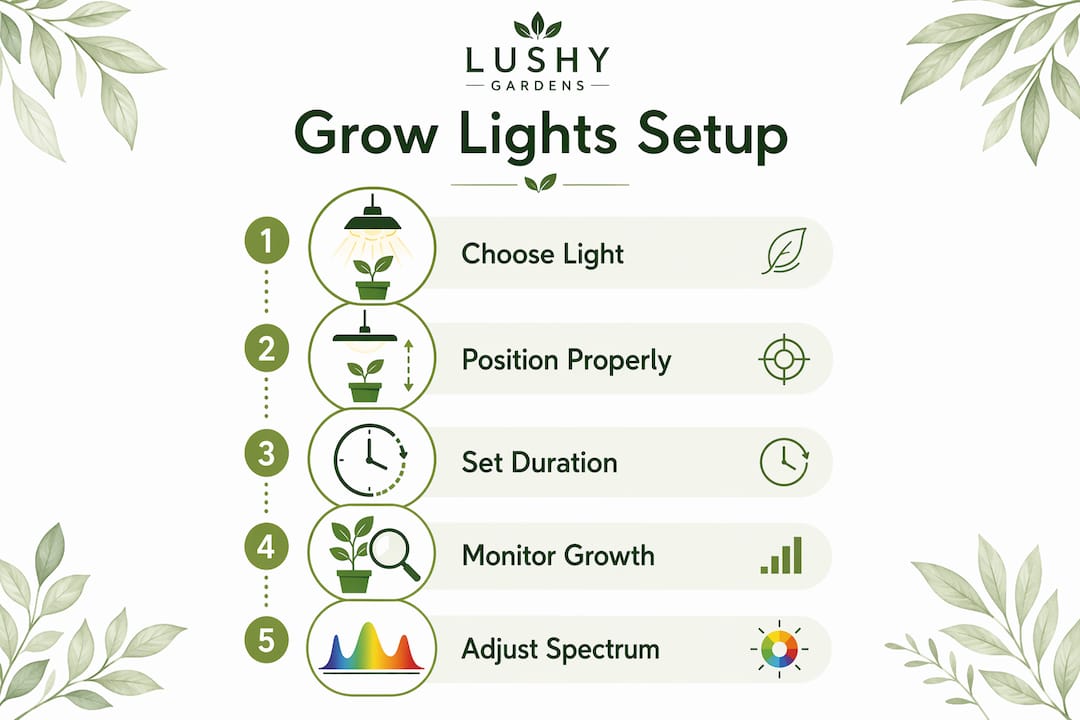
Photosynthetically active radiation covers wavelengths from 400 to 700 nanometers (nm). Within that range, two bands do most of the work. Blue light in the 425–450 nm range drives vegetative growth, stimulating compact leaf and stem development and boosting chlorophyll production. Red light in the 600–700 nm range signals the plant to shift into reproductive mode, promoting flowering and fruiting. Oklahoma State University Extension notes that 440 nm (blue), 660 nm (red), and 730 nm (far-red) are the wavelengths most plants respond to most strongly.
Full-spectrum white LEDs blend these wavelengths to mimic natural daylight, which is why horticulturalists recommend them for general indoor use. You get balanced growth without having to switch fixtures between growth stages. If you want to dig deeper into selecting wavelengths for specific plants, Lushygardens has a detailed light spectrum grower’s guide worth bookmarking.
| Spectrum color | Wavelength range | Primary plant effect |
|---|---|---|
| Blue | 425–450 nm | Vegetative growth, compact structure, chlorophyll production |
| Red | 600–700 nm | Flowering, fruiting, reproductive development |
| Far-red | 700–730 nm | Stem elongation, shade-avoidance response, flowering trigger |
| Full-spectrum white | 400–700 nm | Balanced growth across all stages, mimics daylight |
A few practical notes on spectrum selection:
- Seedlings and cuttings respond well to red and blue combined, or full-spectrum white.
- Vegetative plants (herbs, leafy greens) favor blue-dominant light.
- Flowering ornamentals and fruiting vegetables need more red and far-red.
- Full-spectrum LEDs handle all stages without adjustment, making them the practical default for mixed plant collections.
How to position and use grow lights effectively indoors
Placement is where most beginners go wrong. The physics here are straightforward: light intensity drops sharply as distance increases, so a few inches of adjustment makes a real difference in what your plant actually receives.
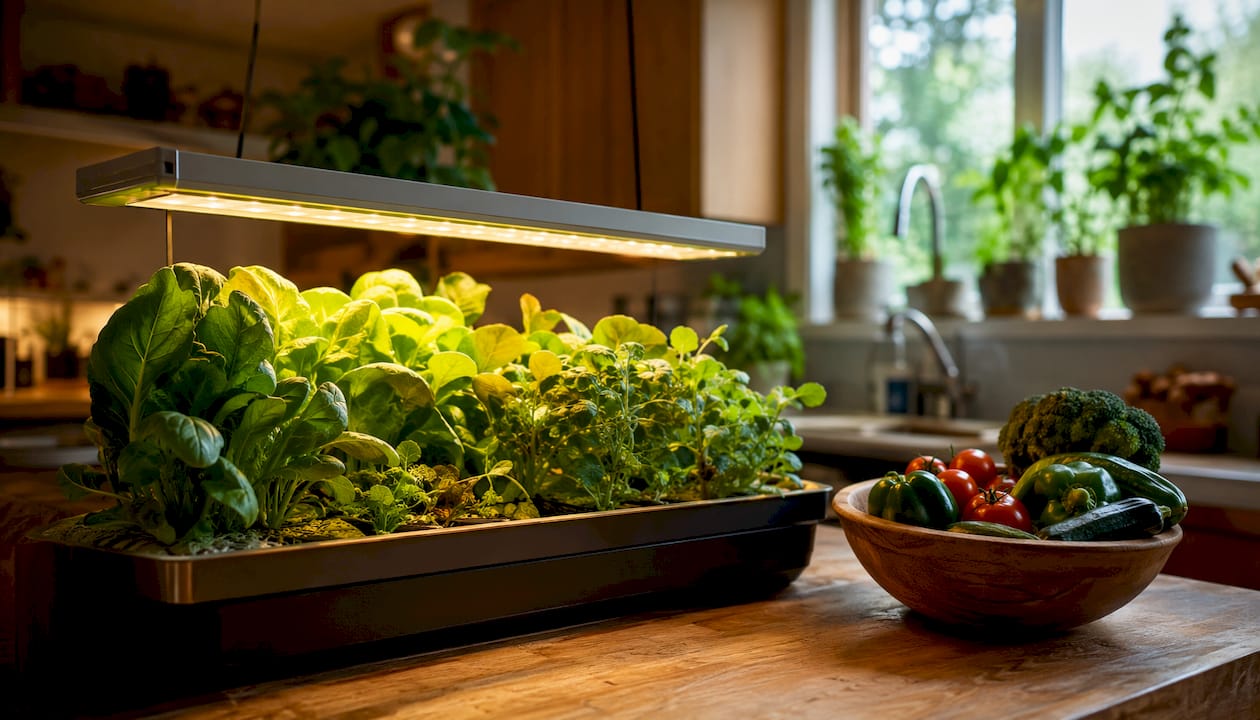
Position lights 6–12 inches above your plants and always overhead, not to the side. Overhead placement guides stems to grow straight up. Side lighting causes plants to lean and stretch toward the source, producing uneven, weak growth. As your plants grow taller, raise the fixture to maintain that 6–12 inch gap. Skipping this step is one of the most common beginner mistakes, and it usually shows up as leaf burn on the newest growth closest to the light.
For daily duration, 12–16 hours of light per day with at least 8 hours of darkness works for most plants. That dark period is not wasted time. Plants use it for respiration and cellular repair, and many flowering species need it to trigger blooming. A simple plug-in timer takes the guesswork out of this entirely.
Watch your plants for feedback. Crispy brown leaf edges or bleaching signal the light is too close or too intense; leggy, pale stems reaching upward mean the light is too far away or too dim. Adjust gradually rather than making sudden large changes, which can stress plants further.
Do’s and don’ts for grow light use:
- Do use a timer to keep light cycles consistent every day.
- Do raise the fixture as plants grow taller.
- Do position the light directly overhead for even coverage.
- Don’t leave lights on 24 hours a day. Plants need darkness.
- Don’t ignore leaf color changes. They are your clearest signal that something needs adjusting.
- Don’t assume one distance works forever. Check placement weekly.
Pro Tip: Hold your hand at plant canopy level under the light for 30 seconds. If it feels uncomfortably warm, the fixture is too close. Your hand is a surprisingly reliable proxy for what your plant is experiencing.
For anyone growing edibles indoors, Lushygardens covers growing vegetables indoors with specific lighting recommendations by crop type.
Expert insights on getting grow lights right
The biggest mistake experienced growers see beginners make is treating grow lights as a set-it-and-forget-it solution. UNH Extension is direct on this: active management of height and monitoring of plant stress signs is what separates successful indoor growing from a slow decline. Plants change. Seasons change. Your setup needs to change with them.
Horticultural society guidance consistently points to grow lights as the tool for extending growing seasons and preventing dormancy, particularly through winter months when natural photoperiods drop well below what most plants need to stay active. Even plants labeled “low-light” grow more robustly with supplemental lighting. Low-light tolerance means a plant survives in dim conditions, not that it prefers them.
A few advanced tips worth knowing:
- Rotate pots a quarter turn every week or two so all sides of the plant get even light exposure.
- If you notice yellowing on lower leaves while upper growth looks healthy, the canopy may be blocking light from reaching the bottom of the plant. Raise the fixture or thin out dense foliage.
- For plants with distinct growth stages (tomatoes, peppers, herbs going to seed), shift toward more red-spectrum light once flowering begins. Full-spectrum LEDs handle this automatically; if you have a tunable fixture, lean the ratio toward red.
- Check your grow light’s PAR output rating before buying. A higher PAR value at a given distance means more usable light energy reaching your plants, not just more watts consumed.
The LED lifespan advantage also has a practical maintenance angle: because LEDs do not burn out suddenly the way incandescent or HID bulbs do, they dim gradually over time. Mark your installation date and plan to reassess output after a few years of heavy use, even if the light still appears bright to your eye.
Pairing good lighting habits with a consistent care routine pays off faster than most gardeners expect. Lushygardens’s plant care routine checklist walks through daily and weekly tasks, including lighting checks, that keep indoor plants performing at their best year-round.
Key Takeaways
Grow lights succeed indoors because they deliver the specific PAR wavelengths and daily duration that window light alone cannot reliably provide, especially through winter.
| Point | Details |
|---|---|
| Indoor light is often insufficient | Windows deliver less than 10% of outdoor light intensity, making supplemental lighting necessary for most plants. |
| LEDs are the best home choice | LED grow lights last up to 50,000 hours before dimming to 70% output, run cool, and cost less to operate than older light types. |
| Spectrum determines plant response | Blue light (425–450 nm) drives vegetative growth; red light (600–700 nm) triggers flowering and fruiting. |
| Placement and timing matter | Position lights 6–12 inches overhead and run them 12–16 hours daily with at least 8 hours of darkness. |
| Active management beats passive setup | Monitor leaf color and growth habit weekly, and adjust light height as plants grow to avoid burn or etiolation. |
Recommended
- How to choose indoor plant lights for healthy growth – Lushy Gardens
- Can LED Lights Grow Plants? – Lushy Gardens
- Best Indoor Plant Lights for Plant Lovers – Expert Comparison 2025 – Lushy Gardens
- What Is Light Spectrum for Plants: A Grower’s Guide – Lushy Gardens

I’m Eleanor, a seasoned gardener with over three decades of experience tending to Mother Nature’s creations. Through Lushy Gardens, I aim to share my wealth of knowledge and help fellow plant enthusiasts uncover the wonders of gardening. Let’s dive into this journey together, one leaf at a time.


