
Table of Contents
TL;DR:
- Leaf variegation results from differences in chlorophyll levels and chloroplast function, producing multi-colored leaf patches. It can be genetically stable or caused by viral infections, affecting plant energy production and growth. Understanding its cause helps optimize care, propagation, and appreciation of the plant’s visual and biological significance.
Leaf variegation is defined as the presence of differently colored zones on plant leaves, caused primarily by variations in chlorophyll concentration and chloroplast function. These zones appear as white, yellow, cream, pink, or silver patches against a green background, and they occur across hundreds of ornamental and wild species. The causes range from genetic mutations and impaired chloroplast development to viral infections and structural differences in leaf tissue. Understanding leaf variegation in plants goes far beyond admiring a pretty pattern. It tells you how a plant produces energy, how stable its coloring will be, and exactly what care it needs to thrive.
What is leaf variegation and what causes it biologically?
Leaf variegation consists of differently colored zones on leaves caused primarily by differences in pigment, most notably chlorophyll. Where chlorophyll is absent or reduced, cells appear white, cream, or yellow. Where it is present at normal levels, the tissue stays green. This basic principle applies whether you are looking at a Monstera deliciosa ‘Albo Variegata’ or a variegated Hoya.
The deeper cause lies inside the cell itself. Impaired chloroplast development and disrupted chlorophyll biosynthesis pathways produce pale or white sectors. Chloroplasts are the organelles responsible for photosynthesis, and when their development goes wrong, the affected cells simply cannot produce green pigment. This is not a surface-level color change. It is a structural failure at the cellular level.
Genetic mutations are the most common driver of this process. Research on the Arabidopsis variegation mutant var2 shows that defects in chloroplast development and division together cause the white sectors characteristic of variegated leaves. Mutations in chloroplast division factors such as PDV1 and PARC6 result in plastid-free cells in white sectors. Those cells are essentially empty of the machinery needed for photosynthesis.
In citrus research, studies on ‘Gonggan’ mandarin found that variegation is linked to downregulation of chloroplast development genes including TOC159 and PDV2, alongside upregulation of chlorophyll degradation genes such as CLH2, SGR, and NOL. This means the plant is both building fewer chloroplasts and destroying the chlorophyll it does produce. The result is a leaf that looks striking but operates at reduced photosynthetic capacity.
Beyond genetics, viral infections can also disrupt leaf patterns. Viruses interfere with normal gene expression in leaf tissue, producing mosaic or mottled patterns that mimic genetic variegation. The key difference is stability: genetically driven variegation is heritable and consistent, while virus-induced patterns are unpredictable and often a sign of plant stress.

Key biological causes of leaf variegation include:
- Genetic mutations affecting pigment production and chlorophyll metabolism
- Impaired chloroplast biogenesis and division
- Upregulation of chlorophyll degradation enzymes (SGR, CLH, NOL)
- Viral infections disrupting normal gene expression in leaf cells
- Structural differences in epidermal cell layers affecting light reflection
Pro Tip: If a variegated plant suddenly produces all-green leaves, it is likely reverting. Remove fully green stems promptly, since green growth is more vigorous and will outcompete the variegated portions over time.
What are the different types of leaf variegation patterns?
Variegation patterns vary widely, including spots, stripes, marbling, and sector-based color divisions. Each pattern reflects a different underlying mechanism, and recognizing the pattern helps you predict how stable the coloring will be and how the plant will behave under different growing conditions.
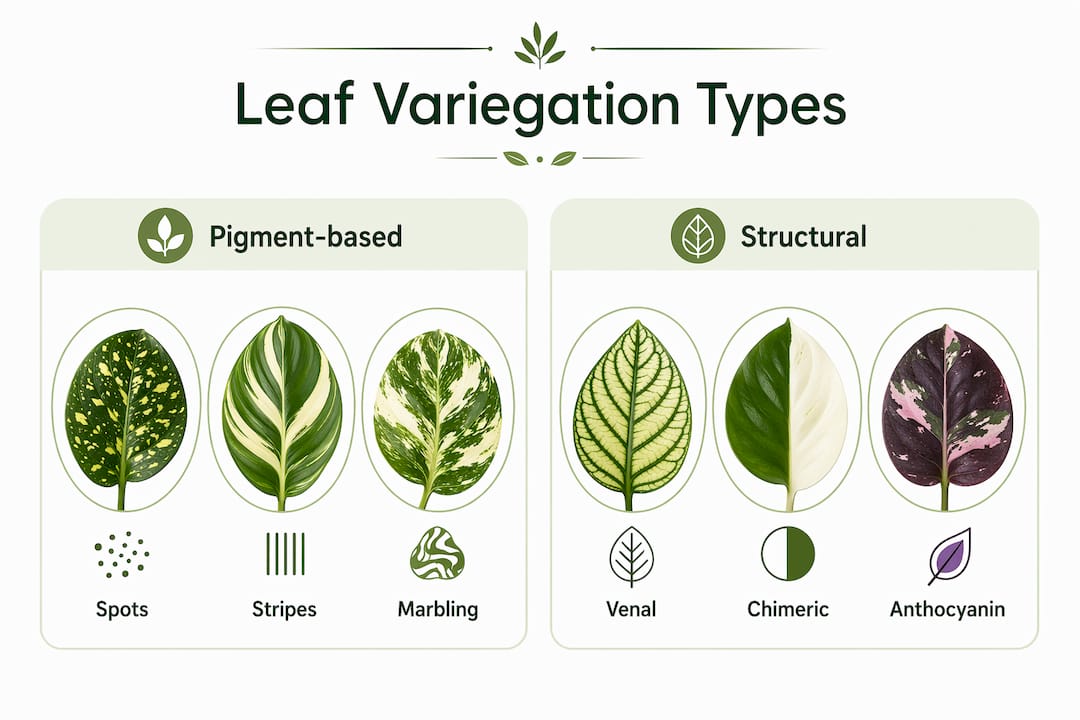
The two broadest categories are pigment-related variegation and structural variegation. Pigment-related variegation occurs when certain cells lack chlorophyll or contain alternative pigments such as anthocyanins, which produce red and pink patches. Structural variegation results from physical differences in cell layers, such as air pockets beneath the epidermis that scatter light and create a silvery or white appearance. Goeppertia insignis, commonly known as the rattlesnake plant, displays this structural type with its striking dark and light green banding.
Venal variegation is a distinct subtype worth knowing. In venal variegation, the veins themselves appear in a contrasting color, often white or yellow, against a darker green leaf body. This pattern is common in certain aroids and some Caladium cultivars. It differs from general variegation because the color change follows the vascular structure of the leaf rather than appearing in random sectors.
Coleus cultivars demonstrate how anthocyanin-driven pigmentation creates bold red, burgundy, and pink zones alongside green and white areas. Milk thistle (Silybum marianum) shows white marbling along its veins, a pattern caused by structural differences in the mesophyll layer rather than chlorophyll absence.
| Variegation type | Primary cause | Typical appearance | Example plants |
|---|---|---|---|
| Chlorophyll-based | Absent or reduced chlorophyll | White, cream, or yellow sectors | Monstera, Hoya, Pothos |
| Anthocyanin-based | Presence of red/purple pigments | Red, pink, or burgundy patches | Coleus, Caladium |
| Structural | Air pockets or cell layer differences | Silver, white, or reflective zones | Goeppertia insignis, Begonia |
| Venal | Vascular-specific pigment change | Contrasting vein color | Caladium, some aroids |
| Mosaic/viral | Viral infection disrupting gene expression | Irregular mottled or blotchy pattern | Tobacco mosaic virus hosts |
How does variegation affect plant health and care?
White sectors lack chlorophyll and function as low-energy tissue, which directly slows growth in variegated plants like Monstera and Hoya compared to their fully green counterparts. This is the single most practical fact for any variegated plant owner to internalize. A leaf that is 50% white is producing roughly half the energy of a fully green leaf of the same size. That energy deficit accumulates across the whole plant.
Slower growth means variegated plants need more time between repotting, more careful watering schedules, and brighter indirect light to compensate for their reduced photosynthetic output. Overwatering is a particular risk because the plant is not consuming water as fast as a green plant of the same size would. Roots can sit in wet soil longer, increasing the chance of rot. If you notice yellowing leaves on plants alongside fading variegation, care mistakes are the most likely culprit.
Variegation stability varies significantly depending on its cause. Genetically stable variegation, such as that found in tissue-cultured Monstera thai constellation, remains consistent across new growth. Chimeric variegation, where two genetically distinct cell populations coexist in the same plant, is less predictable. A chimeric plant can produce entirely green or entirely white leaves depending on which cell line dominates during growth.
Propagation adds another layer of complexity. Cuttings from chimeric plants do not always reproduce the parent’s pattern. A cutting taken from a heavily variegated section may produce mostly green growth, or vice versa. This unpredictability is why rare variegated cultivars command high prices in the houseplant market.
Practical care priorities for variegated plants:
- Provide bright, indirect light to offset reduced photosynthetic capacity
- Water less frequently than you would for a fully green plant of the same size
- Avoid heavy fertilization, since slow-growing plants cannot process nutrients quickly
- Monitor for reversion to all-green growth and prune it back early
- Check for brown leaf tips as a sign of stress in low-chlorophyll tissue
Pro Tip: Variegated plants placed in low light will often produce more green growth over time as the plant compensates for energy deficiency. Moving them to brighter conditions early encourages the plant to maintain its patterning.

Can leaf variegation offer benefits beyond aesthetics?
Variegation serves real ecological functions, not just decorative ones. Variegated patterns may aid plant adaptation through herbivore deterrence and temperature regulation. Some researchers propose that white or silver patches on leaves mimic insect damage, discouraging herbivores from feeding on tissue that appears already compromised. This is a plausible defense strategy in tropical understory environments where herbivory pressure is high.
Temperature regulation is a less obvious benefit. Reflective white or silver sectors absorb less solar radiation than fully green tissue. In high-light environments, this can prevent overheating in leaf cells and reduce water loss through transpiration. Plants like Goeppertia species, which grow in dappled forest light, may use structural variegation partly for this thermoregulatory purpose.
From a scientific standpoint, variegation mutants reveal mechanisms controlling chloroplast development and degradation pathways with wide biological and practical implications. Arabidopsis var2 mutants, for example, have been central to understanding how plants regulate chloroplast quality control. This research feeds directly into plant breeding programs aimed at improving crop efficiency and stress tolerance.
In horticulture, the benefits are more straightforward. Variegated cultivars drive significant commercial demand. Rare forms of Monstera, Philodendron, and Epipremnum sell for prices that would have seemed absurd a decade ago, precisely because their patterns are visually striking and difficult to reproduce at scale. This ornamental value has pushed breeders to develop stable variegated lines through tissue culture and selective propagation, creating an entire sub-industry within the houseplant market.
The ecological, scientific, and commercial benefits of variegation include:
- Potential herbivore deterrence through visual mimicry of damaged tissue
- Reduced heat absorption in high-light environments via reflective sectors
- Scientific utility as a model system for chloroplast biology research
- High ornamental and commercial value in the houseplant and nursery trade
- Contribution to plant breeding research on chlorophyll metabolism and crop improvement
Key takeaways
Leaf variegation is a biological phenomenon rooted in chloroplast function, and understanding its cause determines how you care for, propagate, and appreciate any variegated plant.
| Point | Details |
|---|---|
| Core definition | Variegation is caused by differences in chlorophyll and chloroplast function, not surface pigment alone. |
| Genetic vs. viral causes | Genetic variegation is stable and heritable; viral variegation is unpredictable and often a stress signal. |
| Reduced photosynthesis | White and yellow sectors produce less energy, meaning variegated plants grow slower and need adjusted care. |
| Pattern types | Chlorophyll-based, anthocyanin-based, structural, venal, and mosaic patterns each have distinct causes and appearances. |
| Beyond aesthetics | Variegation may deter herbivores, regulate temperature, and serves as a key research model in plant biology. |
Why I think most gardeners misread their variegated plants
Most people who buy a variegated Monstera or a chimeric Pothos treat it like any other houseplant, just with prettier leaves. That is a mistake I see repeatedly, and it leads to frustration when the plant grows slowly, drops leaves, or reverts to green.
The thing that changed how I approach variegated plants was understanding that the white sectors are not decorative. They are non-functional tissue from an energy standpoint. Once you accept that, every care decision becomes clearer. You stop pushing the plant with fertilizer. You stop putting it in a corner because it looks nice there. You start treating light as the single most important input.
I also think the obsession with rare variegated cultivars has outpaced people’s understanding of what they are buying. A highly variegated cutting with 80% white leaves is not a prize. It is a plant that is barely surviving on the green tissue it has left. The most stable, long-term rewarding variegated plants are those with a balanced mix of green and patterned tissue, enough chlorophyll to grow steadily, and enough pattern to stay visually interesting.
Chlorophyll degradation enzymes like SGR and CLH are active in variegated tissue, which means the plant is continuously breaking down what little pigment it produces in those sectors. That is not a flaw to fix. It is the biology of the plant. Work with it, not against it.
— Povilas
Grow your variegated plants with confidence
Lushygardens has the practical guides you need to move from understanding variegation to actually keeping your plants healthy. The gardening basics guide covers foundational plant care principles that apply directly to variegated species, from soil selection to light positioning. For ongoing maintenance, the daily plant care checklist gives you a structured routine that accounts for the slower growth rates and adjusted watering needs of low-chlorophyll plants. If your variegated plant is showing stress signs like unexpected color changes, the Lushygardens guide on why leaves turn yellow helps you diagnose the problem fast.
FAQ
What is leaf variegation in simple terms?
Leaf variegation is the appearance of two or more colors on a single leaf, caused by differences in chlorophyll concentration or cell structure. Green areas contain normal chloroplasts, while white, yellow, or silver areas have reduced or absent chlorophyll.
Is variegation in plants always genetic?
No. Variegation can result from genetic mutations, chimeric cell populations, viral infections, or structural differences in leaf tissue. Genetic variegation is stable and heritable, while virus-induced variegation is unpredictable and often signals plant disease.
Do variegated plants grow slower than green plants?
Yes. Because white and yellow sectors lack chlorophyll, they produce less energy through photosynthesis. This reduced energy output leads to slower overall growth compared to fully green plants of the same species.
Can variegation disappear over time?
Yes. Chimeric variegation in particular can revert to all-green growth, especially when the plant is stressed or placed in low light. Removing fully green stems as soon as they appear helps maintain the variegated pattern.
What are the main types of leaf variegation?
The main types are chlorophyll-based (white or yellow sectors from absent chlorophyll), anthocyanin-based (red or pink patches from alternative pigments), structural (silvery zones from cell layer differences), venal (contrasting vein color), and mosaic (irregular patterns from viral infection).
Recommended

I’m Eleanor, a seasoned gardener with over three decades of experience tending to Mother Nature’s creations. Through Lushy Gardens, I aim to share my wealth of knowledge and help fellow plant enthusiasts uncover the wonders of gardening. Let’s dive into this journey together, one leaf at a time.


