
Table of Contents
TL;DR:
- Most yellowing or browning in indoor palms results from water quality, humidity, or care mistakes.
- Correct diagnosis based on leaf discoloration patterns helps address issues effectively.
- Overwatering and poor water quality are common causes, while disease is rare indoors.
You did everything right. You watered your indoor palm regularly, set it near a bright window, and maybe even talked to it once or twice. Yet here you are, staring at leaves that are turning yellow, crispy, or brown at the tips. The frustration is real, and you are definitely not alone. Many indoor palm owners face this exact situation, from total beginners to people who have been growing plants for decades. The good news is that most cases of yellowing and browning have clear, fixable causes. This guide walks you through exactly what is going wrong and how to fix it, backed by plant science and practical experience.
Table of Contents
- How to spot what’s wrong: Reading palm leaf symptoms
- Watering mistakes: Overwatering, underwatering, and water quality
- Nutrient deficiencies: Feeding your palm what it craves
- When the issue is not environment: Is it disease?
- The overlooked truth about palm plant problems indoors
- Get personalized tips for healthier palms and indoor plants
- Frequently asked questions
Key Takeaways
| Point | Details |
|---|---|
| Leaf color reveals the cause | The pattern of yellow or brown on palm leaves is a clear clue to the underlying problem. |
| Water quality matters | Most brown tips result from chemicals in tap water and are easily fixed with filtered water. |
| Fertilize palms carefully | Choosing the right palm fertilizer prevents most yellowing and mimics natural healthy growth. |
| Disease is rare indoors | Palm leaf disease is uncommon inside homes and most problems are due to care, not infection. |
How to spot what’s wrong: Reading palm leaf symptoms
With the problem established, let’s identify the subtle clues your palm plant is giving you. Before you change anything about your care routine, take a close look at the leaves themselves. The pattern of discoloration tells you almost everything you need to know. Getting this step right saves you from chasing the wrong solution for weeks.
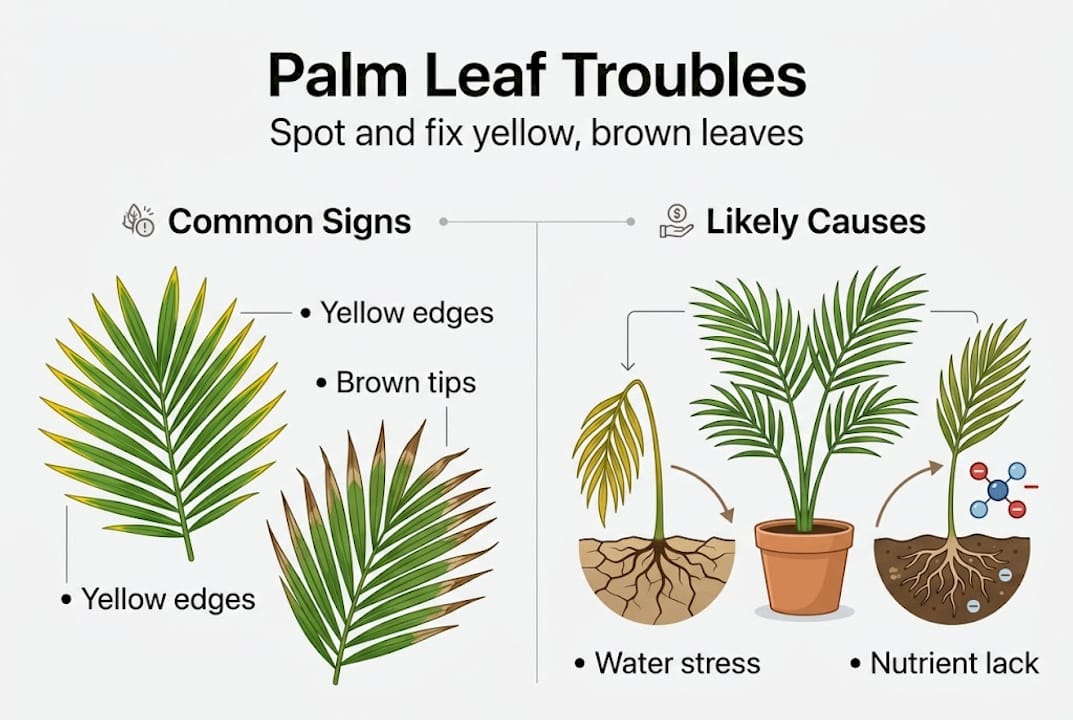
Not all yellow or brown leaves mean the same thing. A palm with crispy brown tips is dealing with something very different from one with entirely yellow fronds. Learning to read these signs is like reading a map. It points you directly to the problem without guesswork. In fact, diagnosing by pattern is the most reliable first step: tips and edges turning brown usually signal low humidity, underwatering, or salt buildup, while entire fronds turning yellow-brown often point to overwatering or nutrient deficiency, and discoloration on just one side of the plant can suggest a rare disease.
Here is a quick comparison to bookmark:
| Symptom pattern | Most likely cause | Next action |
|---|---|---|
| Brown tips only | Low humidity, salt buildup, poor water quality | Switch to filtered water, increase misting |
| Brown edges, green center | Underwatering or wind exposure | Adjust watering schedule |
| Entire frond yellow | Overwatering or nitrogen deficiency | Check drainage, review fertilizing |
| One-sided yellowing | Possible disease or root damage | Isolate and inspect roots |
| Spots with yellow halo | Fungal infection (rare indoors) | Treat with neem oil |
The most common patterns that indoor palm owners deal with are:
- Brown tips on otherwise healthy green leaves (most frequently caused by water quality or dry air)
- Fully yellow old fronds near the base of the plant (often a natural aging process or overwatering)
- Brown streaks running along the leaf (a sign of more serious nutrient or disease problems)
- Pale, washed-out yellow on new growth (usually points to iron deficiency)
Understanding the root causes of yellow and brown leaves is the foundation of fixing them, and the more precisely you can describe the pattern, the faster you find the solution.
“Not every discolored palm leaf is a crisis. Most of the time, the plant is giving you a very specific signal, and once you learn the language, the fix is obvious.” — Experienced indoor palm grower
When you inspect your palm, check under the leaves too. Pests like spider mites leave tiny webbing and cause stippled yellowing that starts at one area before spreading. If you see no pests and no obvious pattern, move on to reviewing your watering habits first, since that is the cause in the majority of cases. For a thorough breakdown of yellowing leaves troubleshooting, it helps to go through a systematic checklist rather than randomly adjusting care.
Watering mistakes: Overwatering, underwatering, and water quality
Now that you can read the symptoms, let’s look at the most common culprit: water and how you use it. Watering seems straightforward, but with palms it is surprisingly easy to get it wrong in two opposite directions at the same time. You can overwater one month and underwater the next, and both will leave marks on the leaves.
Water quality is a bigger deal than most people realize. Tap water contains fluoride, chlorine, and dissolved salts, and poor water quality is one of the leading causes of brown tips on houseplants. These chemicals build up in the soil over time, slowly burning the leaf tips from the inside out. Many palm owners never suspect their water because it looks clean and clear. Switching to filtered or distilled water for your palm can stop tip browning in its tracks, sometimes within just a few weeks of new growth.
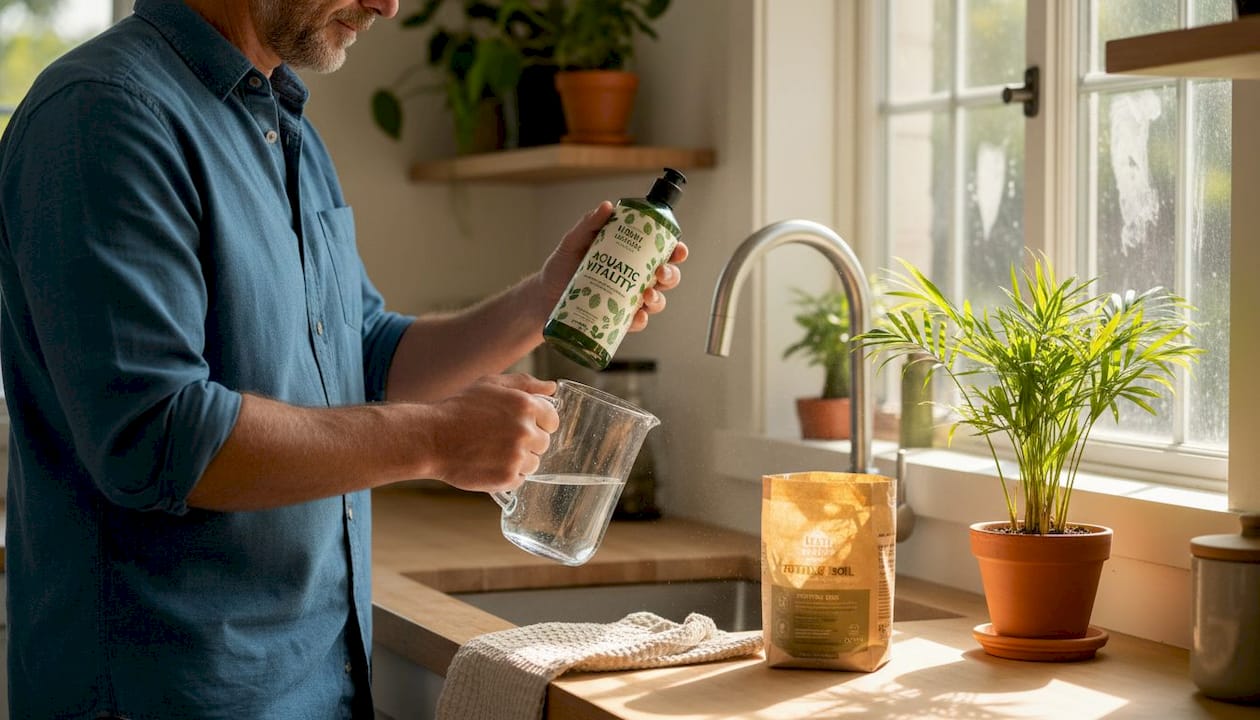
Overwatering is the number one killer of indoor palms. When the soil stays soggy too long, the roots begin to suffocate because they cannot get the oxygen they need. Damaged roots cannot absorb water even when it is available, which causes the leaves to yellow broadly and look wilted despite wet soil. The signs of overwatering include yellowing on many fronds at once, soft or mushy stems near the base, and soil that smells sour or earthy.
Underwatering shows up differently. The leaves become dry and brown, starting at the tips and edges and working inward. The soil pulls away from the edges of the pot, and leaves may curl or feel papery. Unlike overwatering, underwatered palms tend to look crispy rather than limp.
Here are the signs that separate the two, so you never mix them up:
- Overwatered palm: yellowing many fronds at once, soggy soil, soft stems, possible root rot smell
- Underwatered palm: crispy brown tips and edges, very dry soil pulling from pot sides, limp but not mushy leaves
How to water your indoor palm the right way:
- Check the soil moisture before every watering. Push your finger about two inches into the soil. Water only if it feels dry at that depth.
- Water slowly and evenly until it drains from the bottom of the pot, then empty the drainage tray so roots do not sit in standing water.
- In winter, reduce watering frequency by about half since palms grow more slowly and need less water in lower light.
- In summer or if your home is dry, check moisture levels more often since soil dries faster.
- Use filtered, distilled, or rainwater to avoid chemical buildup on leaf tips.
Pro Tip: Let tap water sit uncovered in a bucket for 24 hours before using it on your palm. This allows chlorine to evaporate, which reduces (though does not eliminate) its impact on sensitive plants.
Understanding the difference between overwatering vs underwatering is one of the most valuable skills you can build as an indoor gardener. Once you recognize what each looks like, you will catch problems early before the damage spreads. You can also review a detailed breakdown of causes of brown leaf tips to cross-reference what you are seeing on your plant.
Nutrient deficiencies: Feeding your palm what it craves
If watering changes did not fix the leaves, let’s look into the nutrients palms need to thrive. Indoor palms cannot reach into the soil for new nutrients the way outdoor plants can. They depend entirely on what you give them, and the most common deficiencies show up directly on the leaves.
The three nutrients palms miss most in indoor settings are iron, magnesium, and potassium. Iron deficiency causes new leaves to come in pale yellow or almost white while older leaves stay green. Magnesium deficiency creates yellow bands along the edges of older fronds while the center stays green. Potassium deficiency is often the most dramatic: it causes older fronds to turn orange-brown, almost scorched-looking, starting at the tips and working toward the base. A micronutrient deficiency affects how plants absorb and use energy, and palms are especially vulnerable because they are slow to show early signs and slow to recover.
Here is how common palm deficiencies compare:
| Deficiency | Which leaves affected | Pattern | Fix |
|---|---|---|---|
| Iron | New (young) growth | Pale yellow or white | Foliar iron spray or soil drench |
| Magnesium | Older (lower) fronds | Yellow edges, green center | Epsom salt solution monthly |
| Potassium | Older fronds | Orange-brown tips, scorching | Palm-specific fertilizer |
| Nitrogen | All leaves | Uniform light green or yellow | Balanced fertilizer |
To avoid and correct deficiencies, follow these steps:
- Choose a palm-specific fertilizer with a ratio like 8-2-12, which is recommended for palms because it provides the right balance of nutrients including micronutrients.
- Fertilize during the growing season only, typically spring through early fall. Stop fertilizing in winter.
- Always water your palm before feeding it. Applying fertilizer to dry soil burns roots.
- Start at half the recommended dose if your palm is already stressed. Work up slowly.
- Avoid general-purpose fertilizers with high phosphorus ratios since they can block iron and zinc uptake.
Pro Tip: Do not assume a struggling palm needs more fertilizer. Too much fertilizer causes salt buildup in the soil, which burns roots and worsens the browning you are trying to fix. When in doubt, flush the soil with plenty of water and wait before feeding again.
It is worth noting that leaves turning yellow from nutrient problems look very similar to the early stages of some palm diseases. This is exactly why experts recommend testing the soil and adjusting your fertilizer routine first before jumping to disease treatments. Misdiagnosed care mistakes are incredibly common and fixable once you know what to look for.
When the issue is not environment: Is it disease?
When standard care changes do not help, consider these rare disease cases. The truth is that most indoor palms never develop a true disease. Controlled indoor environments simply do not provide the conditions that most palm pathogens need to thrive. But in some situations, especially if a palm came from a garden center with stressed roots or if it has been severely overwatered for a long time, disease can take hold.
The two most serious palm diseases are Fusarium wilt and Ganoderma butt rot. Both are mentioned in research on ornamental palm diseases as causes of rapid decline, though they are far less common indoors than nutrient deficiencies or watering problems. Fusarium causes one-sided browning that moves quickly down a frond and into the trunk. Ganoderma produces a shelf-like fungal growth (called a conk) at the base of the trunk and causes the palm to collapse from the inside out. There is no cure for either.
Watch for these warning signs that suggest something beyond a care issue:
- Browning that spreads extremely fast, covering an entire frond within days
- A foul or musty smell coming from the trunk or soil, even with good drainage
- One-sided leaf death with no clear environmental cause
- Oozing, discolored sap from the trunk
- Wilting that does not respond to correct watering at all
Pro Tip: If you suspect a serious disease, isolate the palm from all other plants immediately. Most indoor palm diseases cannot be cured, but early isolation protects your other plants. Take clear photos and contact your local cooperative extension office for identification help before disposing of the plant.
The signs of overwatering and recovery overlap with early disease symptoms, which is why ruling out care issues first is so important. If you correct your watering and nutrition and still see rapid, one-sided decline, it is time to get professional help or make the tough call to let the plant go.
The overlooked truth about palm plant problems indoors
Here is what years of watching people care for indoor palms really teaches you: the biggest threat to your palm is not disease, pests, or bad luck. It is well-intentioned overcare. The most damaged palms we see are the ones that got watered every single day, fed with heavy doses of fertilizer every week, and moved from spot to spot in search of the “perfect” light.
Palms are remarkably resilient when left alone to adjust. They struggle most when owners react to every yellow leaf with a major intervention. One yellow frond at the base of a mature palm is usually just normal aging. It does not need a new fertilizer, a repot, or a move to a different room.
The real skill in palm care is learning to observe without immediately reacting. Keep a simple log of when you water, when you fertilize, and what the leaves look like week to week. This habit alone solves the majority of problems because patterns become visible fast. You will notice that browning started after you switched water sources, or that yellowing showed up two weeks after you doubled your fertilizer dose.
Reading essential indoor plant care tips reinforces this: consistent, simple routines beat complicated interventions almost every time. Trust the process, keep the soil moisture right, feed the plant correctly during growing season, and the palm will usually do the rest on its own.
Get personalized tips for healthier palms and indoor plants
Ready to give your palm the best indoor life? Here’s how we can help you take the next step. At Lushy Gardens, we have built a library of practical, no-fluff plant care resources designed for real indoor gardeners who want real results. Whether you are working through a frustrating browning problem or just want to build a smarter care routine from the ground up, our plant troubleshooting guide is a great place to start. You can also use our step-by-step plant care routine checklist to stay consistent with watering, feeding, and seasonal adjustments. If you are newer to growing plants indoors, our gardening basics guide builds a solid foundation so you can avoid common pitfalls before they start. Your palm deserves to thrive, and we are here to help make that happen.
Frequently asked questions
Can yellow palm leaves turn green again?
No, yellow leaves will not revert to green once they have lost chlorophyll, but correcting the cause stops further damage and keeps new growth healthy and vibrant.
What if only the tips of my palm leaves turn brown?
Brown tips are almost always a water quality or humidity issue. Switching to filtered water and misting the leaves regularly usually stops new tip browning, as fluoride and chlorine in tap water are common triggers.
How do I know if my palm has a disease or just needs fertilizer?
Test the soil and fertilize with a palm-specific blend like 8-2-12 first, since diseases are rare indoors and nutrient deficiencies cause nearly identical symptoms but respond to feeding within weeks.
Is tap water safe for indoor palms?
Tap water can cause brown tips over time because fluoride, chlorine, and salts accumulate in the soil and damage sensitive root tips. Use filtered or distilled water whenever possible for best results.
Recommended
- What causes brown leaf tips? Diagnose & fix plant issues – Lushy Gardens
- Why Is My Plant Turning Yellow and Brown? – Lushy Gardens
- Why Are My Plants Leaves Turning Yellow? Solutions That Work – Lushy Gardens
- Problems With Yellowing Leaves – Causes and Solutions – Lushy Gardens

I’m Eleanor, a seasoned gardener with over three decades of experience tending to Mother Nature’s creations. Through Lushy Gardens, I aim to share my wealth of knowledge and help fellow plant enthusiasts uncover the wonders of gardening. Let’s dive into this journey together, one leaf at a time.


