
Table of Contents
TL;DR:
- Carbon dioxide is essential for plant photosynthesis and growth, acting as the primary carbon source. Plants absorb CO2 passively through stomata, with efficiency influenced by environmental factors like light, water, nutrients, and temperature. Elevated CO2 benefits C3 crops significantly but causes acclimation effects, impacting long-term growth and nutrient content.
Carbon dioxide is the primary carbon source plants convert into glucose during photosynthesis, making it the single most critical atmospheric gas for plant growth and survival. Without a steady supply of CO2, the entire chain of reactions that produces food, oxygen, and biomass collapses. The role of carbon dioxide in plants extends well beyond a simple ingredient. It shapes how plants grow, how ecosystems store carbon, and how agriculture responds to a changing atmosphere. This guide covers the physiology, ecology, and agricultural implications of CO2 in plant biology, drawing on the latest 2026 research.
How do plants absorb and use carbon dioxide?
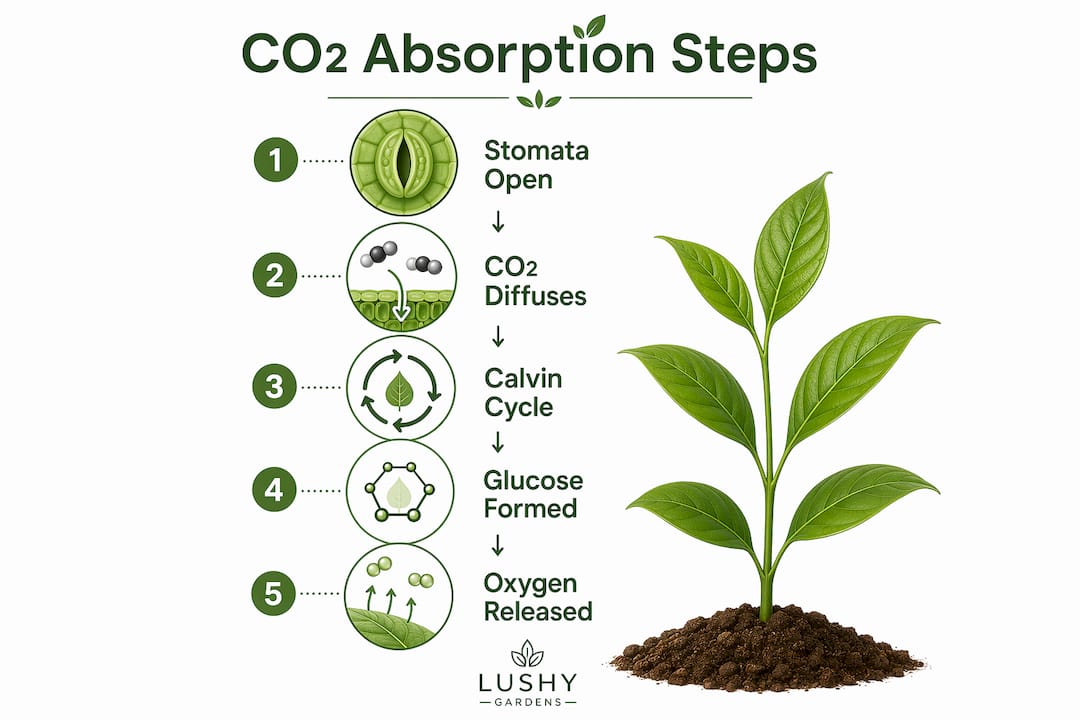
Carbon dioxide absorption in plants begins at the leaf surface, where tiny pores called stomata open to allow CO2 to diffuse inward. This process is entirely passive. Stomata regulate CO2 intake by balancing carbon gain against water vapor loss, a trade-off that defines much of plant physiology. When water is scarce, stomata close to prevent dehydration, which simultaneously cuts off CO2 supply and slows photosynthesis.

Once inside the leaf, CO2 moves into chloroplasts, the organelles where photosynthesis takes place. The Calvin cycle, also called carbon fixation, is the set of reactions that converts CO2 and water into glucose using energy captured from light. Glucose then fuels cell division, root growth, seed production, and every other energy-demanding process in the plant. Oxygen is released as a byproduct through the same stomata that admitted the CO2.
Several factors determine how efficiently a plant uses the CO2 it absorbs:
- Light intensity: Photosynthesis requires light energy to drive the Calvin cycle. Low light limits glucose production even when CO2 is abundant.
- Water availability: Water is both a reactant in photosynthesis and the trigger for stomatal opening. Drought reduces both CO2 uptake and the reactions that use it.
- Nutrient supply: Nitrogen, phosphorus, and magnesium are all required to build the enzymes and chlorophyll that process CO2. Deficiencies create bottlenecks.
- Temperature: Enzyme activity in the Calvin cycle peaks within a specific temperature range. Extreme heat or cold slows carbon fixation regardless of CO2 levels.
Pro Tip: If you grow plants in a sealed greenhouse or grow tent, CO2 levels can drop sharply within hours as plants consume it. Use a CO2 monitor and consider a CO2 device station like the TrolMaster Hydro-X to maintain optimal concentrations and prevent growth stalls.
Emerging research also shows that soil inorganic carbon contributes to plant carbon assimilation through root-zone uptake. This means the importance of CO2 for plants is not limited to what enters through leaves. Root-zone health directly affects how much carbon a plant can fix overall.
How do c3 and c4 plants respond differently to co2?
Not all plants respond to elevated CO2 the same way. The distinction between C3 and C4 photosynthetic pathways is the most important factor in predicting how a plant species will behave as atmospheric CO2 rises.
C3 plants, which include wheat, rice, soybeans, and most temperate crops, fix carbon directly through the Calvin cycle. At current atmospheric CO2 levels, the enzyme RuBisCO that drives this process is not fully saturated. That means more CO2 directly accelerates the reaction. C3 crops grown at 820 ppm CO2 showed a 74% increase in leaf area and an 87% increase in shoot dry weight. Those numbers confirm that C3 species have significant untapped capacity to grow faster when CO2 supply increases.
C4 plants, including corn, sugarcane, and sorghum, use a two-stage carbon concentration mechanism that pre-saturates RuBisCO before the Calvin cycle begins. This makes C4 plants highly efficient at current CO2 levels, but it also means they gain far less from additional CO2. The table below summarizes the key differences:
| Feature | C3 Plants | C4 Plants |
|---|---|---|
| Examples | Wheat, rice, soybeans | Corn, sugarcane, sorghum |
| CO2 saturation at current levels | Not saturated | Near-saturated |
| Yield increase at 800–1000 ppm CO2 | 40–100% | 10–25% |
| Leaf area response at 820 ppm | +74% | Minimal |
| Shoot dry weight response at 820 ppm | +87% | Minimal |
| Nutrient density under elevated CO2 | May decline | Largely stable |
One trade-off that researchers and educators should flag: C3 plants are more responsive to elevated CO2, but this responsiveness can reduce the concentration of zinc, iron, and protein in grain crops. A wheat plant growing faster under high CO2 dilutes its nutrient content across a larger biomass. For food security, that is a meaningful concern alongside the yield gains.
What role do plants play in the global carbon cycle?
Plants are the primary mechanism by which atmospheric CO2 is converted into solid organic matter. Photosynthesis functions as a planetary-scale carbon sink, pulling billions of tons of CO2 out of the atmosphere each year and locking it into wood, roots, leaves, and soil organic matter.
“Photosynthesis and cellular respiration are coupled reactions that fix and release CO2, maintaining the balance essential to the global carbon cycle.” Lab Heritage
This balance matters because plants are not only carbon sinks. They also release CO2 through cellular respiration, which runs continuously day and night. Net carbon storage occurs only when photosynthesis exceeds respiration over time. Forests, particularly tropical forests, achieve this at scale. The tropical tree species Prosopis cineraria reaches a net photosynthetic rate of 19.2 μmol CO2 m⁻² s⁻¹, sequestering approximately 25,804 kg of CO2 equivalent over its lifetime. That single species illustrates why tropical forests are irreplaceable in climate regulation.
The carbon cycle also involves organisms beyond vascular plants. Microalgae consume carbon and emit oxygen through photosynthesis, contributing significantly to oceanic carbon uptake. Understanding the full scope of photosynthesis and carbon dioxide exchange requires looking at both terrestrial and aquatic systems.
For climate change mitigation, the implication is direct. Deforestation removes not just trees but the ongoing photosynthetic capacity that keeps atmospheric CO2 in check. Protecting and restoring forests is one of the few carbon removal strategies that works at a scale matching the problem.
How does elevated co2 affect plant growth and agriculture?
The effect of CO2 on plant growth becomes most visible when concentrations rise well above the current atmospheric level of roughly 420 ppm. At concentrations of 800–1000 ppm, C3 plant yields can increase 40–100%, while C4 plant yields rise 10–25%, provided water and nutrients are not limiting. That conditional phrase is critical. The yield gains are real but not automatic.
Greenhouse growers have applied this knowledge for decades. Commercial tomato, cucumber, and pepper operations routinely maintain CO2 at 800–1200 ppm to accelerate growth and improve fruit set. The results are measurable and repeatable under controlled conditions. However, supplemental CO2 in greenhouses requires careful ventilation and monitoring to prevent depletion and maintain plant health. A sealed growing space can drop from 1000 ppm to below 200 ppm within a few hours on a sunny day, which actively suppresses photosynthesis.
A second complication is acclimation. Plants exposed to elevated CO2 over time can downregulate their photosynthetic machinery, reducing the long-term growth boost. This happens when nutrient supply, particularly nitrogen, cannot keep pace with the increased demand from faster growth. The practical steps to maximize benefits from elevated CO2 are:
- Confirm adequate nitrogen, phosphorus, and potassium before raising CO2.
- Monitor soil moisture closely, since higher CO2 increases water demand in fast-growing plants.
- Measure actual CO2 concentration with a calibrated sensor rather than assuming levels from injection rates.
- Rotate crops or vary species to prevent nutrient depletion patterns that accelerate acclimation.
- Review plant acclimation strategies before introducing significant environmental changes to established crops.
Pro Tip: In a mini greenhouse, position your CO2 source near the base of the canopy rather than above it. CO2 is denser than air and stratifies downward, so bottom injection reaches the stomata more directly and reduces waste.
Key takeaways
Carbon dioxide drives photosynthesis, and managing its availability, whether in a greenhouse or a forest, is the most direct lever for influencing plant productivity and carbon storage.
| Point | Details |
|---|---|
| CO2 enters through stomata | Passive diffusion through stomata balances carbon gain against water loss in every plant. |
| C3 plants gain most from elevated CO2 | C3 crops show up to 87% more shoot dry weight at 820 ppm, far exceeding C4 responses. |
| Nutrient supply limits yield gains | Without adequate nitrogen and water, elevated CO2 triggers acclimation and reduces long-term growth. |
| Forests are critical carbon sinks | Tropical trees like Prosopis cineraria sequester tens of thousands of kg of CO2 over a lifetime. |
| Greenhouse CO2 needs active management | Sealed environments deplete CO2 rapidly; monitoring and ventilation are required to sustain growth. |
Co2 in plant biology: what the research actually tells us
I have spent years reading plant physiology literature, and the finding that surprises most students is not the yield numbers. It is the acclimation effect. The assumption that more CO2 always means more growth is wrong in practice. Plants are not passive recipients of atmospheric conditions. They actively adjust their enzyme concentrations, stomatal density, and root architecture in response to sustained changes in CO2. A plant grown at 1000 ppm for six months looks different at the cellular level than one grown at 400 ppm, and not always in ways that favor yield.
What I find most underappreciated in classroom discussions is the soil side of the equation. The soil and root-zone carbon dynamics research published in 2026 confirms that plants draw on inorganic soil carbon in ways that interact with atmospheric CO2 uptake. Treating photosynthesis as a purely aerial process misses a significant part of the picture. For researchers designing CO2 enrichment experiments, ignoring soil carbon inputs can produce results that do not replicate in field conditions.
For educators, I would recommend pairing the standard photosynthesis and respiration framework with at least one session on the C3/C4 distinction. Students who understand why corn does not respond to elevated CO2 the way wheat does will have a much more accurate mental model of both plant biology and climate projections. The difference is not a footnote. It determines which crops benefit from a higher-CO2 world and which do not.
Explore Lushygardens for plant care and growth resources
Lushygardens covers the full spectrum of plant biology in practice, from understanding photosynthesis to managing the daily conditions that keep plants thriving. If you want to apply what you have learned about CO2 and plant health to your own growing space, start with the plant care routine checklist to build a consistent daily practice that supports healthy photosynthesis. For those growing in controlled environments, the mini greenhouse tips guide covers CO2 management, ventilation, and light optimization in detail. Lushygardens also offers seasonal plant care guides that align your growing conditions with the natural rhythms that maximize CO2 uptake and growth across the year.
FAQ
What is the role of carbon dioxide in photosynthesis?
CO2 is the carbon source that plants convert into glucose during the Calvin cycle, using light energy captured by chlorophyll. Without CO2, the Calvin cycle cannot produce glucose, and plant growth stops.
How do plants absorb carbon dioxide?
Plants absorb CO2 through stomata, small pores on leaf surfaces, via passive diffusion driven by the concentration gradient between the air and the leaf interior.
Do all plants respond the same way to elevated co2?
No. C3 plants like wheat and rice show yield increases of 40–100% at 800–1000 ppm CO2, while C4 plants like corn and sugarcane show only 10–25% gains due to their more efficient carbon concentration mechanism.
Can too much co2 harm plants?
Extremely high CO2 concentrations are not directly toxic to most plants, but acclimation effects can reduce photosynthetic efficiency over time if nutrient and water supply do not keep pace with increased growth demands.
Why are forests important for atmospheric co2?
Forests sequester carbon by fixing more CO2 through photosynthesis than they release through respiration, locking carbon into wood and soil. Tropical species like Prosopis cineraria can sequester over 25,000 kg of CO2 equivalent in a single tree’s lifetime.
Recommended
- The Role of Nitrogen in Gardening: 2026 Guide – Lushy Gardens
- Light Requirements for Plants: Complete Guide – Lushy Gardens
- Plant Problems in 2026: 65% Soil pH Imbalance Hinders Growth – Lushy Gardens
- What Is Photosynthesis and How It Impacts Houseplants – Lushy Gardens

I’m Eleanor, a seasoned gardener with over three decades of experience tending to Mother Nature’s creations. Through Lushy Gardens, I aim to share my wealth of knowledge and help fellow plant enthusiasts uncover the wonders of gardening. Let’s dive into this journey together, one leaf at a time.


